Showing posts sorted by date for query connect the dots. Sort by relevance Show all posts

Monday, March 16, 2015

This Week in Heat Records Not Being Tied to Climate Change

2015 LA Marathon-137
The 2015 Los Angeles Marathon was run in record
heat, sending 30 runners to hospital
Winter warmth records fell across the West, but reporters didn't connect the dots to climate change. So how are we doing in March?

Heat records have fallen in the last week (or are forecast to be shattered today) from San Francisco to south Florida:
And how many of those articles mention global warming? Not one.

Look, I don't expect every local forecast to launch into an in-depth scientific explanation of the greenhouse effect. But at the end of a long piece on a heat wave, couldn't you drop in, "Scientists say these trends are exactly what we can expect more of in a warming world"?

UPDATE 3/17: Josephine Marcotty of Minneapolis Star Tribune gets it right. “There is a lot of scientific evidence saying that climate change is causing more extremes,” says William Glesener of the Minnesota Department of Natural Resources

Friday, November 14, 2014

Hot Water Again Halts Maine Shrimp Season & Again No One Will Say Global Warming

ArrivalOfMaineShrimp-SacoMaine'sCampEllis(Feb10-2011)1From moose to puffins to lobsters, global warming is devastating Maine's wildlife, seafood and economy. Why is it so hard for media to say so?

The latest bad news is hitting Maine's shrimp fishermen:
Federal regulators shut down the commercial fishing season for northern shrimp in the Gulf of Maine for a second straight year on Wednesday, citing concerns about the declining population and warmer ocean temperatures.

The Atlantic States Marine Fisheries Commission's Northern Shrimp Section voted to cancel the upcoming season, a year after the section closed this year's season for the first time in more than 30 years. A technical committee that advises the section recommended extending the moratorium for another year.

The "depleted condition of the resource and poor prospects for the near future" warrant another closure, the committee reported, adding that "long term trends in environmental conditions" for the little pink shrimp are unfavorable. The amount of the shrimp's population that can be fished is at an all-time low, regulators said.
The Associated Press blames "warmer ocean temperatures" but never directly references global warming, never mind connecting the dots to carbon pollution. It did the same thing last year. The Portland Press Herald repeatedly ignored the climate connection in its news coverage, but did editorialize on it.

The connection to climate change is crystal clear. September ocean surface temperatures were 1.2 degrees F above the 20th century average, "the highest on record for September and also the highest on record for any month," according to NOAA's National Climatic Data Center.

Associated Press reporter Patrick Whittle clearly understands the connection between carbon pollution and warmer Gulf of Maine water because he's reported on it before. But global warming is most often treated as its own, separate story and not mentioned in news coverage of climate impacts. Also, I notice that the URL for that story hints his title once called the Gulf of Maine a poster child for global warming. That's since been softened to "Warming Gulf of Maine imperils lobster, fish catch" and the climate connection isn't made explicit until the story's 6th paragraph.

So why didn't the latest coverage of the shrimp shutdown mention global warming? The press release from the 15-state Atlantic States Marine Fisheries Commission didn't make any mention of climate change, and the AP didn't make the bridge for its readers. A similar story played out last year when the Massachusetts Port Authority issued a report on sea level rise - Massport wouldn't say climate change and reporters wouldn't connect the dots.

What that means is it's not just about the science. Media outlets are requiring a multi-phase scientific and political approval process:
  • The scientific evidence must be iron-clad
  • Scientists must be willing to face threats from Tea Partiers
  • Regulators must be willing to put their jobs on the line in the face of politically-motivated attacks 
Then MAYBE reporters will connect the dots. And that's if media owners will let journalists report on global warming at all. Hubbard Broadcasting directly funds climate science denial. In Maine, two news anchors at WVII and WFVX in Bangor quit on-air, saying climate science-denying station management kept inserting politics into news coverage.

The next time you see a poll on how many Americans accept climate science, imagine what the numbers would look like if the media actually connected the dots to climate change in every story like this.


Monday, October 6, 2014

Reuters Covers Sea Level Rise Flooding Miami, But Won't Say Climate Change

_MG_8720
Miami families chalk 6' sea level rise at
HighWaterLine.org event (Jayme Gershen)
Reuters has a compelling story on how sea level rise is impacting Miami Beach, but even more interesting is what the story leaves out: Climate change. And there's evidence to suggest Reuters' omission is no accident.

First, the Reuters coverage of the Miami Beach "King Tide" that's expected to peak October 9 at about a foot above normal:
The event, caused by the alignment of the sun, moon and Earth, provides a taste of the potential impact of a longer-term two-foot sea level rise predicted for south Florida by 2060, according to the United States Geological Survey. The low-lying greater Miami area, with a population of 5.7 million, is one of the world's most at-risk urban communities, scientists told a U.S. Senate subcommittee hearing in April.

The King Tide is expected to rise to almost four feet. With seven miles of coastline, Miami Beach is already seeing more frequent salt-water street flooding at high tide, according to Miami Beach City Manager Jimmy Morales.

To combat such widespread flooding, the city has set aside $300 million to 400 million to install up to 50 pumps in the coming years in what some say is a vain effort to protect an estimated $23 billion of real estate.

Bigger sea walls are not an option as Miami Beach's flooding is caused largely by water rising underfoot through porous limestone bedrock. Officials concede pumping water back into the ocean is only a short-term solution.
It's a really interesting article, but it leaves you with an unanswered question: Why is sea level rising? It's a critical part of the story. Leaving out the cause makes sea level rise seem like something that's beyond our control, but it most certainly is not. The intensity of future global warming and the height of future sea level rise will be determined by how much and how fast we cut industrial carbon pollution right now.

You might think it's a coincidence that Reuters left out any mention of global warming - maybe they just assumed everyone knows and accepts mainstream climate science! But there's evidence the action is deliberate. As Media Matters has reported, a former reporter accuses Reuters Deputy Editor-in-Chief Paul Ingrassia of denying the clear scientific connection between industrial carbon pollution and global warming intensity. The reporter accused Ingrassia of letting his personal politics taint Reuters' climate coverage and repeated Media Matters investigations have shown Reuters climate coverage continues to decline in frequency and quality.

Reuters' silence on the connection between sea level rise and carbon pollution comes with real consequences, especially in Florida. Gov. Rick Scott wouldn't even let climate scientists finish making their case for climate action before cutting them off. Sen. Marco Rubio lets his pro-polluter politics cloud his judgment on climate change.

In this case, Reuters isn't just failing to connect the dots for its readers - it's letting science deniers off the hook for their reckless decision to put politics ahead of people.

Via ClimateCrocks.com

Wednesday, July 9, 2014

Striped Bass Shift Linked to Climate Change? Don't Ask Virginian-Pilot

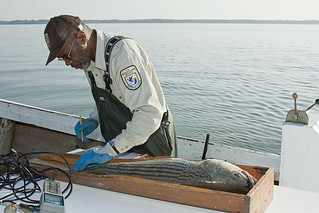
Albert Spells measures a striped bass; this one is longer than 28 inches and too big to keep. ©Janet Krenn/VASGWhen reporters ignore climate change in their stories, they end up sounding like they're blaming the supernatural for events easily connected to climate change. Take this Hampton Roads Virginian-Pilot story on a sharp decline in catch of striped bass:
They say there are a handful of elements that have lowered the ocean take the past two years.

Weather has been the biggest reason. Warmer starts to the past two winters have caused many rockfish to stay in the middle of the Chesapeake Bay, or up the coast around upper Maryland and New Jersey. [...]

"It's been the strangest year," said Rob O'Reilly, chief of fisheries management for the Virginia Marine Resources Commission. "The weather has been so screwy that some fish haven't moved south like they usually do, and the ones that have positioned themselves offshore."
Reporters are often reluctant to connect the dots to climate change because they're not climate science experts and they're worried that doing so will draw the ire of anti-science Tea Party activists.

But when reporters ignore reality, they leave their audience in the dark. Strange! Screwy! Don't ask me for answers, you're on your own!

And then newspapers wonder why half of their audience has stopped paying $15 a month for a subscription. If you have to go find the truth yourself anyway, might as well do it for free on the internet.

Thursday, March 1, 2012

Cherry Blossoms Coming Earlier, But Media Won't Make Climate Connection

UPDATE 3/12/2012: Thanks to our ongoing warm temperatures, the Capital Weather Gang predicts the cherry blossoms could peak March 18, one day short of the earliest on record.

0436_Washington DC_cherry blossoms on the Tidal Basin The cherry blossoms at the Tidal Basin in Washington, DC are expected to peak between March 24 and 31, the National Park Service announced today. That's 5 to 10 days earlier than normal and right in line with our global warming-fueled trend - a Smithsonian study found the blossoms come out about 4.5 days earlier than they used to, part of a shift that all plants are feeling

Of course, reporters can't say any of that! The peak's just early somehow, and the warm weather must be described as unusual or unseasonable and reporters must never mention that the changes are exactly in line with broader global warming trends.

Just look at coverage of our warm winter. DC's fresh off its 3rd-warmest winter on record and 2 of the top 4 have come within the last 10 years, exactly the type of changes climate scientists say we can expect in a warming world. But on local weather blogs, neither the Washington Post's Capital Weather Gang nor WJLA's StormWatch 7 would even say the word climate.

People sometimes ask me if I'm frustrated that a minority of Americans still don't accept climate science. Just the opposite - I'm amazed the poll numbers are so strong! Even though the media won't connect the dots, Americans are doing it on their own, telling pollsters that changes in their own backyards are convincing them that our climate is warming.