Hey, it's 5th anniversary of the Virginia earthquake that shook DC! Back then, we pointed out the budget of the U.S. Geological Survey had been slashed by austerity measures.
What about in the five years since? Surely as our economy has rebounded, we've restored investments in protecting every single American from major earthquakes, especially quake-prone economic engines like Los Angeles, San Francisco and Seattle, right?
Clearly a nation with a $16.77 trillion annual GDP can't afford frivolities like trying to give its citizens advance warning of major earthquakes and volcano eruptions.

Showing posts with label earthquakes. Show all posts
Showing posts with label earthquakes. Show all posts
Tuesday, August 23, 2016

Thursday, April 2, 2015
Kansas Finally Admits It Has a Fracking Earthquake Problem
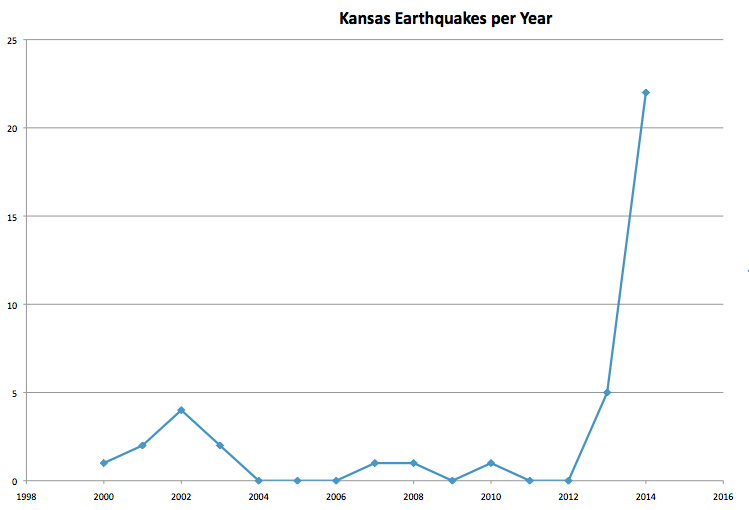
As E&E's Mike Soraghan reports, Kansas is facing up to its frackquake problem and taking action:
Regulators in Kansas have imposed sharp restrictions on oil and gas activity in two southern counties in response to increased earthquakes in the area.Meanwhile, Oklahoma's denial sounds a lot like Florida's state-ordered climate science denial. We can't talk about the cause because that would be a distraction from trying to deal with the effects, or something!
The Kansas Corporation Commission (KCC) cited an "immediate danger" to public safety as the reason for limiting the pressure that can be used to inject wastewater into disposal wells and the volumes that can be injected.
The Oklahoma commission has also avoided explicitly linking earthquakes to disposal wells, saying getting embroiled in such a debate could bog down its response. But Kansas officials made a direct correlation.This is an issue that states far from America's new FrackQuake Alley need to face up to. Here in Massachusetts, new fracked gas pipelines are being sold as the solution to all our problems. But in addition to the question of whether we even need new enormously expensive pipelines, do we really want to be supporting this kind of destructive drilling that also threatens public health in fracked communities?
"The increased number of recorded earthquakes in Kansas coincides with an increase in the number of injection wells and the amounts of injected saltwater in Harper and Sumner counties," the order states.
Kansas had 127 earthquakes last year, according to the commission order, and more than 50 this year by mid-March. From 1981 to 2010, Kansas had 31 quakes.
UPDATE 4/22/15: Oklahoma has ended its frackquake denial.
Thursday, January 9, 2014
I Survived the 2014 SouthCoast Earthquake. Where's My Commemorative T-Shirt?
I happened to be doing some work in our ground-level utility room here in Fairhaven, MA and felt the 1.9 magnitude earthquake that rumbled through the greater New Bedford area today. It wasn't nearly as strong as the 2010 DC area quake that woke me up or the 2011 Virginia quake that swayed the chandelier over my head in Vermont, but I definitely felt a brief rumble.
What's weird is that I'd never experienced an earthquake in my first 33 years. Now I've felt three in the last three years.
What's weird is that I'd never experienced an earthquake in my first 33 years. Now I've felt three in the last three years.
Sunday, March 3, 2013
Did Fracking Cause Alabama Earthquake?

Now there's a compelling case to be made that fracking triggered a minor earthquake in Alabama last Friday.
Friday, March 9, 2012
Investigation Says Fracking Caused Ohio Earthquakes
 An investigation by Ohio authorities has definitely linked hydraulic gas fracking with a series of earthquakes in the Youngstown region:
A preliminary report released by the Ohio Department of Natural Resources on Friday based the conclusion on "a number of coincidental circumstances." Factors included the opening of D&L Energy's well in December 2010, quakes being clustered around the well bore, a fault since identified in the bedrock, and evidence from monitoring.The U.S. Geological Survey has FAQs on earthquakes caused by fracking.
The state will impose tough new brine disposal regulations as a result. Future injection into Precambrian rock will be banned and state-of-the-art pressure and volume monitoring will be required. Electronic tracking systems will be required to identify chemicals in the fluids entering the state.
Monday, January 2, 2012
Fracking, Suspected in Virginia's Quake, Linked to Ohio Tremors
 After Virginia's August 23rd earthquake, there was speculation about whether it was linked to nearby gas fracking. In the wake of a series of quakes in Ohio capped by a 4.0 rumbler on Saturday, officials aren't being so cautious - they're ordering nearby fracking wells to shut down:
The quake was the 11th over the last eight months in Mahoning County, all within two miles of the injection wells, he said. Saturday’s quake was the largest yet. A quake on Dec. 24 measured 2.4.Learn more about fracking from the Environmental Working Group, and how it cause earthquakes from the Christian Science Monitor's Pete Spotts.
There is “little doubt” that the quake is linked to injection wells that the state and the owner agreed on Friday to shut down, [state geologist Michael C.] Hansen said. [...]
The wells are among 177 in Ohio. Drilling wastes from Ohio and Pennsylvania are being pumped in increasing volumes into the wells for permanent disposal.
Geologists have long suspected that injecting liquids into underground rock formations can trigger earthquakes along fault lines. The liquids allow rocks to flow more easily past each other. Earthquakes have been linked to injection wells in Arkansas, West Virginia, Colorado and Texas.
Sunday, August 28, 2011
Bottled Water Blitz Wastes Money & Ignores a Real Risk
 Was the DC region's mad rush for bottled water ahead of Hurricane Irene a necessary evil of disaster preparation or a waste of money? As with many questions like this, it's an environmental concern, sure - but the bigger issue is what an unnecessary waste of money it is, along with the real risk we're ignoring.
Yes, bottled water is worse for the environment and might be worse from a health perspective than tap water. But considering Americans drink nearly 9 billion gallons of bottled water last year requiring millions of gallons of petroleum to produce, the Irene surge is a drop in the bucket.
If there's a storm coming and you don't already have backup water, there's absolutely no need to waste money on buying it from the store. Any household has plenty of pitchers, bottles, Tupperware and pots that can serve as temporary tap water storage. For free! Putting those containers in the fridge or freezer can then keep your food cold longer in case you lose power. (Side note: I think people take "water" too literally. Just looking in my own fridge right now, I have a case of Sprite Zero that could sustain me for few days in a pinch. I guess waiting in long lines to purchase items specifically to ward off this threat gives people a sense of security.)
But the whole mad dash to prepare shows just how unprepared most people really are for sudden disaster. It's the unforeseen catastrophes that are the real danger, like if Tuesday's earthquake had been stronger. Ready.gov advises you to keep a disaster kit with three gallons of water for each person in your household. Ideally, you'd buy three gallon jugs of water, stick them in your closet, and forget about them until you needed them. Unopened bottled water doesn't go bad, so these jugs could literally last a lifetime. You could also just get a battery-powered UV water sterilizer, as my friend Every Day Father points out.
I don't say "a lifetime" by accident - it's extremely rare for the DC area to lose both safe tap water AND the ability to travel for three consecutive days. The only recent example I could find of a disaster knocking out drinking water was after the remains of Hurricane Isabel hit the DC region in 2003. Fairfax County issued a boil water order, but lifted it just two days later and even then, free bottled water was distributed. And since then, Fairfax has worked to upgrade its water facility's backup power system.
My concern is that obsessing over canned goods, water and flashlight batteries ignores a huge gap in our emergency response system. More than a quarter of American households now rely only on wireless phones. As the earthquake reminded us, our cell phone system can't handle disasters.
Even if the system survives, how long would our cell phone batteries last without electricity? When I woke up Sunday morning, there were 118,000 customers without power in Northern Virginia. My Blackberry battery sometimes lasts less than a day. How many people paid for bottled water, yet would've relied on only their cell phones for emergency calls during an extended power outage - a much more likely storm outcome than losing water?
Fortunately, there's an easy solution available for under $30. Ready.gov recommends keeping a solar cell phone charger in your disaster kit. And when you're not riding out a storm, you can use it to charge your devices while camping.
As for upgrading our national wireless infrastructure, cell phone companies say it's not their job. "For cell phone carriers it really doesn't make sense from a cost perspective for them to be building their networks for the highest demand," CNET's Maggie Reardon told CBS News.
Would the federal government be willing to invest a few billion dollars putting people to work making sure our wireless networks are ready for the worst? Not while Rep. Eric Cantor's running the House - for him, not even earthquake response is worth funding without simultaneously laying off other government workers.
Wednesday, August 24, 2011
Exploiting the Earthquake & Hurricane Irene to Point Out We've Cut Earthquake & Hurricane Monitoring
 Since I never waste an opportunity to exploit a tragedy, I thought I'd point to this tweet from the Center for American Progress' Michael Linden in the wake of yesterday's earthquake:
US Geological Survey's budget was cut by some $20 million this year. #justsayingAnd as Hurricane Irene approaches, CAP's ThinkProgress.org reports on budget cuts hurting weather monitoring & emergency response. You may also remember Gov. Bobby Jindal (R-LA) mocking funding for life-saving volcano monitoring and Republican efforts to cut tsunami monitoring at the same time the Japanese earthquake & tsunami struck.
"[P]ointing out that they cut funding on this stuff doesn’t constitute 'politicizing' any ongoing natural disasters," writes Matt Yglesias, "Astute readers will note, however, that the meaning of across the board spending cuts is that you’re cutting spending on all programs."
"Across the board" spending cuts sound equitable, hence are more politically palatable. But as Matt points out, that means cutting funding for feeding hungry children, taking care of sick people, and fighting forest fires - things that cutting might get you voted out of office. Any politician who'd rather cut funding for earthquake monitoring and feeding hungry children than raise taxes on the wealthy should have to explain that choice to voters.
Tuesday, August 23, 2011
Moderate Earthquake Shakes East Coast from Virginia to Vermont
OK, so it was moderate by California standards. By East Coast standards - holy crap! An earthquake with a preliminary magnitude of 5.9 shook Virginia at 1:51pm. It was centered 41 miles northwest of Richmond and 83 miles southwest of Washington, DC.
The Green Miles is in Vermont for work this week. I felt the conference center here in Stowe start rocking gently and thought it was a small, local earthquake. My jaw dropped when I saw tweets from DC friends reporting shaking there. The epicenter was 600 miles away, but it was still strong enough here to send the chandeliers swaying. Amazing!
While DC residents will remember the minor earthquake centered near Germantown on July 16, 2010, there was also a small earthquake in central Virginia on October 3, 2010.
UPDATE: According to the U.S. Geological Survey, it was the largest earthquake in Virginia since 1897.
Saturday, March 12, 2011
Japan's Nuclear Crisis Reveals Difference in Communication Styles
Shortly after the earthquake & tsunami in Japan, statements by Japanese nuclear officials prompted both TPM's Josh Marshall and Matt Yglesias to express hope that the plants in question were out of danger. But if you go back and read the statements, Japanese officials weren't saying there would never be any danger; they were specifically saying "no release of radiation had been detected" so far.
I wonder if there's a cultural difference there - while we're used to hearing nightmarish warnings from U.S. officials, Japanese officials have simply related the current facts without inference, speculation or prediction.
Why the difference? Some U.S. officials say nothing short of the worst-case scenario will get Americans to heed any threat. And even then, they may ignore emergency instructions - among the Galveston, TX residents who heard the dire warning they faced "certain death" if they didn't evacuate ahead of Hurricane Ike, 50% stayed put anyway.
So when Japan's Chief Cabinet Secretary says "there is no immediate danger" after this morning's blast at the Fukushima Daiichi plant, who can be sure what to expect next?
Text REDCROSS to 90999 to make a $10 donation to help those affected by the earthquake in Japan and tsunami throughout the Pacific.
Sunday, October 3, 2010
Minor Quake Hits Central Virginia
According to the Washington Post, a minor earthquake struck central Virginia yesterday:
An earthquake, which many people felt and recognized, rumbled through part of the Washington region Saturday, authorities said.According to the U.S. Geological Survey, it was centered about 20 miles north of Richmond. If your experience is anything like ours from the recent DC-area earthquake, get ready to hear anyone who's ever been in California sanctimoniously tell you how this wasn't a real earthquake.
The quake, recorded as a magnitude 3 by the U.S. Geological Survey, shook the ground in east central Virginia, between Fredericksburg and Richmond, about 4:15 p.m.
No damage or injuries were reported.
Friday, July 16, 2010
Small Earthquake Felt in Northern Virginia
If you're looking for the August 23, 2011 earthquake in Virginia, click here!
 I just experienced my first earthquake, getting shaken awake at about 5:02am here in Falls Church. Not sure how long it lasted, but after waking up, it felt like my bedroom was inside a giant cell phone on the vibrate setting for about 15 seconds.
UPDATE 5:15am: US Geological Survey reporting a preliminary magnitude of 3.7, centered near Gaithersburg, MD.
UPDATE 5:26am: After being reviewed by seismologist, USGS puts quake at 3.6 centered a bit closer to Germantown, MD.
UPDATE 5:33am: I just glanced at my traffic stats and apparently thousands of people got shaken awake & rushed to Google to see what the hell that was. I'm sure plenty of people are rushing to their TVs & radios too, but it makes for an interesting media moment.
My first reaction was to go to USGS because I know from past quakes it's updated incredibly fast. It wasn't on there yet, so my second stop was Twitter. Sure enough, there were already tweets about it -- I think Van Jones' was the first I noticed.
UPDATE 5:45am: By the way, so much for this whole "animals as earthquake psychics" thing. I'd been blogging about the quake for 5 minutes when my cat stumbled out of my bedroom like "Hey! What are you doing up? Maybe it's because you were so eager to feed me, huh?"
UPDATE 5:58am: According to ArlingtonAlert.com, no reports of any quake damage in Arlington. But what of Not Larry Sabato's damaged self-esteem?
UPDATE 6:06am: Not Larry Sabato says it looks like a lot of people got woken up by the quake & just decided to stay up, tweeting, "Hysterical- the #DCQuake really woke a lot of people up. Traffic already tied up for morning commute in #Rosslyn outside my window."
UPDATE 6:10am: From NBC's Jeff Rossen via Twitter: "USGS: The quake was largest recorded within 50 kilometers of Washington DC since a database was created to track activity in 1974."
UPDATE 9:08am: Twitter's @capitolization jokes: "OPM says The Federal Govt is open today but liberal leave."
UPDATE Saturday: Just noticed USGS is also reporting a 2.0 aftershock about 10 minutes after the first quake.
Subscribe to:
Posts (Atom)