Cable boxes are garbage - slow, expensive, and huge power vampires.
Led by Federal Communications Commission Chairman Tom Wheeler and supported by Congressional leaders like Sen. Ed Markey, there's an effort to "unlock the box" - to let your cable channels run through third-party boxes like Roku and AppleTV. Those third-party boxes are much cheaper, faster, and better than cable company boxes.
The FCC is set to vote Sept. 29. Please take a moment right now to urge the FCC to unlock the box.

Showing posts with label energy efficiency. Show all posts
Showing posts with label energy efficiency. Show all posts
Thursday, September 15, 2016

Sunday, April 5, 2015
Comcast's New "Power Save" X1 Boxes Still Waste Tons of Energy
Energy-wasting cable boxes cost families an extra $100 a year each, so when Comcast sent me a new X1 box, I was eager to learn more about its new "Power Save" feature.
The first disappointment: "Power Save" arrived turned off. I had to go into the power settings to tell it to go to Power Save after a certain number of hours. How many customers will ever do that? 10 percent?


The first disappointment: "Power Save" arrived turned off. I had to go into the power settings to tell it to go to Power Save after a certain number of hours. How many customers will ever do that? 10 percent?
But what's even more confusing is figuring out what Power Save actually does. From Comcast's Power Save FAQ:
Your energy saving depends on the specific X1 set-top box type (DVR or non-DVR), how much time the device is in Power Save mode and what power-saving activities are going on behind the scenes (such as scheduled recordings). Because of these variables, we can't say exactly how much energy your set-top box saves in Power Save mode, but to maximize your energy savings, you should always put your set-top box in Power Save mode as soon as you are done watching TV.
Notice how Comcast carefully avoids making factual claims about how much energy is actually saved - if any.
OK, time to put it to the test. My old Comcast box registered 86 degrees in a 75 degree room. How does the new X1 box do when in use?
82 degrees in a 67 degree room. Not much better. And after it had been in Power Save mode all night (with no DVR recordings or any reason to be active):
Even though the room was down to 62 degrees and it had been in "Power Save" mode for several hours, the Comcast box still registered 78 degrees, not much different than when in use.
Comcast's "new" boxes don't seem any better than the old ones at sucking tons of vampire power, turning lots of your money into waste heat.
UPDATE 8/6/15: One other thing that's bugged me after several months of use. To save money & energy, I have the box and my TV plugged into a power strip that I can turn off. But the Comcast X1 box takes several minutes to start back up - even longer than my computer. And that long wait isn't because of fantastic performance - the box is painfully slow to respond to the remote and move between menu screens.
The bottom line is that while this box delivers flashier graphics, in terms wasting energy and slow performance, it's no better than the old boxes it replaced.
UPDATE 8/6/15: One other thing that's bugged me after several months of use. To save money & energy, I have the box and my TV plugged into a power strip that I can turn off. But the Comcast X1 box takes several minutes to start back up - even longer than my computer. And that long wait isn't because of fantastic performance - the box is painfully slow to respond to the remote and move between menu screens.
The bottom line is that while this box delivers flashier graphics, in terms wasting energy and slow performance, it's no better than the old boxes it replaced.
Monday, June 23, 2014
Your Cable Boxes Secretly Cost You an Extra $100 a Year. Each.
.JPG)
I thought I'd see how much heat is needlessly thrown off by my Comcast box made by Motorola, so I put a thermometer on it and went out to run some errands. When I came home, it registered 86 on top of the box (compared to 75 in the room), but apparently at some point it had hit an astounding 94 degrees.
As I've covered before, this a failure of the free market, which gives cable companies no incentive to provide you anything more energy efficient than the crappy boxes they currently give you. It's not them who has to pay the electricity bill for these energy hogs.
That's why cutting the cord and getting rid of cable not only will save you big money on your cable bill, it'll save you small but noticeable money on your electricity bill. While cable boxes use 35 watts of power even in standby mode, streaming devices like Apple TV and Roku only use a maximum of 3 watts even when in use.
Congress could pass legislation mandating efficient boxes, which would save us money twice - once on our electricity bill, and again in infrastructure (those power plants) that we wouldn't need to build to power the boxes. But then the cable companies would give money to Americans for Prosperity to
Monday, April 30, 2012
Is Your City Still Wasting Money on Inefficient Streetlights?
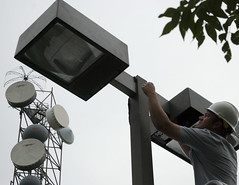 At The Atlantic's Cities Blog, Nate Berg points out that streetlights drain a huge amount of a community's budget, but thanks to new technologies, cities like San Diego can slash their energy bills & carbon footprints:
Under the leadership of a program called CleanTECH San Diego, cities in the area have been able to streamline what would otherwise be a cumbersome process to make the switch from old bulbs to new. And with grant money from the American Recovery and Reinvestment Act of 2009, 13 cities in the region have kicked off projects to replace about 55,000 streetlights, which will save an estimated $3 million annually.Another leader - Ann Arbor, MI, projected to save $100,000 a year by installing new LED streetlights with motion detectors (unlike older streetlight bulbs that need a few minutes to power up to full intensity, LEDs can fire up instantly).
The largest among those cities is San Diego, which will be replacing about 90 percent of its streetlights, roughly 35,000. The city is replacing its old low-pressure sodium lights – a common streetlight – with induction bulbs that use about 40 percent less energy. 16,500 have already been converted, and officials expect the transition to be finished by next spring.
Before the conversion, the city had been paying about $4.7 million a year to light its streets. When all 35,000 lights are replaced, that cost will drop to about $2.8 million a year, according to Tom Blair, deputy environmental services director for the City of San Diego.
And it's not just energy costs that will go down. The old sodium bulbs typically had to be replaced every 3 or 4 years, while the new induction bulbs can last more than a decade. Blair says a set of induction bulbs were installed in downtown San Diego about 12 years ago and have yet to need replacement. "That’s a significant savings," Blair says.
"It was kind of a no-brainer," says Marty Turock, a program manager at CleanTECH San Diego. "Virtually every city, at least within San Diego County, recognized that doing the street lighting retrofits was one of the biggest impacts and one of the biggest payback energy efficiency projects they could take on."
Sunday, August 7, 2011
Doonesbury Whiffs on White Roofs

If white roofs didn't deliver year-round energy savings, why would anyone do it? Yet that's exactly what Garry Trudeau's character Mike Doonesbury mistakenly claims.
As Mother Jones' Kiera Butler detailed last year, white roofs are a net energy win no matter where you live:
The latest white-roofs study used computer simulations to figure out what might happen if every roof in every city of the world were white. The finding: An average temperature reduction of .7 degrees Fahrenheit. Good news in general, but here’s the problem for homeowners: Since white roofs cool buildings all year round, some people have pointed out that folks with white roofs in northern climates might end up cranking the thermostat higher than their neighbors with dark-colored roofs during winter months.White roofs can save up to 20% of a building's energy costs on a hot day, as Bill Clinton recently wrote in Newsweek. The further south you go, the more in energy savings you'll see from having one - but even in Maine, you'll see a net benefit. Makes sense - not only does AC cost more than heat, but deflecting strong summer sun is a bigger benefit than absorbing much weaker winter sun.
Roofs of the future might solve this problem: Last year, a team of MIT researchers came up with a prototype of high-tech tiles that change color based on the air temperature. A cool idea for sure, but unfortunately the smart tiles aren't on the market yet. So till they are, should you spring for a white roof even if you live in the chilly north? Hashem Akbari, a senior scientist and leader of the Heat Island Group at the Lawrence Berkeley National Laboratory, says yes, since AC typically uses a lot more energy than heat. "The wintertime penalties are only a fraction of summer time savings."
And above & beyond the net energy benefit, white roofs would cut the urban heat island effect and take some of the edge off global warming. So why aren't we putting people to work painting every roof white?
Sunday, June 26, 2011
Cable Companies Don't Care How Much Of Your Money Their Crappy Boxes Waste

Thanks to outdated, inefficient cable boxes that run 24/7 regardless of if they're in use recording, an NRDC study (PDF) finds your cable box with DVR is a prime source of vampire power - wasted electricity when your appliance is "off."
But what do cable companies care? They don't have to pay your power bill. So as the New York Times reports, cable companies give you the box that's cheapest for them:
“The issue of having more efficient equipment is of interest to us,” said Justin Venech, a spokesman for Time Warner Cable. But, he added, “when we purchase the equipment, functionality and cost are the primary considerations.”Cable companies make it clear in the article they'll have to be dragged kicking & screaming into the age of energy-efficient technology. But couldn't cable companies use the public relations boost that comes from a little greening? As The Atlantic reports this month:
But energy efficiency experts say that technical fixes could eliminate or minimize the waiting time and inconvenience, some at little expense. Low-energy European systems reboot from deep sleep in one to two minutes.
Alan Meier, a scientist at Lawrence Berkeley National Laboratory, said of the industry in the United States, “I don’t want to use the word ‘lazy,’ but they have had different priorities, and saving energy is not one of them.”
Media-distribution companies, particularly in the cable and telephony markets, have among the worst customer relations in any industry: J. D. Power ranked the cable companies 18th out of 19 industries in service.The easiest way to drive a stake through the heart of vampire power? Plug appliances into a power strip & turn that off when they're not in use. Discovery's HowStuffWorks has more details on vampire power:
Sunday, November 14, 2010
McMansion Misconceptions
Covering the arrest on corruption charges of Prince George's County Executive Jack Johnson & his wife, WAMU Reporter David Schultz tweeted on Friday:
In the last 40 years, we've seen major advances in insulation like double-paned windows. On top of that, appliances today don't need nearly as much juice as they did a generation ago. So why has per person residential energy use nearly doubled in the last 35 years?
 The answer is simple -- we've wasted all those insulation & efficiency gains by building ever-larger houses. The rises in residential electricity use & home sizes have mirrored each other:
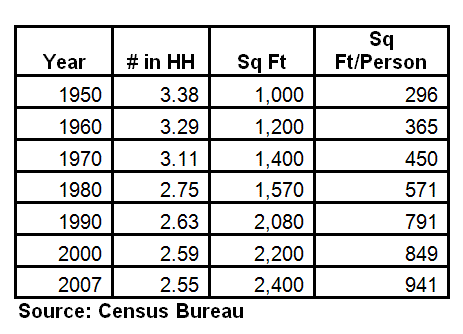
Don't get me wrong, efficiency & insulation are critical pieces of the bigger puzzle. But as long as our government policies continue to encourage larger homes, it's the equivalent of attacking the obesity epidemic by encouraging people to order a Diet Coke with their Super-Sized Extra Value Meal.
Far and away, weirdest thing to come out of today's Jack Johnson proceedings: Johnsons' home heating bill totals more than $1,000/ month ... Judge was going to prohibit Johnsons from making transactions >$1k. their lawyers objected, citing mortgage & pepco billsI'm very thankful for my tiny apartment power bill as compared to friends with large suburban homes. I tweeted:
Friend in PA with a medium-sized (for this era) house says his highest power bill was $900, so it's definitely possibleDavid replied:
That's more than I pay in rent, srsly. Insulation folks, it's all abt the insulation.I realized David was limited to 140 characters here, but when I hear things like this, I worry conservationists have oversold the potential of insulation & energy efficiency. I'm guessing Jack Johnson has an obscenely gigantic house that you could cover in the world's biggest Snuggie & it would still require huge amounts of energy & cash each month to heat.
In the last 40 years, we've seen major advances in insulation like double-paned windows. On top of that, appliances today don't need nearly as much juice as they did a generation ago. So why has per person residential energy use nearly doubled in the last 35 years?

Don't get me wrong, efficiency & insulation are critical pieces of the bigger puzzle. But as long as our government policies continue to encourage larger homes, it's the equivalent of attacking the obesity epidemic by encouraging people to order a Diet Coke with their Super-Sized Extra Value Meal.
Friday, April 23, 2010
Monday, January 12, 2009
Moran's Renewables & Efficiency Plan: Raising the Bar
Brian Moran, running against Creigh Deeds and Terry McAuliffe for the Democratic nominaton for governor in Virginia, unveiled his plan for a renewable energy and efficiency standard today:
Some quick takes:
“I have proposed a bold step, which will make Virginia a leader in renewable energy,” Moran said. “The next governor needs to be looking toward the future and creating an environment which will attract good high-paying green jobs, and help Virginia grow in the green economy. My commitment to our environment and our economy is too strong to do anything less.”Under Moran's plan, Virginia would need to get at least 25 percent of its power by 2025 (and 20 percent by 2020) through renewable energy or increases in energy efficiency.
Some quick takes:
- Lumping renewable energy and efficiency together is a bit clumsy. It also makes the campaign's claims the plan would "put Virginia in the top ten states nationally" pretty dubious since most of those states don't allow utilities to use efficiency to meet the goal. Ideally, Moran wouldn't include efficiency in his 25 percent by 2025. If he does, he needs to specify how much of the 25 percent can come from efficiency improvements.
- Moran's plan puts him far ahead of McAuliffe, at least for now. Terry has been talking about taking Virginia's voluntary 12 percent by 2022 renewables & efficiency standard and making it mandatory. He'll need to come up with a much stronger plan if he wants to hold the mantle of the boldest candidate on clean energy.
- In such a tight race, Creigh Deeds risks fading into the rear view mirror if he doesn't at least match Moran's plan.
Tuesday, October 21, 2008
Virginia's "Confederate States of America"-Era Energy System
 A must-read post over at Gristmill from Chesapeake Climate Action Network Executive Director Mike Tidwell:
[A]s the election approaches, here's the surprising question for every Northern Virginia voter: Why is this high-tech region, so dedicated to a "knowledge-based" economy, utterly dependent on an energy system as old as the Confederate States of America? Northern Virginia gets the lion's share of its electric power not from wind turbines or solar farms, but from coal. A shocking 1,180,400 tons of raw coal each year, nearly half of the area's total load. And it's not "clean coal" or "high-tech" coal. Just black, sooty, rip-it-from-the-ground-and-set-it-on-fire coal.Tidwell concludes with a call for investments in efficiency to cut power bills, saying Virginians "use more electricity every day than 75 percent of the rest of America. Surely we could do much, much better." But Virginia's current system allows Dominion to reap the most profits by selling us the most power.
You'd think it would be different. You'd think Northern Virginia would be a leader in developing clean, sustainable energy at a level equal to its high-tech, high-education status.
You'd think. But two roadblocks stand in the way: Virginia Gov. Tim Kaine (D) and mega-utility Dominion Power.
Of course, while Kaine and Dominion are the biggest roadlocks, General Assembly Republicans have shown no interest in cutting consumers' power bills or easing our dependence on dirty, expensive energy sources. And many General Assembly Democrats are, at best, speed bumps, reluctant to challenge Richmond's status quo.
Cross-posted from RK
Wednesday, December 5, 2007
Two Critical Votes on Capitol Hill This Week
The Senate Environment and Public Works Committee today has taken up the Climate Security Act, sponsored by Sen. Joe Lieberman (I-CT) and Sen. John Warner (R-VA). While the mark-up could take days, early indications are it will pass and head to the full Senate for a vote as soon as February. There it will face a filibuster from Republicans. It's uncertain if there will be the 60 votes needed to override that veto, but it should be a good test to see if senators like Lamar Alexander, Lindsay Graham, and Gordon Smith are more loyal to their party or their planet.
Over on the House side, it looks like there's finally movement on the long-stalled energy bill. Somehow, it looks like House Speaker Nancy Pelosi will manage to shepherd through legislation with both stronger corporate average fuel economy (CAFE) standards and a renewable portfolio standard (RPS) of 15%. In other words, we can look forward to more fuel-efficient cars in our driveway and cleaner energy powering our homes. As Grist puts it, Nancy Pelosi is kicking ass!
Want to make sure your representative votes for a strong energy bill? Email your representative right now!
Over on the House side, it looks like there's finally movement on the long-stalled energy bill. Somehow, it looks like House Speaker Nancy Pelosi will manage to shepherd through legislation with both stronger corporate average fuel economy (CAFE) standards and a renewable portfolio standard (RPS) of 15%. In other words, we can look forward to more fuel-efficient cars in our driveway and cleaner energy powering our homes. As Grist puts it, Nancy Pelosi is kicking ass!
Want to make sure your representative votes for a strong energy bill? Email your representative right now!
Tuesday, November 20, 2007
Pain at the Pump: A Thanksgiving Tall Tale?
 Gas prices are nearing record highs. So people are driving less, right?
There's only one problem with that ... drivers are telling pollsters a little Thanksgiving holiday fable. They're actually planning to drive more:Almost six in 10 people surveyed for the Automotive Aftermarket Industry Association of Bethesda, Md., said they have modified their behavior since pump prices began rising. [...]Of those who said they had changed their behavior, 90 percent said they were driving less, and 75 percent said they were better maintaining their vehicles.
Some 31.2 million vacationers will travel by car, up 1.3 percent from last year, AAA said. Another 4.7 million will go by air, up 2.2 percent. The rest will take trains, buses or other modes of transportation. [...]Ah, there's another hiccup. Are drivers really "feeling the pinch"? Obviously drivers are allocating more of their budget to paying for gas. And the media certainly loves to play to populist themes to convince their audience they're clearly not highly-educated McMansion-dwelling SUV-driving elitists but rather Average Joes like them."This is the first time that we have seen gas prices tipping over $3.00 a gallon in November," said AAA's Darbelnet. "A year ago, prices were in the range of $2.20 a gallon, so this year travelers are really feeling the pinch."
But if high gas prices were causing a such a painful "pinch," wouldn't people, like, y'know, drive less? Nope. Gas consumption hasn't posted year-to-year decline in more than 15 years.
Well then Americans must be demanding more fuel-efficient vehicles, right? Nope. Fuel economy hasn't increased significantly in 25 years. In fact, it's not a whole lot different than it was 57 years ago.

OK, OK, so aren't Americans demanding changes from their elected officials? Eh. The energy bill is stuck in Congress and tighter fuel economy standards face an uncertain future.
And as Marc Fisher points out in his "Pretend Primary" series, politicians don't have much incentive to show leadership on problems like sprawl and long drives on the national level:In Iowa and New Hampshire, there's not much reason for presidential candidates to talk about any of this: In those relatively thinly populated states, people think a 20-minute back-up on the Interstate is bad traffic.
There are plenty of ways we could reduce our national gas bill -- more carpooling and public transportation, higher fuel economy standards, plug-in hybrids, biofuels -- but it seems like both the majority of Americans and the majority of elected officials would rather rail against those dastardly oil barons than embrace real solutions. And as Stuart Smalley once said ... every time you point a finger at someone, there are three fingers pointing back at you.
Thursday, September 13, 2007
Burning More Coal, Drilling for Oil, and Splitting Atoms: Meet Gov. Kaine's Energy Plan
I give up. I'm moving to Montreal so I can be there when global warming makes its weather more like Boston's is today.
My friend Lowell at RaisingKaine.com just pointed me to Virginia Gov. Tim Kaine's newly-released Virginia Energy Plan (news release, full report). Here are the highlights:
- "Gov. Timothy M. Kaine unveiled long-range health-care and energy plans Wednesday that would slash the number of uninsured Virginians and dramatically reduce energy consumption."
False. You'd think they could get through the first sentence without an inaccuracy, wouldn't you? Energy use would actually rise under the plan, just at a slower rate. It's right on page 8 of the report, Figure 1-8.
- "One aspect of the plan calls for the state to reduce the energy it uses by 40 percent over the next decade."
Still, in fact, false. The plan calls for reducing the rate of growth of energy use by 40 percent. Energy use would continue to rise. And page 20, the report calls for increasing in-state energy production by 20 percent over projected 2017 levels. Did the reporter even read the plan?
- "Kaine (D) calls for a 30 percent reduction in greenhouse gas emissions by 2025."
Sorta. That's one way of putting it. It's the way the press release put it, so why wouldn't the reporter reguritate it unchallenged, right? Another way of putting it is that Virginia will only reduce carbon emissions to 2000 levels.
- "Virginia could become a leader in efforts to combat global warming if lawmakers embrace the plan."
Batshit insane. The Republican governors of California and Florida have committed to cutting carbon emissions 20% off 1990 levels by 2050. They're the leaders. And under the Western Climate Initiative, Arizona, California, New Mexico, Oregon, and Washington have all already committed to steeper cuts than Kaine is even proposing (read the full plan), and that's before the Republican-controlled House of Delegates gets a chance to soften it up.
But apparently the Virginia Conservation Network likes the plan. Which raises the question, how bad would the plan have to be for them to not like it?
Where's a renewable portfolio standard? Where's cutting our greenhouse gas emissions 80% by 2050, the amount scientists say is needed to avoid the worst effects of global warming? Where's decoupling?
A better plan comes from the Virginia Sierra Club, which has issued its Citizens Energy Plan. Let's hope the governor's paying attention.
My friend Lowell at RaisingKaine.com just pointed me to Virginia Gov. Tim Kaine's newly-released Virginia Energy Plan (news release, full report). Here are the highlights:
- Virginia will not stop burning coal for you or for anyone else. We also will not burn less. In fact, we'll actually burn even more.Adding to The Green Miles' frustration, the Washington Post's article on the energy plan appears to be rife with factual errors:
- Search the entire document and you will not find the words "mountaintop removal." Let's pretend it doesn't exist, mmmkay?
- "Coastal energy production" sounds so much nicer than "drilling off Virginia's coast so we can have more oil to burn," doesn't it?
- Massive taxpayer subsidies should be given to Dominion Virginia Power to build new nuclear power plants.
- Compact fluorescent light bulbs will save us. (For why they'll help but won't do nearly enough on their own, click here.)
- "Gov. Timothy M. Kaine unveiled long-range health-care and energy plans Wednesday that would slash the number of uninsured Virginians and dramatically reduce energy consumption."
False. You'd think they could get through the first sentence without an inaccuracy, wouldn't you? Energy use would actually rise under the plan, just at a slower rate. It's right on page 8 of the report, Figure 1-8.
- "One aspect of the plan calls for the state to reduce the energy it uses by 40 percent over the next decade."
Still, in fact, false. The plan calls for reducing the rate of growth of energy use by 40 percent. Energy use would continue to rise. And page 20, the report calls for increasing in-state energy production by 20 percent over projected 2017 levels. Did the reporter even read the plan?
- "Kaine (D) calls for a 30 percent reduction in greenhouse gas emissions by 2025."
Sorta. That's one way of putting it. It's the way the press release put it, so why wouldn't the reporter reguritate it unchallenged, right? Another way of putting it is that Virginia will only reduce carbon emissions to 2000 levels.
- "Virginia could become a leader in efforts to combat global warming if lawmakers embrace the plan."
Batshit insane. The Republican governors of California and Florida have committed to cutting carbon emissions 20% off 1990 levels by 2050. They're the leaders. And under the Western Climate Initiative, Arizona, California, New Mexico, Oregon, and Washington have all already committed to steeper cuts than Kaine is even proposing (read the full plan), and that's before the Republican-controlled House of Delegates gets a chance to soften it up.
But apparently the Virginia Conservation Network likes the plan. Which raises the question, how bad would the plan have to be for them to not like it?
Where's a renewable portfolio standard? Where's cutting our greenhouse gas emissions 80% by 2050, the amount scientists say is needed to avoid the worst effects of global warming? Where's decoupling?
A better plan comes from the Virginia Sierra Club, which has issued its Citizens Energy Plan. Let's hope the governor's paying attention.
Tuesday, June 19, 2007
How Your Call on Energy Could Swing Virginia's Senators - and the US
 It's critical that Virginians call their Senators today to express their views about two critical votes coming this week. Both are amendments to the Senate energy bill being considered. While both are being portrayed primarily as energy issues, they're also important first steps towards addressing global warming:
 * The Bingaman Amendment would set a 15% national renewable energy standard, meaning 15% of our nation's electricity would have to come from renewable sources like solar, wind, or biofuels. It's sponsored by Sen. Jeff Bingaman (D-NM).
* A provision to raise Corporate Average Fuel Economy (CAFE) standards to 35 miles per gallon by 2020. CAFE standards have not been strengthened in 17 years, and not coincidentally, U.S. fuel economy has stagnated. Cars and light trucks sold in the U.S. average 24.6 miles per gallon, well below the peak of 26.2 mpg set in 1987.
If you're a Virginia resident, please call your Senators now and urge them to support including these provisions in the Senate energy bill! Both are considered on the fence on these votes, so each call is critical.
Sen. John Warner -- (202) 224-2023
Sen. Jim Webb -- (202) 224-4024
I haven't included their emails because calling has much more of an impact than emailing. It takes more motivation and effort to pick up a phone and speak to a real person about your concerns, and your elected officials take that into consideration when giving weight to emails vs. calls. These are definitely call-worthy issues!
Friday, June 8, 2007
A Green Tip for Staying Cool (Or a Cool Tip for Staying Green?)
 Here in the DC area, the temperature is forecast to reach the mid-90s today, with a heat index of 100 degrees. Apparently it's so hot, you can fry a panda on a rock.
So today, a tip for staying cool and green on days like this.
Heating and cooling costs account for 46% of the average American household's utility bill. The Green Miles' electric bill triples from May to July alone.
But there's an easy way to lower your energy costs. Using fans instead of an air conditioner can save as much as 60% on your electric bill. And considering the majority of America's power comes from dirty sources like coal, using a fan is a small step to help fight air pollution and global warming.
Sure, on an extraordinarily hot day like this, you're going to need that air conditioning even more than Blue Oyster Cult is gonna want that cowbell. I know if it's still in the 70's and humid even at midnight, no fan is going to help me sleep. But on the less-oppressive days, fans can make a real difference.
And there's a tip that surprised even The Green Miles. Did you know it matters if your fan is running clockwise or counterclockwise? According to EnergyStar.gov:
In the summer, use the ceiling fan in the counter-clockwise direction. The airflow produced by the ceiling fan creates a wind-chill effect, making you “feel” cooler. In the winter, reverse the motor and operate the ceiling fan at low speed in the clockwise direction. This produces a gentle updraft, which forces warm air near the ceiling down into the occupied space. Remember to adjust your thermostat when using your ceiling fan - additional energy and dollar savings could be realized with this simple step!You can see a diagram of this effect here. Upon closer inspection, it turns out the ceiling fan in my bedroom has a small switch that changes the direction of the fan.
If you want to learn more, About.com has some great tips for staying cool and saving energy.
Of course, there are other green ways to stay cool. Tonight The Green Miles will be at Tallula's EatBar in Clarendon, drinking an ice-cold Samuel Smith Organic Lager.
Thursday, April 26, 2007
CNN: How Going Green Can Save You Money
Yesterday CNN featured some tips on how going green can help you save money on your energy bills! Check it out ...
Subscribe to:
Posts (Atom)