Showing posts with label sea level rise. Show all posts

Monday, April 28, 2014

Even in MA, Coastal Towns Completely Unprepared for Sea Level Rise

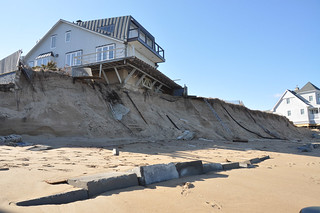
DSC_0900
Here in Massachusetts, climate science denial may be politically toxic, but when it comes to accelerating sea level rise fueled by global warming, some local officials are just as in denial about as their science-denying counterparts in North Carolina.

Climate Central has an interactive sea level rise tool showing how even 5 feet of sea level rise - virtually guaranteed by the carbon pollution we've already put into the atmosphere - will put more than 10,000 homes under water on the Southcoast alone. As Ariel Wittenberg reports in the Standard-Times, many local officials are governing as though the threat doesn't exist:
Asked about the maps, most SouthCoast municipalities say they have dealt with flooding issues as they happen, and have not made plans to combat or adapt to climate change and sea level rise specifically.

In Dartmouth, for example, Town Administrator David Cressman said he and the police chief are "aware of the vulnerabilities" of the police station, which was renovated 10 years ago.

"At times I wondered why they were doing that if it is in a flood zone," he said.
In my town of Fairhaven, where Sconticut Neck is set to become an island, austerity means kicking the can down the beach for future generations to clean up:
[Fairhaven Chairman of the Selectmen Bob Espindola] added it's difficult to think about investing town money in mitigating climate change.

"It's something that is not right on our doorstep and we are thinking about balancing our budget and keeping from making significant cuts," he said.
Screw the grandkids, I want my property taxes cut now!

Tuesday, August 21, 2012

Virginia to Communities on Climate-Fueled Sea Level Rise: You're on Your Own

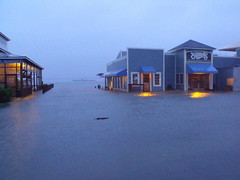
Bubba's Seafood Restaurant - Flooded in the Great Nov 09 Nor-easter_2009_1112Whether you're anti-science crusader Ken Cuccinelli, solution-rejecting Bob McDonnell, or any of Virginia's "centrist" Democrats who know global warming means we're screwed but remain too cowardly to advocate aggressive action, aside from a couple of dozen lonely progressive voices, Richmond is united in telling climate change that it should not be impacting Virginia. Lo and behold, climate change has stubbornly refused to stop accelerating, and now communities like Norfolk are struggling to deal with climate impacts with no help from the state:
City and county leaders, already burdened with typical tasks of local governance – zoning, construction permits, liquor licenses, school board appointments – are also weighing multi-million-dollar flood control projects to keep the ocean at a livable distance.

While they struggle to pull together know-how and funding, those with the broader view and resources – state agencies – are absent from the discussions: In a study released earlier this year, the Natural Resources Defense Council ranked Virginia as one of 29 states that were "largely unprepared and lagging behind" on planning for climate change at the state level.

In many ways the problem is already upon Norfolk. The Atlantic Ocean off Virginia's coast is rising a quarter of an inch annually, equivalent to two feet in 100 years – faster than anywhere else in the United States except for coastal Louisiana. The ocean at Sewells Point, site of the Norfolk Naval Station, rose 14.5 inches between 1930 and 2010. And that's likely to accelerate. Last month the U.S. Geological Survey reported that sea levels are rising more quickly along the Atlantic coast from North Carolina to Massachusetts than globally, possibly as a result of slowing Atlantic Ocean circulation patterns.
The inaction of Virginia's elected officials is actually hurting the state twice - not just paying the price of climate inaction through extreme weather and sea level rise, but hurting Virginia's economy by losing out on clean energy jobs.

But hey, who has time to pay attention to looming disaster when there's women's bodies that need regulating, amirite?

Wednesday, June 27, 2012

Talking Global Warming-Fueled Sea Level Rise with Thom Hartmann

I joined The Big Picture with Thom Hartmann last night to talk about how climate change is fueling an acceleration in the rise of global sea levels, a phenomenon that's hitting especially hard on America's East Coast.

A lighter moment at the end when Thom asked me about "clean coal." Remember when people believed in that mythical creature? So ironic that the same people who screech the loudest about a similarly made-up "war on coal" now (Sen. Jim Inhofe, Sen. Jim Webb, etc.) were the same people who sealed coal's death warrant by blocking national clean energy & climate action legislation, which would've been loaded with carbon capture & storage subsidies.

Sunday, June 10, 2012

Sea Level Rise Denial Comes to Virginia

Remember how everyone was laughing at North Carolina for pretending they could solve the problem of global warming-fueled sea level rise by ordering state workers to pretend it doesn't exist? Ha ha, said Virginians! Stupid North Carolina!

Except Virginia is denying sea level rise as well, reports Scott Harper of the Hampton Roads Virginian-Pilot. I'm not sure who to be most upset at - Republicans like Del. Chris Stolle for pushing sea level rise denial, scientists quoted in the article for cowardly refusing to stand up for facts, or the reporter for repeating Tea Party myths like "environmentalists stopped saying global warming" as fact (dear Scott Harper: see my previous paragraph).

For more in-depth analysis, see ClimateProgress on the reality rejection, Blue Virginia's Kindler on Del. Stolle's Orwellian tactics, and Climate Central on how 58,000 Virginians would be flooded out of their homes by the scientifically expected three feet of sea level rise this century.

Wednesday, May 9, 2012

Copley Square to Cambridge, Now by Helipad: Global Warming's Impact on MBTA

When The Green Miles was growing up in Boston, T service on the Green Line would occasionally be disrupted by flooding. Much of downtown Boston was built on landfill and severe rainfall would flood the Green Line tunnels with dirty water.

The group Metro Boston Climate Defense shows what severe global warming-fueled sea level rise and storm surges would do to the MBTA map:


Wednesday, March 14, 2012

New Study Details Threat of Global Warming-Fueled Sea Level Rise in Virginia

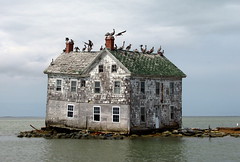
Last House on Holland Island, May 2010Sea levels have already risen 8 inches since 1880 and thanks to global warming are forecast to rise at least several more feet in the lifetime of a child born today. A new study from Climate Central takes a look at what that means for people who live on America's coasts:
The studies look at people who live in homes within three feet of high tide, whereas old studies looked just at elevation above sea level, according to work published in the peer-reviewed journal Environmental Research and an accompanying report by Climate Central.

That's an important distinction because using high tide is more accurate for flooding impacts, said study co-author Jonathan Overpeck, a scientist at the University of Arizona's Institute of the Environment. And when the new way of looking at risk is factored in, the outlook looks worse, Overpeck said.

"It's shocking to see how large the impacts could be, particularly in southern Florida and Louisiana, but much of the coastal U.S. will share in the serious pain," Overpeck said.
And what about here in Virginia? I entered a very modest number - three feet of sea level rise, storm surge & tide - into the ClimateCentral.org model & here's what I got:
Things below +3ft in Virginia:
  • Population 58,507 0.7%
  • Homes 28,511 0.8%
  • Acres 157,123 0.6%
Over 1 in 6 chance sea level rise + storm surge + tide will overtop +3ft by 2020 at nearest flood risk indicator site: Lewisetta - Potomac River, 116 miles away.
View the model for yourself and see what different levels of sea level rise would mean for your community:


Sunday, December 18, 2011

Washington Post Ignores Climate Impacts, Wonders Why People Are Ignorant on Climate Impacts

The Washington Post's Darryl Fears, who conspicuously left climate change out of his recent article on the impacts of sea level rise on the Virginia coast, today has a follow-up article on how some people don't think climate change is connected to sea level rise.

Gee, I wonder why people are so in the dark about climate science? It's quite the puzzler.

Wednesday, October 26, 2011

BBC: "The Disappearing Island in the Chesapeake Bay"

Virginia's Tangier Island was first settled 325 years ago. But as the BBC reports, thanks to a combination of a  Chesapeake Bay polluted by unchecked runoff, rising sea levels fueled by global warming, an eroding shoreline fueled by natural subsidence, Tangier Island is slowly disappearing into the Bay:


Learn in the National Wildlife Federation's 2008 report on the Chesapeake Bay & sea level rise.

Friday, October 14, 2011

New Report Highlights Climate Crisis' Threat to Hampton Roads

A new report takes a closer look at which cities will be hurt by global warming-fueled sea level rise. As Brad Plumer reports, Virginia is in the climate crisis crosshairs:
Things don’t look good for India. But the United States doesn’t get off easy, either. If you look at exposed assets rather than total population, then Miami, New York-Newark, New Orleans and Virginia Beach all climb higher on the list, with $7 trillion in assets vulnerable to severe coastal flooding by 2070. [...]

Take Miami. A three-foot sea-level rise, experts have noted, would likely put all of Miami Beach underwater and turn downtown Miami into an island, channeled off from the rest of Florida. Yet the state isn’t doing all that much to prepare for this eventuality. Instead, it’s racing to subsidize new developments along the coasts, through state-run insurance and funding for coastal protection. By contrast, cities such as London and Amsterdam are taking more prudent steps to guard against future flooding — and, as the OECD report notes, are likely to cope with sea-level rise better.

That’s not an isolated case. In general, the United States has been slow in preparing for rising sea levels. In many cases, we’re actively making things worse, as Steve Nash laid out in this excellent article in the New Republic. This is one area in particular where climate-change denial can do a lot of damage — it’s awfully hard to prepare for a problem that no one can agree even exists.
So we're not doing climate mitigation, like cutting carbon pollution. And as an event just last month at NASA's Langley Center in Hampton pointed out, we're not doing climate adaptation, either, like coastal restoration & limiting development in areas just above sea level.

Basically, if you were consciously trying to leave the worst possible situation for the next generation, you'd be doing exactly what people like Gov. Bob McDonnell are doing now - deny the problem & delay solutions. And note the 2070 date - we're no longer talking about forecast impacts on some future generation, but real changes happening within the lifetimes of the children in your family right now.

Amazing that the same people who profess such a concern with our budgetary national debt have no qualms about leaving our kids stuck with a multi-trillion-dollar climate liability.

Monday, November 29, 2010

Soggy Bottom: New Model Shows Sea Level Rise Impact on DC

Over at TBD.com/weather, John Metcalfe takes a look at the University of Arizona's new interactive model of sea level rise. What would current estimates of 2 meters of sea level rise by 2100 mean for the DC area?
The Jefferson Memorial will not just be by the water, it may be underwater. The northeast part of Roosevelt Island will gain more marshland, as well as the bit of Rock Creek where it meets the Potomac, which should please the old-timers who hunt catfish there. It's hard to see the upside of Bolling Air Force Base becoming submerged, but the military has solid engineers – can't they build a bigger sea wall? And Old Navy's name will finally make a little sense as the creeping water moves inland over the Potomac Yard Shopping Center. I'm sure the chain's marketing whizzes can figure out something about shopping with gondolas.
If those were the worst effects of runaway global warming, that would be expensive to deal with, but not necessarily devastating. However, scientific modeling has seriously UNDERestimated sea level rise to this point -- seas are rising faster than scientists have predicted & so far they're not sure why. And just a few minutes of tinkering with the University of Arizona's model reveals just how much is at stake for the DC area if scientists have even slightly lowballed sea level rise.

What if it's 3 meters instead of 2? Bye bye, National Airport & Tidal Basin:
And what if scientists are dramatically underestimating sea level rise? There's a reason this model includes 6 meters of sea level rise by 2100 -- while it's unlikely, it's possible. And what would that mean? Might be time to relocate the nation's capital to higher ground:
The takeaway of all this -- especially for places like Hampton Roads where smaller degrees of sea level rise would be much more devastating -- is that so far, America is rolling the dice with the above scenarios. Congress has done nothing to address global warming, leaving our fate -- be it 2 meters, 3 meters or 6 meters  of sea level rise -- to chance.

Wouldn't it be better to gradually reduce our carbon pollution now & reduce our chances of a worst-case scenario? Isn't that the conservative thing to do? And the same solutions that protect our climate can also cut energy bills, strengthen our national security, and create millions of jobs.

Or hey, we could follow Jim Webb's lead & do nothing. Maybe there are big untapped economic opportunities I'm missing. Scuba diving expeditions through the underwater remains of Old Town Alexandria?

Wednesday, April 23, 2008

Hampton Roads in 2100: Average Storms Become Isabels

When it comes to flooding, the Hampton Roads area is already the second-most-vulnerable area in the country behind New Orleans. So what happens when sea levels rise about two feet (the conservative projection) over the next century due to global warming?
With a mouse-click, Lockheed Martin analyst Chris Mang showed the impact of a routine winter nor'easter striking on top of the higher water level. Large parts of the city went underwater, much as they did during Hurricane Isabel in 2003.

"In a hundred years, even your average storm becomes a real problem," Mang said. And a hurricane with Isabel's punch would cause far more damage than Isabel did.
Mang detailed the disturbing projections at yesterday's Virginia Commission on Climate Change meeting in Williamsburg.

Some business interests opposed to climate action tried to use the meeting to attack the Lieberman-Warner Climate Security Act, the climate legislation due to come before the Senate in June. They also argued that even in the face of the flood projections, Virginia should do nothing to confront climate change. Fortunately, commissioners fought back:
Keith McCoy, a spokesman for the National Association of Manufacturers, said a patchwork of carbon dioxide emission limits by states would create confusion and possibly prompt industries to move to less restrictive states, with no net loss in emissions.

McCoy said polls suggest that while people want to reduce greenhouse gases, "they don't want to give up their SUVs, and they don't want to turn down their thermostats."

One commission member called McCoy "plain wrong."
You can view the slides of all of the presentations at the commission's website.

Tuesday, November 27, 2007

Ask The Green Miles: Most Vulnerable to Sea Level Rise?

A question from The Green Miles' dad:
Is there a place that would show a rising ocean first and most dramatically? Would it be Florida, Holland, Venice, Bangladesh, some Pacific Island group, or where? Or is it too soon for that kind of extrapolation?
Too soon? The impacts are already right here in my backyard. No fewer than 13 islands in the Chesapeake Bay have already been swallowed up by rising sea level. According to a recent National Wildlife Federation report, over the last century air temperatures in the Bay region have risen 1.4 degrees, water temperatures are up two degrees, and sea levels have risen two feet. That's due mostly to thermal expansion (warmer water takes up more space than cooler water), not melting glaciers or ice caps as commonly though.

But back to the question. Obviously I am not a scientist, so my answer will be more subjective based on what I've seen and read, but this is a blog and you should know this already. In the US, the these are the areas that are most screwed when it comes to rising sea levels:
- New Orleans (I know, you're shocked). It's below sea level already and still sinking due to subsidence, the natural compression of land composed of flood deposits. Why hasn't this been a problem until now? Because before people came along, the land would sink, then Mississippi would flood and retreat, leaving a layer of sand and silt to build it back up. Then we decided to put levees up and build on the floodplain. Now there's just sinking, no silting.
- Hampton Roads, VA (Hampton/Norfolk/Newport News/Virginia Beach), just a few feet above sea level and home to major naval installations.

- Miami, three feet above sea level.
- Lower Manhattan and its hundreds of miles of subway tunnels.
All of the above are not only below or right at sea level but are in prime hurricane landfall zones. But let's be honest - as the richest country in the world, America can afford to build flood barriers or even relocate key populations without a devastating economic impact. Globally, it's the poor nations that can't afford to adapt that will be hit the hardest.

Island nations just a few meters above sea level like The Maldives face grave threats, but for total number of people threatened, I'd have to go with Bangladesh. Not like they're so safe and sound to begin with - a recent cyclone killed 3,400 people, about twice as many people as killed by Hurricane Katrina. One estimate says just a 1.5 meter rise in sea level could affect 17 million people in Bangladesh.

The most frightening part about sea level rise is that no one can truly say how fast it will occur. The human brain tends to think of everything as rational and directly related - a 1% rise in temperature will result in a 1% rise in sea level. But as anyone who has ever, say, made ice knows, at the margin a one degree difference is all it takes to go from solid ice to water.


How will we know if and when we're approaching a similar tipping point? The United Nations International Panel on Climate Change has more or less punted on the issue, focusing on sea level rise probability due to known factors like thermal expansion. Now Arctic Sea ice is retreating faster
than even the most pessimistic projections. Can anyone say definitively that Greenland's ice sheet, with its potential to raise sea levels 20 feet, won't beat expectations as well?

Wikipedia can tell you
much more about sea level rise. And if you have a question about the environment, ask The Green Miles!