Showing posts with label water pollution. Show all posts

Wednesday, January 23, 2013

Worcester Official Unleashes Epic Clean Water Whine

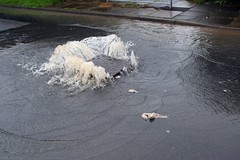
Overflowing sewerThe Environmental Protection Agency is doing a routine inspection to make sure Worcester's water system isn't poisoning anyone. Does Worcester Mag's Walter Bird, Jr. report on whether this will potentially keep people and the fish we eat healthy - maybe even save lives? No - he reports on how Worcester Public Works and Parks Commissioner Robert Moylan, Jr. thinks it's all a huge pain in the ass:
Public Works and Parks Commissioner is not relishing a visit to the city Tuesday, Jan. 22 by the US Environmental Protection Agency (EPA), saying inspectors likely will be looking for "faults" in the operation and maintenance of Worcester sanitary sewer collection system. That is the conclusion he reached after talking to colleagues in Portland, New Bedford and Holyoke, where the EPA conducted similar inspections. Visits were also made to Andover and Lawrence.

"I have contacted my colleagues in Portland, Maine; New Bedford; and Holyoke who are responsible for the sanitary sewer system in their community," Moylan says in a Jan. 16 memo to City Manager Mike O'Brien. "Each of them is a seasoned veteran with extensive experience. Each stated unequivocally that the inspection was aimed at finding fault; this was not an inspection to assist, advise or to be helpful. The EPA team was not interested in what the community was doing right, they were only interested in finding what they believed to be failings and stated the same."
FACKIN' EPA, ALWAYS BUSTIN' MY BALLS ABOUT MAKIN' SURE PEOPLE AHH NAWT DRINKIN' PISS!

Look, I don't doubt the EPA's wastewater system oversight is terribly boring and very complex - but it's also incredibly important. It focuses on "failings" because that means people are getting sick or ecosystems are being polluted. Have Worcester's public officials and journalists forgotten that?

Monday, April 30, 2012

Ask the Green Miles: Which Fish are Most Sustainable & Have Least Mercury?

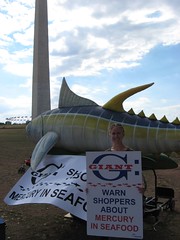
Toxic Tuna Tour in DC 10/20/07First, the short answer: Check out the FDA's advisory on mercury in fish & shellfish, then cross-reference the FDA's chart of typical mercury content in fish with your local Seafood Watch pocket guide.

But in the big picture, if you're concerned about mercury in your fish, you should be thrilled about the Obama administration's new limits on mercury emissions from coal-fired power plants. They're often wrongly treated as separate concerns - coal plants pollute our air & water, and there's mercury in fish. That's why reporters let Republicans like Mitt Romney (sometimes joined by coal-state Democrats) bash Environmental Protection Agency regulations on coal-fired power plants in the abstract without connecting the dots to the 1 in 7 newborns at risk for brain damage and learning difficulties due to mercury exposure in the womb.

Grist's David Roberts digs deeper into why the new mercury rules are a BFD.

Wednesday, December 29, 2010

EPA Moves to Restore Chesapeake Bay

Juvenile blue crab, Poplar IslandSince the attempts of Gov. Bob McDonnell (R-VA) to protect his big agriculture & tobacco donors the Chesapeake Bay were flunked, I'm glad to see President Obama's Environmental Protection Agency stepping in to provide a real plan:
Shawn M. Garvin, the agency's regional administrator for the mid-Atlantic, described the plan as "the largest water pollution strategy plan in the nation" and possibly "number one or number two" in the world. He noted that it will affect "basically every drop of water that gets to the bay" from as far north as Upstate New York.

The legally enforceable road map, which runs roughly 200 pages along with 800 pages of appendices, will help determine everything from how pig farms in West Virginia will dispose of waste to the way Pennsylvania copes with stormwater runoff. Environmentalists hailed it as the most promising plan the United States has ever adopted to revive an estuary plagued by low oxygen and struggling fish and oyster populations, while some critics warned it could be costly and hard to execute.
It's saving the Bay that could be costly? Damaging the Bay has cost the economies of Virginia, Maryland & DC more than $4 billion over the last 30 years. Hopefully the EPA's plan is the first step towards real leadership on restoration - something that's been lacking in a generation worth of elected officials from both political parties.

Friday, July 20, 2007

Week of Bad News for Region's Water

Just about every day for the last week, the Washington Post has had a story about a threat to our region's water -- both in streams and in taps. The most worrisome report concerned levels of chlorine pollutants in DC's drinking water:

Toxic chlorine pollutants were found at unsafe levels in 40 percent of D.C. tap water samples tested this spring during the water utility's annual chlorine surge, according to a national environmental group's report to be released today.

The nonprofit Environmental Working Group conducted tests at 18 sites -- including private homes, an elementary school, the U.S. Capitol and the Environmental Protection Agency -- to measure the levels of chlorine toxins that could cause cancer, reproductive problems and developmental delays in children. In 90 percent of the samples, the tests found another class of chlorine toxin at levels that some epidemiological studies have associated with low birth weight and serious birth defects.

The findings suggest that the chemicals needed to help make Potomac River water potable could be creating a different risk to consumers. Chlorine is used to kill disease-causing microbes. Heavy use results in chemical compounds, called disinfection byproducts, that are formed when organic matter in the river water reacts with the chlorine.
You can read the full Environmental Working Group report here.

Also this week:

* A Smithsonian Institution researcher discovered an invasive species of Asian crab in the Chesapeake Bay.

* A joint study between the U.S. government and the Chesapeake Bay Foundation found ethanol production could damage the bay. How? More corn-based ethanol means more demand for corn, which means more farmers growing corn. It's yet another reason we should be looking at next-generation cellulosic or biomass ethanol instead of corn-based ethanol.

* Also from the Chesapeake Bay Foundation, a report discussing the impacts rising sea levels could have on the bay. The most disturbing passage:

[Smith Island minister Rick Edmund] said residents are hoping Congress will approve a $9.4 million plan, proposed by Sen. Benjamin L. Cardin (D-Md.), to build artificial breakwaters offshore.

But Edmund said island residents know that their problems will probably get worse.

"Climate change," he said in a telephone interview yesterday, "will get us in the long run."
* The final piece of news could be taken one of two ways. You could see it as, "The Potomac River is safe to swim in on some days!" Or you could see it as, "After all these years, on a lot of days the Potomac still isn't safe to swim in."