
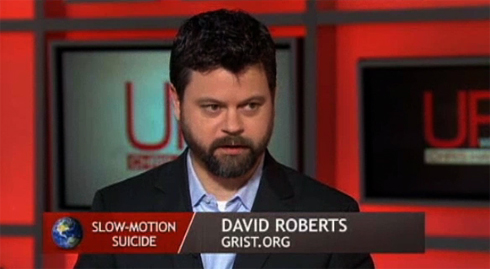
 Grist's David Roberts, who blogs on the best policies to solve our climate & energy challenges and the politics that perpetuate our problems, has announced he's taking a one-year sabbatical from blogging, reporting & tweeting. I'll miss his work while he's gone but understand his motives - what's more disappointing is the void he leaves behind.
When I first started blogging here at The Green Miles, David's writing challenged me to improve. It's easy to make fun of climate science deniers, but it's much harder to figure out why they reject it. When I later got to meet him at Netroots Nation, I was struck by his work-life balance (he calls it The Medium Chill) and ability to keep his eye on the climate prize - to maintain his passion without becoming too embittered by small setbacks & petty disputes.
Knowing he values that balance, I wasn't surprised by his decision to step away. If you spend a lot of time working on the climate crisis OR interacting online OR reporting, burnout is a major problem. David does all three. With President Obama having already rolled out his plan to act on climate and Congress in gridlock, now's the best time in years for a climate activist to take some time off.
But what bugs me is that in David's absence, there are few great climate bloggers to fill his shoes. It's a reflection of how much of blogging has evolved from free-range to factory farming:
- Blogging as career. While pioneering bloggers like Markos "DailyKos" Moulitsas, Duncan "Atrios" Black, and Heather "Digby" Parton still blog independently, many of the next generation of bloggers have been hired by emerging progressive news websites (i.e. Huffington Post & TPM), by mainstream media blogs (i.e. the Washington Post's WonkBlog) or by organizations in need of online help (I got hired by the National Wildlife Federation). Which is understandable because ...
- Blogging for free sucks. It's a lot of work for very little reward. I can understand why many first-generation bloggers gave it up and why younger folks choose to use Facebook, Twitter & Tumblr instead. But combine these first two points and now we have ...
- The blanding of blogging. Many of those who do blog spend less time trying to break the mold and more time trying to impress the Beltway establishment that might hire them. What Dave Grohl said about American Idol destroying the next generation of musicians applies here - they spend less time trying to find their own voice than trying to make their voice sound like everyone else's. I read lots of nibbling around the edges and "smart takes," but who'll stand up when necessary to say shit is fucked up and bullshit? And their middle manager editor at a newspaper website - they're going to run that?
- The Washington Post WonkBlog's Brad Plumer
- Huffington Post's Kate Sheppard
- National Journal's Coral Davenport
- Andrew Freedman & Heidi Cullen of ClimateCentral.org
- Joe Romm of ThinkProgress.org
- Tim McDonnell of Mother Jones & Climate Desk
- RL Miller of DailyKos

