Showing posts with label LEDs. Show all posts

Monday, August 18, 2014

How TV News "Balance" Slants Towards Cranks, Against Science

Why do TV news stories about anti-science cranks tend to slant towards the cranks and against science? It's mostly because of the same wrong idea about balance that skews climate change stories - but it's also revealing of how TV news forces reporters to do stories fast & cheap.

Here's an example of a crank profile from New England Cable News, which devoted an entire segment to a Cambridge, MA resident who doesn't like new street lights. But "I don't like to look at them" is no more of a winning argument against street lights that are saving taxpayers $500,000 a year than it is against wind turbines, so the guy is also claiming they're making him sick:
Abrams also says he doesn’t like the shadows the new lights cast either. "There's hundreds of shadows on the sidewalk, these lamps cast, it kind of makes me dizzy," he said.
So, crank with an agenda says one thing, who should we put him up against? If you've followed how the media covers climate change, you know anti-science cranks must be juxtaposed with opinionless, objective science:
The U.S. Department of Energy online says it remains unproven that typical exposures to outdoor lighting have negative health impacts, but also say it cannot be ruled out without more data.
That's where the skewed idea of "balance" pushes the story towards the crank. The opposite of a crank isn't a scientist - it's a progressive:

But in the constraints of one eight-hour night shift, finding that progressive to defend science can be hard. Gotta just make the Cambridge city worker the "other side" and call the story done.

Another problem with crank stories is that often the reporter must hold back key facts to prevent the reporter from looking stupid for doing a crank story in the first place. Check out the very last line of this story:
The city also points to some light shields they can install to block the light from going in peoples windows. The city says before the most recent yellow lights, the city had bright white lights. They believe it's just a matter of people getting used to them. Other cities such as Boston have converted the bulk of their lights over to LED, and cities like Los Angeles and Seattle have done so as well.
Cities with a total population of 5.1 million people have installed these lights with no evidence of problems, but the reporter has to put that at the end, because otherwise the story would be revealed as a waste of time just two sentences in.

One final thing the reporter never talks about: How scientists long ago cracked the mystery of how to keep out unwanted light ...
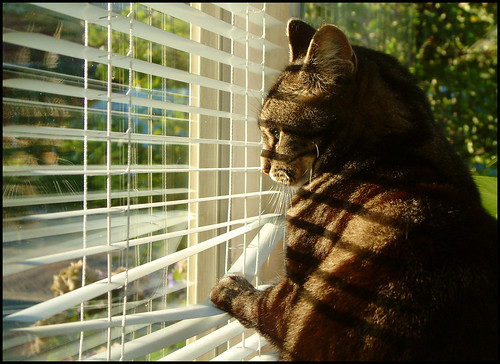
"How I hate venetian blinds"

Monday, April 30, 2012

Is Your City Still Wasting Money on Inefficient Streetlights?

Ops-center-induction-lights-install_24At The Atlantic's Cities Blog, Nate Berg points out that streetlights drain a huge amount of a community's budget, but thanks to new technologies, cities like San Diego can slash their energy bills & carbon footprints:
Under the leadership of a program called CleanTECH San Diego, cities in the area have been able to streamline what would otherwise be a cumbersome process to make the switch from old bulbs to new. And with grant money from the American Recovery and Reinvestment Act of 2009, 13 cities in the region have kicked off projects to replace about 55,000 streetlights, which will save an estimated $3 million annually.

The largest among those cities is San Diego, which will be replacing about 90 percent of its streetlights, roughly 35,000. The city is replacing its old low-pressure sodium lights – a common streetlight – with induction bulbs that use about 40 percent less energy. 16,500 have already been converted, and officials expect the transition to be finished by next spring.

Before the conversion, the city had been paying about $4.7 million a year to light its streets. When all 35,000 lights are replaced, that cost will drop to about $2.8 million a year, according to Tom Blair, deputy environmental services director for the City of San Diego.

And it's not just energy costs that will go down. The old sodium bulbs typically had to be replaced every 3 or 4 years, while the new induction bulbs can last more than a decade. Blair says a set of induction bulbs were installed in downtown San Diego about 12 years ago and have yet to need replacement. "That’s a significant savings," Blair says.

"It was kind of a no-brainer," says Marty Turock, a program manager at CleanTECH San Diego. "Virtually every city, at least within San Diego County, recognized that doing the street lighting retrofits was one of the biggest impacts and one of the biggest payback energy efficiency projects they could take on."
Another leader - Ann Arbor, MI, projected to save $100,000 a year by installing new LED streetlights with motion detectors (unlike older streetlight bulbs that need a few minutes to power up to full intensity, LEDs can fire up instantly).

Sunday, January 22, 2012

A Visual Demonstration of Why LED Lights Save You Money

Incandescent light bulbs are terribly inefficient at turning electricity into light, wasting most of the energy they use as heat. Compact fluorescent lights (CFLs) and light-emitting diodes (LEDs) waste very little energy as heat, meaning they'll rapidly pay back their higher cost & much more by saving you money on your electricity bill.

I got a demonstration of their efficiency after this weekend's snow & ice thanks to a string of LED Christmas lights still up on my fence. While incandescent Christmas lights quickly melt a cone into the snow & ice around them, I plugged in the LEDs and hours later, they were still frozen firmly in place:

Friday, January 2, 2009

Quick Post-Holiday Tip

From Virginia Young Democrats Environmental Caucus Chair Hannah Wiegard:
If you're in the market to replace some strings of X-mas lights, opt for LED. They carry an Energy Star label and can save up to 88% on electricity. And they'll all be on sale half price at this time of the season.
Excellent point! I'm off to stalk the aisles of CVS for sales.

Tuesday, October 9, 2007

Can a Traffic Light Help Lower Your Taxes?

Caught a beautiful late-summer sky recently at the corner of N. Monroe and Fairfax Drive (sorry for the low quality of the cell phone camera). But there's a little environmental beauty in the foreground, as well:

Arlington County has retrofitted more than half of its signalized traffic intersections with light-emitting diode (LED) traffic lights. These LED traffic lights are brighter and only use 25% as much electricity as traditional traffic signals. LED traffic lights also last ten times longer than incandescent bulbs, so the maintenance cost of these new signals is sharply reduced. All of our traffic signals will be LED lights by 2010, saving enough electricity to power about 250 homes.
Info comes from the Arlington Fresh AIRE site. The electricity savings are only a tiny fraction of Arlington County's total power usage, but the cost and maintenance savings will really add up. Always nice when the right environmental move and the right economic move converge!