Showing posts with label katrina. Show all posts

Wednesday, October 14, 2009

Big Oil Front Group: Drilling Will CLEAN Beaches

The Green Miles isn't anti-coastal drilling as part of some treehugging doctrine. If allowing some drilling is the price of getting a clean energy & climate action bill passed, I probably wouldn't be screaming for a veto. I just think that until we've grabbed the lowest-hanging fruit of renewable energy and energy efficiency (and we've barely started picking), we shouldn't put our coastal economies at risk.

But this is what makes rational discussion of the issue so difficult: Big Oil's willingness to lie right in Virginians' faces about the realities of drilling. Here's what the Heartland Institute, which admitted to taking more than half a million dollars from ExxonMobil before it stopped revealing its funders, is telling Californians about coastal drilling:
Offshore oil drilling has a proven track record as a safe and effective means of acquiring energy. Oil platforms in the Gulf of Mexico weathered hurricanes Katrina and Rita with little or no spillage, according to the National Ocean Industries Association.
The "National Ocean Industries Association" is yet another industry front group that joined ExxonMobil to fund one of the worst global warming denier groups ever. So one polluter front group is quoting a lie from another polluter front group that Katrina and Rita caused no spills.

What does the actual historical record tell us? Just check this actual headline from 2005: "Katrina oil spills may be among worst on record." Considering Virginia is right in the line of fire every hurricane season, this is a huge worry.

But that's far from the biggest doozy:
Drilling would help clean up the coastline. According to the National Academy of Sciences, 60 percent of the oil found in the North American marine environment comes from natural seepage through the ocean floor. Only 1 percent comes from offshore oil and gas development. Drilling and removal of oil allows for less natural seepage, hence cleaner beaches and a cleaner marine environment.
Here's the problem: natural seepage happens in tiny amounts over long periods of time, while man-made spills happen all at once and in large quantities.

Let's do a visual demonstration. Natural seepage:


Now the man-made version:

With absolutely outrageous lies like this, how can we believe anything Big Oil tells us about the dangers of offshore drilling or how much revenue we could expect from it? ExxonMobil will spill oil on your leg and tell you it's raining.

Unfortunately, neither Creigh Deeds nor Bob McDonnell sound willing to take the tough stand against Big Oil. Expect to hear more questionable forecasts of black rain for the next four years.

Sunday, July 15, 2007

Yes, Averting a Climate Crisis Will Cost Money. How Much More Will Inaction Cost?

From "Louisiana’s Wetlands: A Lesson in Nature Appreciation," by John Tibbetts:
From 2000 through 2003, the Corps of Engineers and the state of Louisiana collaborated on a feasibility study for a $17-billion coastal restoration plan lasting 30 years. Yet this study, based on Coast 2050, also seemed far too expensive at the time. “It never went up to Congress because it exceeded what potentially could be funded,” says [US Geological Survey wetlands scientist Greg] Steyer. “We were asked to focus it on more of the near term, over ten years, addressing what are the critical projects that could be done.”
From today's Washington Post article on climate change legislation:
"I sincerely doubt that the American people are willing to pay what this is really going to cost them," John D. Dingell (D-Mich.), chairman of the House Energy and Commerce Committee, said in a recent C-SPAN interview.
People often ask me, "If the science on global warming is really so solid and the problem is really so menacing, wouldn't our government have taken action by now?" My answer is that we ignore critical threats all the time.

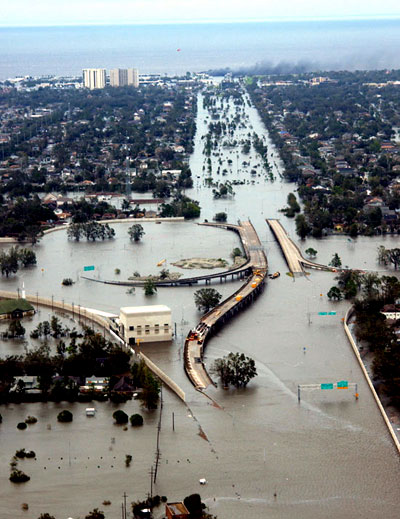
Mike Tidwell published his book, "Bayou Farewell: The Rich Life and Tragic Death of Louisiana's Cajun Coast," a full two and a half years before Hurricane Katrina hit. We knew New Orleans would be destroyed, yet as Steyer's above quote indicates, we decided not to spend the money to protect it.

We wouldn't spend $17 billion to restore Lousiana's wetlands to soften the blow of incoming hurricanes. Yet if Louisiana's wetlands and barrier islands had stood at their original (pre-Army Corps of Engineers-induced erosion) levels, it could've cut five to nine feet off Katrina's storm surge. Instead, we're paying $200 million to rebuild the Gulf Coast.

If we won't pay for renewable energy or carbon-cutting technologies, how much more will we have to pay to mitigate the effects of global warming?

Thursday, February 8, 2007

The Army Corps of Engineers: Destroying Once & Future Cities

Some good and bad stories when it comes to design & the environment. As the title indicates, we'll start with the bad.

The same Army Corps of Engineers that oversaw billions of dollars worth of projects that ended up worsening the impact of Katrina on New Orleans now wants to spend billions of dollars on projects that scientists say will worsen the impact of future hurricanes. A dozen coastal scientists have written the National Park Service to object to one element of the plan, saying, “This is not science-based management."

Now to the good! Newsweek takes a look at "7 Simple Steps" that result in major energy savings. It concludes, "If saving energy is so easy and profitable, why isn't everyone doing it? It has to do with psychology and a lack of information."

XCurmudgeon details his recent efforts to conserve energy, and their immediate impact on his energy bills. He inspired me to rearrange the power configuration of my home computer, which freed up a power strip to go to my TV/DVD player/Xbox, which will now not be sucking power when I'm not using them.

To learn more about what you can do in your daily life to reduce your impact on the environment, check out Arlingtonians for a Clean Environment's Green Living Challenge! And don't forget, you can become a Friend of ACE by contributing at least $20 using the SixDegrees link on the right side of this page.

My friend Myra tipped me off to the National Building Museum's frequent events focused on green building design, with two coming up in the next month or so. On February 22nd at 6:30pm, the museum will host Educating the Green Way: The Children’s Museum of Pittsburgh. Then on March 7th at 6:30pm, there's Green Design: The Myth and Reality. Check out the museum's website to learn more!

One other tidbit ... an interesting story from ABC News about how more Americans are taking volunteer vacations.