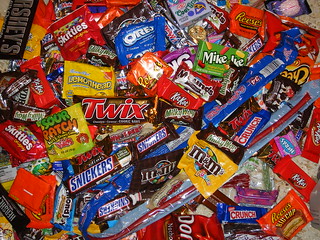
Every year, headlines are filled with reports of tainted Halloween candy. Razor blades in apples! How would you hide one without making it completely obvious? They never say. Poisoned candy! But every kid knows exactly who gave what candy - if you wanted to hurt kids, giving out poisoned candy would be no more secretive than chasing kids around your neighborhood waving a rake.
Let's review 2015's Halloween candy danger scares that made national headlines. Not one of them was even confirmed as an actual attempt to hurt children, never mind an incident that actually hurt a child:
Gloucester, NJ: Man arrested for making own tainted candy & falsely reporting it
Kennett Square, PA: Kids admit making up report of finding needles in Twix bars
Hudson, NH: Cause never publicly identified for razor blade allegedly found in trick-or-treating bag; two years before in a neighboring town, a "razor blade in trick-or-treating bag" turned out to have fallen out of a pencil case
Hopkinton, MA: New, wrapped discs of toilet bowl cleaner found in trick-or-treating bags, despite kids not being able to say who gave them out. This was apparently supposed to be dangerous because kids are so stupid they'll eat toilet bowl cleaner.
Poisoned Halloween candy is an urban legend, but that doesn't stop local and even national news from reporting every flimsy story as a WARNING FOR PARENTS TONIGHT. The follow-up news confirming the hoax inevitably gets much less coverage.
The first rule of being a green parent is do not sweat being a green parent. You'll have a million other things to stress out about and no matter what you do, you'll feel like you're fighting a losing battle.
You'll have good weeks where you feel like recycling and composting are keeping your household footprint to not much more than it was pre-kids. And you'll have weeks where you look around at piles of unrecyclable plastic clamshell-style packaging & little-used plastic toys and feel hopeless.
With our daughter now two years old, I wanted to share a few tips from our experience navigating life as first-time parents trying to maximize savings and miminize waste & stress:
We used the Beaba to make our own baby food. It takes more time & planning, but we found it worked well, produced more vibrant-looking baby food, and saved money in the long run. We bought one round of Gerbers, then re-used those glass containers endlessly for our own food.
We're doing disposable diapers. Studies have shown that the extra energy & water consumed washing cloth diapers offsets the landfill impact of disposables. As I said, unless it's a clear environmental win, it's not worth adding stress and a significant amount of additional grossness to an already spit-up-and-volcano-diaper-filled life. We also recommend the Diaper Genie, which holds a lot of diapers in a small amount of plastic & keeps the odors locked in.
It's worth signing up for Amazon Prime to get Amazon Family discounts on subcribe & save items. Compile 5 subscription items into one shipment & you get an extra 15% off. Between diapers, wipes, diaper genie refills, etc. it's pretty easy to add up to five. The prices on wipes are particularly good. Unless you're somehow able to walk or bike those cases of diapers home, you'll have a lower carbon footprint than driving.
Skip diaper wipe warmers and other absurd gadgets. My wife diligently saved every receipt, allowing us to return products that we found we didn't really need.
You'll have many items that you need for a few months, then never again. Talk to other parents about what you can borrow. If you need to buy, buying used and then re-selling can save money and reduce waste. Amazon now sells more used products than ever (look on the right side of product pages). When it comes time to get rid of something, I've been pleasantly surprised how many buyers (or just takers for "free to a good home" items) you can find on Craigslist.
Learn how to use everything before the baby comes. Install the car seat & get it checked at your local fire station. Set up, unfold & repack the stroller. Unpack the breast pump, figure out how it works, and decide how & where you'll be storing & cleaning everything.
If you're upgrading from a car to a larger vehicle, check FuelEconomy.gov. An efficient large SUV like the Toyota Highlander Hybrid can get much better fuel efficiency than a smaller less-efficient model like the Jeep Wrangler.
A sturdy carrier like an Osprey to save your back on long walks & hikes is definitely worth the investment.
Let your kids get a little dirty. It's good for them.
Consumer Reports was a life-saver as I quickly & constantly having to become an expert on what to buy. Bike seat or trailer?? Consumer Reports helped guide us to a front handlebar seat. My local library has an online subscription that we used for free access.
Do the best you can to minimize your impact, but don't drive yourself crazy. You'll have many other, less-busy years of your life to shrink your footprint and lobby for environmentally-friendly changes in your own community.
There is no such thing as poisoned candy or razor-bladed apples - it's an urban legend that does not happen in real life.
But that hasn't stopped generations of parents from telling generations of kids (like me!) that Halloween candy must be inspected carefully before eating because while our neighbors may seem nice and generous, in fact TONIGHT ONE OF THEM MAY MAKE AN ATTEMPT ON YOUR LIFE.
The myth of booby-trapped candy seems plausible at first, but quickly falls apart. When I was a kid, I could've told you exactly who gave me what candy at which house. If someone wants to hurt the children in their neighborhood, poisoning candy is no more anonymous than trying to wring their necks right there on the porch. Repeating this myth and inspecting candy scares our children for no reason. After all, you don't inspect every piece of candy (or any other food) from the grocery store, and that would be much easier to taint anonymously - there's just no urban legend surrounding grocery store candy.
The other damaging part of the myth is that we teach our children that packaged candy is "safe," but fruit, nuts or anything else not packaged is not, so our children end up eating nothing but sugar on Halloween. As John Oliver explains, that's actually the real danger at the scale Americans eat it (read more in Mother Jones):
New York City 11-year-old Kareem Granton ran away from home last spring and spent five days hanging out at Chuck E. Cheese and riding the subway before the police found him. The Today Show presented this as a HARROWING TALE of a near-teenager somehow surviving without a parent monitoring his every move, before giving us a "social experiment" that purported to prove how dangerous everyday life is for kids.
Today's implication was that Granton could've been murdered at any moment, even though half a million NYC students take the subway or bus to school every day, and no less of an authority than New York City Mayor Michael Bloomberg says it's perfectly safe for children ages 8 and up to ride the subway to school by themselves.
So to show how life is actually terribly risky in URBAN HELLHOLES like New York, The Today Show's Jeff Rossen sent an 11-year-old BY HIMSELF to extremely safe, busy public areas, then told bystanders they were history's greatest monsters for not immediately treating him like a kidnapping victim.
"At New York's famed Coney Island amusement park, Bjorn boarded ride after ride with no mom or dad in sight," reported Rossen, with absolutely no hint of self-awareness that he was actually describing an idyllic day for an 11-year-old of any previous generation. When Bjorn asked questions of strangers, they helpfully gave him whatever he needed.
Fortunately, Rossen was able to turn to John Walsh to inform people on the boardwalk that Bjorn was actually lucky to have survived the hour without being murdered by a lurking predator:
"Yeah, but he seemed comfortable and confident, self-assured," replied one. "He seemed old enough, it's broad daylight, lots of people around."
But Walsh pointed out: "They're not going to be crying or hysterical. And kids are so vulnerable, at that age particularly. They're so trusting, they're so innocent, and you don't want the bad guy to come up and say, 'I can help you.'"
Even if a child looks totally safe and secure, you must still treat them like they're terrified and in grave danger!
The experiment continued at a much quieter park where Bjorn walked through a group of adults, passed women pushing strollers, and listened to a musician. No one even looked twice. When the Rossen team had Bjorn sit alone on a bench for many minutes with no guardian in sight, no one said anything.
An 11-year-old sitting by himself with no one bothering him in a park filled with parents, and no one called the police? YOU SAVAGES.
The moral of the story: If we see an 11-year-old outdoors alone, we should be constantly asking him if he needs help. But having spent my entire childhood roaming the streets of Boston with friends with not one horror story but plenty of Kareem Granton-esque adventures, all I could conclude was:
Bjorn had fun
No one bothered him and he didn't hurt himself
Whenever he needed help, there was always a grownup right there happy to assist him
Minutes later, Today launched into a new warning to parents: "Kids hooked on the Internet can suffer from chronic sleep deprivation, poor nutrition and academic failure."
Might letting them out of the house once in a while by themselves ease that problem? Sorry, we'll have to leave it there!
American parents have spent the last two generations trying to keep their children safer by keeping them closer to home and under constant protective watch. As The Atlanticreports, today kids are just as frequently injured in accidents and just as rarely victims of crime as they were when kids were allowed to run off and play in the woods by themselves.
Also, children are less confident and parents are more frazzled. What's not to like?
So why does helicopter parenting persist? Helicopter parenting makes parents FEEL constantly needed and important, even if the evidence shows their kids would be better off on their own sometimes.
It's also no coincidence that the rise of protective parenting overlaps almost perfectly with the rise of local television news. Every time there's an incident, local TV news breathlessly asks IS YOUR CHILD IN DANGER?? Meanwhile, the most common ways for children to die: Accidents involving guns and cars, neither of which your child will find in the woods.


 discounts on subcribe & save items. Compile 5 subscription items into one shipment & you get an extra 15% off. Between diapers, wipes, diaper genie refills, etc. it's pretty easy to add up to five. The prices on