Showing posts with label reduce/reuse/recycle. Show all posts

Tuesday, May 29, 2012

Ask The Green Miles: Mattress Disposal

January 5, 2012 Inmates at the Hutchinson, Kan., Correctional Facility disassemble a mattress for recyclingHere's a question that cuts to the core of me, Baxter:
Do you have any ideas on mattress disposal?
You see, I recently bought a new mattress when I didn't really need to ... and trying to get rid of the old one made me wish I'd held onto it a little longer.

Goodwill & similar organizations won't accept used bedding for fear of bedbugs. Putting it on Craigslist only got me emails from scammers. I spent a week looking for a way to keep it out of the incinerator with no luck.

"There are some awesome mattress recycling facilities ... but unfortunately not in this area," says Allison Lohrenz, the solid waste programs coordinator here in Falls Church. "Cross your fingers that one will be here soon!"

Right now, mattress recycling is limited to local efforts & special events (and special events aren't so great for people who live in apartments & don't have a basement to stick their old mattress in until the next recycling event comes around). Grist's Ask Umbra points to some hope for mattresses in Massachusetts:
Massachusetts is home to one of the nation’s few mattress recyclers, and another outfit is venturing into New England soon. It’s amazing what happens to your mattress: the wood is chipped for energy, the steel springs recycled, the cotton and foam used for insulation or other textile needs.
You should email your local elected officials & recycling coordinator and ask them to support bringing a mattress recycling program to your area ... but in the short term, your mattress is most likely heading for the landfill or an incinerator.

Got a cool mattress recycling program in your area (or an alternate idea for what to do with your old mattress)? Let us know in the comments section.

Sunday, December 11, 2011

It's Like Boxed Wine, But For Laundry Detergent

Spotted the new Seventh Generation EcoLogic laundry detergent bottles at Harris Teeter the other day:
Seventh Generation, the nation's leading brand of non-toxic household and personal care products, introduces a cutting-edge advancement in the art of sustainable product packaging -- a new liquid laundry detergent bottle made from 100 percent recycled cardboard and newspaper.

Seventh Generation's Natural 4X Laundry Detergent bottle, designed with its partners at Ecologic Brands, is unlike any other packaging currently found in the laundry aisle -- or any other aisle, for that matter. It features a rugged, fully-recyclable and even compostable outer shell made from 70 percent recycled cardboard fibers and 30 percent old newspaper fibers that supports a recyclable lightweight plastic pouch inside. By using 66 percent less plastic than typical 100 ounce 2X detergent bottles, the new container allows consumers to conserve effortlessly.
When it's empty, the outer cardboard & paper shell, #4 plastic pouch and the #5 cap can all be recycled. Makes you wonder why the pouches in boxed wine aren't recyclable like the boxes themselves.

It's a good reminder that recycling in your home is just one half of the equation. It's just as important to buy products made from recycled material to demonstrate there's a market for recycled material. And at the same time, products made from recycled material keep waste out of landfills, save energy, and reduce pollution.

Wednesday, September 14, 2011

In Defense of Using Old Stuff Till It Breaks

A friend got his nice, new briefcase stolen at District Chophouse last night. Luckily his laptop, iPod, Blackberry and wallet were not inside ... but his keys were.

My friends always kid me about my giant ugly secondhand laptop backpack that's been in use for a total of about a decade and has gone through several repairs. I've thought about replacing it, but this makes me think twice. At least it screams IF I COULD AFFORD ANYTHING OF VALUE DON'T YOU THINK I'D PUT IT IN A NICER BAG THAN THIS.

Monday, September 12, 2011

One Small Recycling Event Keeps 30,632 Pounds of Electronics Out of Landfills

I was really impressed by Saturday's Fall Recycling Extravaganza here in Falls Church. There were plenty of staff, the event was well-organized, there was no line, and in no time I'd dropped off about 50 pounds of old electronics (most of that a computer & its monitor).

How much electronic equipment, potentially laden with hazardous material, was kept out of the landfill? Here's a tally from Barbara Gordon, Falls Church director of communications:
A total of 30,632 pounds or 15.3 tons of electronics and computer equipment were collected at the City of Falls Church’s fall Recycling Extravaganza on Sept. 10. Total weight of items collected and therefore kept out of the waste stream and the land fill were:
  • 19,472 pounds of electronics
  • 136 TVs, estimated at 6,120 pounds
  • 144 computer monitors, estimated at 5,040 pounds
  • Combined total 11,160 pounds of cathode ray tubes
And that's just in a Little City of 12,332. If your community isn't holding a similar event, it's not because there isn't demand.

Thursday, September 8, 2011

Fall's Local Recycling Events Start This Weekend

Got an old computer you want to dispose of safely? Eyeglasses with an outdated prescription? Communities in our region are holding their fall recycling events, collecting a lot more than what they pick up curbside:
You can Google to find out if your community offers electronics recycling events, or see more options at the Environmental Protection Agency's eCycling.

Saturday, May 28, 2011

The Story of Stuff (Video)

My buddy Everyday Father asked me to post an oldie but a goodie that has somehow never made its way to The Green Miles - The Story of Stuff:

Tuesday, August 10, 2010

Recycling vs. Trash: Time to Swap Sizes?

Five years ago, I had a standard-sized garbage bin in my kitchen and put recycling in paper grocery bags.

Two years ago, I switched to a smaller garbage bin and not only needed more recycling space, my old system didn't work because I've gone exclusively to reusable grocery bags. So I started using a big clear plastic bin for recycling bottles & cans (and just clap your hands) and used a reusable bag to collect the paper.

Today, my new apartment building does single-stream recycling, so I just use one bin for containers, paper & cardboard. My problem is that I now recycle or compost much more waste than I send to the landfill. I end up having to take out the recycling a couple of times a week, while my trash only needs to get taken out every few weeks. The composting helps get rid of most of what could be unpleasant after a few weeks, but long-term, it's not the optimal set-up.

Maybe it's time to use the bigger bin for recycling & the smaller bin for landfill?

Wednesday, June 11, 2008

Timberland Reduces Its Footprint

A recent hiking binge left The Green Miles in need of some new footwear. Sneakers are fine for most trails, but every once in a while you'll regret it when you jump off a ledge and a piece of gravel jabs the bottom of your foot through the soft sole.

So I went shopping online for some new hiking boots. I only looked at Timberlands because of their commitment to sustainability. Timberland has pledged to make all its owned-and-operated facilities carbon neutral by 2010.

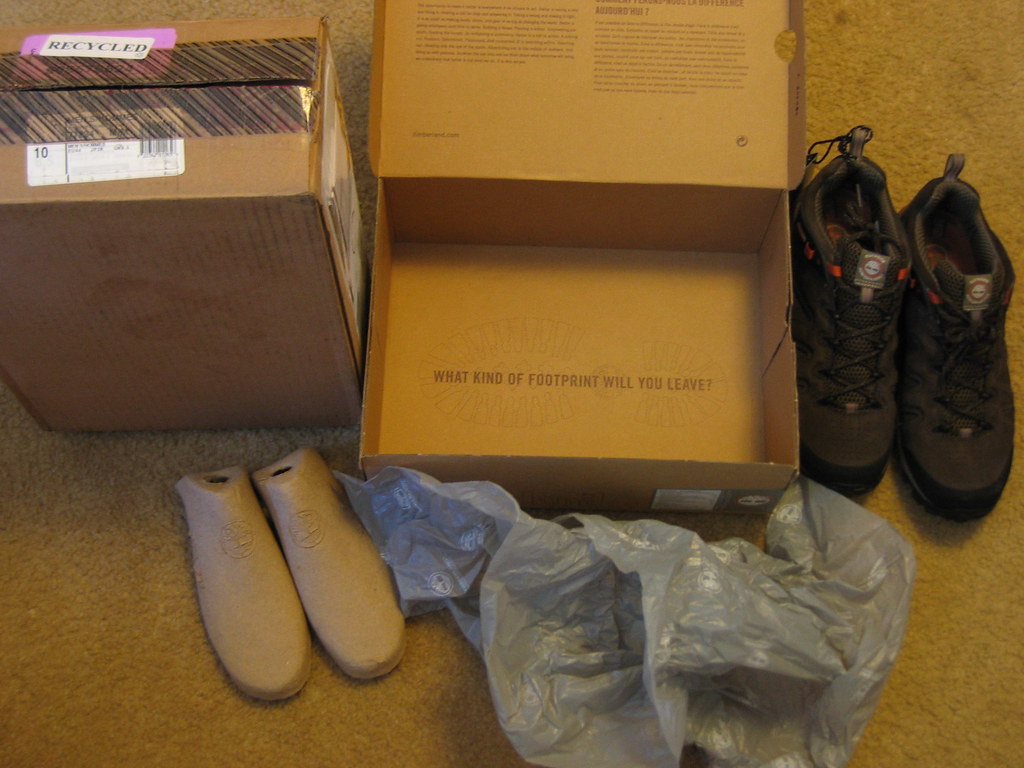
The shoes arrived today and literally announced their eco-friendliness from the moment I looked at the box. It had a big "RECYCLED" label on one end and had clearly been used to ship shoes a few times before making it to Arlington. Reusing is one of the few things that can truly be called carbon neutral, making the box free of cost for both Timberland and the planet.

Inside the box was a shoe box made of 100% post-consumer recycled content and printed with soy-based ink. The shoe-stuffers looked to be made of recycled materials. In fact, the only part of the package that wasn't recyclable was the plastic shoe-wrap - which itself was made from recycled materials.

The bottom of the shoe carried an "our footprint" sticker. It looked like a nutritional label, but instead of calories and dietary fiber it counted renewable energy and recycled content.

Finally, I noticed the box said "reuse, then recycle." It didn't take long for someone to find a new use for it:

Friday, May 2, 2008

BYOBag

From Bill Maher's Earth Day entry at HuffingtonPost.com:
[S]upermarket clerks must stop putting the big bottle of detergent with a handle on it in a plastic bag. I don't mean to tell you how to do your job, but you see that handle you just lifted the detergent with? I can use that same handle to carry the detergent to my car. And stop putting my liquor in a smaller paper sack before you put it in the big paper sack with my other stuff. What, are you afraid my groceries will think less of me if they see I've been drinking? Trust me, the broccoli doesn't care, and the condoms already know.
And it's with that completely inappropriate introduction that I give you the brand new Arlingtonians for a Clean Environment reusable bag!

To celebrate, ACE is having a kickoff party:

BYOBag Kickoff Ceremony
Sunday, May 18, 1 to 4 p.m.
Market Commons, 2800 Clarendon Blvd., Arlington
  • Join us we kickoff our campaign to promote the use of reusable bags and the many problems with plastics in our environment. This (rescheduled) event will be part of the Market Commons Spring Fling. The student winners of our BYOBag poster contest will also be recognized.
  • We'll have free ACE Living Green BYOBags for the first 50 visitors. The spring fling will also include music and kids' activities.
  • We need volunteers for our table. Contact us at volunteer@arlingtonenvironment.org or 703-228-6427.
To learn more about why reusable bags are so much better for the environment than either paper or plastic bags, check out this post from The Green Miles archive.

Wednesday, March 19, 2008

Cool Reusing Idea: Free Book Box

Recently I was in Richmond and noticed this:

It's a box filled with books, put there by an organization called Books on Wheels. It seems like a great way to promote reading among people who might not have disposable income to use on books.

There are plenty of environmental benefits in getting another use out of the paper in the books. Even the box itself looks like it may have been recycled from a previous life as a free magazine dispenser.

Thursday, October 4, 2007

Paper or Plastic: Which is the Green Answer?

Neither. The Washington Post has a great graphic today comparing paper and plastic grocery bags, coming to the conclusion that neither is a decisively better choice for the environment. Instead, you should choose reusable grocery bags. Environment.About.com recently came to the same conclusion. It makes you wonder, considering how we're nickel and dimed for everything else these days, why are paper and plastic bags still handed out for free?
The Green Miles recently wrote about how he's fighting through the frustrations of the transition to reusables.

Tuesday, September 11, 2007

Why Resuables Make The Green Miles Feel Like Johnny Appleseed

Confusion reigned from the moment I handed my reusable grocery bag to the bagger at my local Harris Teeter recently. First she tried handing it to the customer who’d just checked out, thinking it was something they’d dropped. Then she just set it aside, clearly having no idea what it was, and started putting my groceries into standard plastic bags. Finally, the cashier turned to her and explained how the reusable bag worked.

Incidents like that make me feel like the Johnny Appleseed of reusables, spreading the word about reusables whereever I go. And sure, that's cool, but on the other hand, it would be nice to sport reusables without having it be a major production.


Granted, I’ve used my reusable bag many times at Harris Teeter with no problems, and it was obviously a new bagger, but the situation illustrates one of the sticking points as reusable items are introduced. Service employees have to be trained to use the new items, even if that training is only a quick explanation from the senior cashier. That training may come from the employer or the customer, but until employees more universally recognize reusables, it can make the process a pain in the neck for the customer.

Another example came just yesterday as I flew back from San Francisco on United Airlines. The Green Miles travels with his handy
ACE/Daily Grind reusable coffee mug because:
- Conservationally, it saves me from having to use somewhere around five paper coffee cups and plastic water bottles per trip
- Conveniently, I don’t have to worry about tracking down a recycling bin for any plastic water bottles I would’ve used
- Socially, at events like the Society of Environmental Journalists conference it
Nuke LaLoosh-style announces my presence with authority as a green mack daddy
I got it filled with coffee at a shop in the airport, then on the plane, asked the flight attendant to fill it with soda. It had worked fine on the flight out, but just like the grocery bagger, this flight attendant was definitely unclear on the concept. She saw my mug and said, “Oh here, I’ll give you the cup of ice and the can of soda and you can fill it yourself.” She thought she was being helpful. Not so much.

At that point, any hope of conserving a plastic cup had been lost, so I dumped the ice into my mug and gave the cup back to her, which she threw out. So instead of the usual two containers (plastic cup and soda can), we used three (cup, can, mug). This is progress? At least I was able to recycle the can in the terminal thanks to
Dulles’ new recycling bins.

If a product is a pain to use, people will stop using it. (I know, I missed my true calling in marketing, didn’t I?) It’s something we well-meaning conservationists need to keep in mind as we push reusables like grocery bags, coffee mugs, and water bottles. The early adopters should be prepared for minor hassles like the ones described above. But really, they’re minor inconveniences when you know you’re breaking the resource-container-landfill cycle, don’t you think?

Tuesday, March 20, 2007

Green Living Challenge #3: Petrochemicals in Your Coffee Cup

Since I posted about reduce/reuse/recycle yesterday, I thought I'd keep with that theme and chalk up another 5 points in Arlingtonians for a Clean Environment's Green Living Challenge ...

Use a reusable mug when purchasing coffee or tea

From EcoCupInfo.com:

Every year, Americans drink more than 100 billion cups of coffee. Of those, 14.4 billion are served in disposable paper cups— enough to wrap the earth 55 times if placed end-to-end! Those paper cups contain a plastic lining made from a petrochemical that would produce enough energy to heat 8,300 homes. That’s a town the size of Newtown, Connecticut.
I'm willing to bet that if they were called petrochemical cups instead of paper cups, a lot more people would bring their own travel mugs. I've always had a travel mug or two in the cabinet, but I usually only break them out when I'm bringing a big cup of coffee at the start of a long drive.

Part of the reason this hasn't registered with me until now is that I rarely buy brewed coffee. I have a coffee-maker at work, and I'm religious about making it there, bringing in cream and sugar, etc. Not to get all coffeenerdness, but I've always preferred a strong cup of drip coffee to a cappuccino/latte/whatever anyway, and when the lattes are $4 compared with $10 for an entire pound of coffee beans, it's an easy choice.

But I watch co-workers go out for coffee several times a day, coming back with a new, white, bleached paper cup every time. Is coffee really that hard to wash off of a cup? There's even a dishwasher in the office! Keep a couple of travel mugs handy and you'll never have to lift a sponge!

OK, I suppose ranting won't win any converts, but here's something that might. The Daily Grind location at N. Quincy and N. Fairfax in Ballston is offering special Green Living Challenge travel mugs. At $10, they're cheaper than Starbucks travel mugs, and Daily Grind will give you refills for just $1. Get it refilled every day for two weeks and you've made your money back.

So now I have the tools (shiny new travel mug), the motivation (of completing the challenge), and the desire (Daily Grind makes a nice strong Guatemalan) to complete another step of the challenge! You can track my progress here.

Points for this action: 5

Total points to date: 45

Points needed to complete Green Living Challenge: 100

Monday, March 19, 2007

King of Reusing (Soon to be Known as a Tree-Hugging John Henry)

(Note: Title best when sung to the tune of Better Than Ezra's "King of New Orleans.")

You've heard the environmental mantra, "Reduce, Reuse, Recycle." It's easy to skip the first two and go straight to the last one. After all, they're almost in decreasing order of difficulty -- while reducing and reusing ask you to change your behavior, recycling merely involves adding a little effort to the end of your existing habits.

That's not to say recycling isn't important -- it is. But by reducing and reusing, there's no end product whatsoever -- you eliminate even the need to recycle. No materials used to create new product, no big, gas-guzzling trucks needed to haul the recycling away.

A couple of weeks ago I was helping a friend move when she ran out of boxes. Most of the big stuff was already in the truck and there were plenty of people to help with the little stuff, so I offered to make a box run. She gave me $20 and told me to go to The Container Store in Clarendon to buy some boxes.

I was almost offended. Buy boxes? Are they that valuable and rare of a commodity?

A flashback may help explain. Growing up, my dad worked in a printing shop. Before any move, he'd spend weeks assiduously bringing empty paper boxes home, a couple at a time since he took the T home. In the Grant household, boxes flowed like hot and cold running water.

So when she told me to buy boxes, I knew exactly where to go -- the liquor store. Sure, I may have needed to restock my liquor cabinet, but I also knew they'd be happy to get rid of some of their old boxes. An easy chance to reuse.

I take the same approach with grocery store bags. I get paper bags, which get a first reuse as a fort for my cat. They get a second reuse as container for my recycling, which I have to walk over to the local Arlington County recycling center since my apartment complex, Ballston Park, offers bare minimum recycling facilities. Then they get recycled at the facility.

Of course, I could eliminate the need for the paper bags altogether by bumping up my degree of difficulty from reusing to reducing with a reusable grocery bag. I've now acquired a reusable grocery bag and am keeping it in the same cabinet where I keep my coupons, and I'm hoping to get in the habit soon.

Although considering I already walk to the grocery store to buy mostly organic products, if I add a reusable grocery bag, my bleeding heart may explode like I was a tree-hugging John Henry.