Showing posts with label roads. Show all posts

Monday, November 2, 2015

Official Admits Iowa Needs to Go on a Road Diet

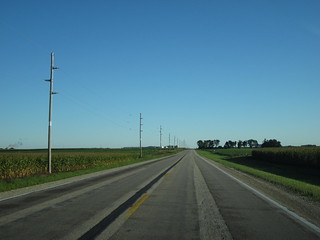
US Highway 218 - IowaThe first step to getting your highway budget back to a sane level is admitting you have a problem. As Charles Marohn reports at StrongTowns.org, Iowa Dept. of Transportation Director Paul Trombino recently did just that, pointing out Iowa can't afford to maintain all the roads & bridges it's built:
I said the numbers before. 114,000 lane miles, 25,000 bridges, 4,000 miles of rail. I said this a lot in my conversation when we were talking about fuel tax increases. It’s not affordable. Nobody’s going to pay.

We are. We’re the ones. Look in the mirror. We’re not going to pay to rebuild that entire system.

And my personal belief is that the entire system is unneeded. And so the reality is, the system is going to shrink.

There’s nothing I have to do. Bridges close themselves. Roads deteriorate and go away. That’s what happens.

And reality is, for us, let’s not let the system degrade and then we’re left with sorta whatever’s left. Let’s try to make a conscious choice – it’s not going to be perfect, I would agree it’s going to be complex and messy – but let’s figure out which ones we really want to keep.
As Congressional budget negotiators come up with increasingly bizarre tricks to try to pay for a transportation budget that's mostly spent on building new roads, the question remains: What if voters don't want to pay for it?

We should talking about building fewer new, unneeded highways and focusing our resources on maintaining what we have. We know urban roads can lose lanes, with Austin recently showing that many urban roads can be slimmed down while improving safety and cutting speeding.

What can we do about expensive and little-used rural highways? How many could lose a lane and no one would ever miss it?

Monday, May 18, 2015

Do Voters Really Want to Spend More on Roads?

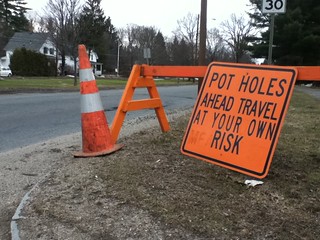
Spring in New EnglandFollowing in the footsteps of Massachusetts voters last fall, Michigan voters recently rejected a gas tax increase. This reaction from Gov. Rick Snyder (R-MI), who pushed the tax hike referendum, caught my eye:
"While voters didn't support this particular proposal, we know they want action taken to maintain and improve our roads and bridges," Snyder said.
We hear that from politicians and political commentators all the time, but is that really true? And what if it's not?

Raising the gas tax is a very good idea, yet it's also extremely unpopular. This is always interpreted as anti-tax fervor, or that there's something unique about the gas tax that voters don't want that raised but they'd be more tolerant of some other tax hike to fund roads, because voters are dumb, I guess?

As Gov. Snyder said, it's always taken on faith that voters want to spend more on roads and bridges, but don't want to have to pay for it. Most polling isn't helpful in that it just asks if voters want to raise the gas tax to fund transportation projects, but doesn't ask whether funding more transportation projects is itself a worthy goal.

Here's what some polling can tell us:
  • A 2014 YouGov/Huffington Post poll found fewer voters wanted to spend more (45%) on roads and bridges than wanted to spend the same (31%) or less (15%). That's not exactly a mandate for saying "we know they want action taken," is it?
  • A Smart Growth America poll back in 2007 found voters supportive of spending more on road repair, but strongly opposed to spending more on new roads. This is a key point because states spend most of their transportation money on building new roads.
  • poll ahead of the Michigan referendum showed the biggest chunk of voters didn't want their taxes raised and others didn't like the complex referendum proposal. But at least 1 in 5 voters didn't want to spend the money spent at all, calling it wasteful government spending. 
What would it look like if we stopped increasing spending on roads and bridges? In the short term, we'd build fewer brand new or expansion projects, and focus on repairing existing ones. If those polls are right, that's actually much more in line with public sentiment than our Big New Project status quo.
Would it be a traffic nightmare if we stopped expanding roads? Transportation researchers say no:
The Surface Transportation Policy Project and other researchers have found that for every increase in our highway network, half of the new capacity is taken up by "induced demand" -that is, traffic drawn to the road because it's there. Building new roads and adding more lanes draws people who otherwise would not have driven onto the roads. Combined with the delays created by construction and the time it takes to complete a major project, roadbuilding provides almost no relief from traffic delays. And it's incredibly expensive.
Maybe instead of spending more money on roads and bridges whether voters like it or not, politicians and pundits should try listening to them instead?

UPDATE 5/31/15: I joined the BradCast to discuss this topic, you can listen here.

Tuesday, February 5, 2013

On America's Congested Highways, Every Day is Free Cone Day

zakimGreat analogy from Matt Yglesias to explain why congested roads should be tolled:
Build a useful road and you'll find that space on the road at peak times is a valuable commodity. And yet it's also a commodity that's generally either available for free or else available for a price that's unrelated to the demand for space on the road. Naturally an underpriced valuable commodity leads to overconsumption. Traffic jams, in other words.

Every once in a while Ben & Jerry's holds a "Free Cone Day" that invariably leads to long lines. Roadways in dynamic metro areas are basically holding Free Cone Day five days a week. Charge people enough money to eliminate routine congestion and you'll find yourself with fewer traffic jams and an enormous pool of revenue that can be used to maintain your basic infrastructure and upgrade your bus service.
Watch Jonas Eliasson, Director of the Centre for Transport Studies at Sweden’s Royal Institute of Technology, explain how congestion pricing can improve traffic patterns - and drivers may not even realize they've been nudged out of their congested routine (if you can't watch the video, read about it here):

Tuesday, January 10, 2012

Why Do We Subsidize Roads But Expect Profits From Amtrak?

Amtrak's Capitol LimitedFederal, state & local governments spent nearly $193 billion on highways in 2008, recouping only about $30 billion of that in toll revenue. That means highways lost $160 billion, money we spent with no expectation of ever getting it back.

Yet when Congress spends a little over $1 billion on Amtrak, why do Republicans expect it to turn a profit?

If Amtrak is expected to turn a profit, shouldn't highways be expected to do so as well? Why should Amtrak be asked to compete on an uneven playing field? It's like asking Starbucks to turn a profit if Dunkin Donuts is handing out free coffee next door.