Showing posts with label DC. Show all posts

Tuesday, May 28, 2013

Sen. Jim Inhofe on Disaster Aid: Totally Not at All Racist

The Future of U.S. Ground ForcesDisaster aid went to victims of superstorm Sandy far away from the New Jersey landfall in places like Rhode Island. But Sen. Jim Inhofe (R-OK) had some very specific places in mind for his claim that Sandy aid was wasted or stolen:
They were getting things — for instance, that was supposed to be in New Jersey, they had things in the Virgin Islands, they were fixing roads there. They were putting roofs on houses in Washington, D.C. Everyone was getting in and exporting the tragedy that took place. That won't happen in Oklahoma.
Gee, I wonder what the Virgin Islands (76% black) and DC (the original Chocolate City) have in common?

I don't know what's more amazing: That Inhofe didn't even bother to toss one non-minority-heavy area onto his list, or that unless a Republican says BLACK BLACK BLACKITY BLACK no reporters will call him on being a racist.

All victims of natural disasters deserve our support. You can donate directly through the Red Cross.

Saturday, March 30, 2013

Is Man-Made Deer Overpopulation the Right Issue to Take a Stand for Animal Rights?

Deer III - Rock Creek ParkIf you were to design a system for ensuring an overpopulation of deer, it would look a lot like DC's Rock Creek Park - a huge expanse of temperate land with well-maintained vegetation, no predators, and no hunting allowed.

And it's worked perfectly! So now the National Park Service is having to pay hunters to harvest the deer for food:
Sixty to 70 deer are expected to be shot. After the carcasses are tested for disease, the venison will be donated to food pantries.

The Park Service says that what it euphemistically calls a deer “harvest” is needed to safeguard the health of the park, the herd, and the people who live nearby or use the park. With 70 deer per square acre, the park has about four times the density considered ideal.
Animal rights activists have called for the Park Service to use birth control, but that's proved expensive and ineffective. Meanwhile, the results of the man-made deer explosion have proved disastrous, with car-deer accidents and Lyme disease among the serious public health threats. When animal rights activists are comparing the deer cull to Newtown and using the hashtag #DontKillBambi, are they being dismissive of those threats to people?

The case for culling is even greater if you see Rock Creek Park for what it is - a man-made deer farm. Why not take advantage of it, especially considering how much deer meat food pantries stand to gain? I'd seen reports online that one deer can feed up to 200 people, which seemed high but is backed up by the math. One pound of deer meat makes up to six servings. The average deer provides 40 to 60 pounds of meat. By that math, assuming every culled deer is healthy, we're talking about meat for 10,000 meals provided free to food pantries.

Monday, March 4, 2013

DC Cherry Blossoms Continue Climate-Driven Early Bloom Trend

2012 03 17 - 5236 - Washington DC - Cherry BlossomsOnce again, DC's cherry blossoms are forecast to bloom much earlier than the 20th-century average - sometime between March 26-30, horticulturalists say.

And once again, the Washington Post story on the early blooms doesn't mention that the early blooms are part of trend at all, never mind a global warming-fueled that may eventually push the cherry blossoms into February.

All connections to climate change must be made in sidebar stories - readers of the main news story on the blossoms are to be kept blissfully ignorant of whether or why they're arriving earlier and earlier.

Sunday, October 23, 2011

Designs of DC's Downtown Public Parks Discourage Public from Using Parks

Matt Yglesias often makes the case that, in a city where building height limits put a huge premium on ground space, some of DC's parks could be put to better use as homes & businesses:
New York City doesn’t have this problem, but Washington, DC and some other American cities really do seem to me to be plagued with excessive useless parkland. If you had a park featuring a playground no kids were ever on, or a basketball court that was never in use, people would be asking “what went wrong here?” That’s not to say that every park should have a playground. But every park should be used for something. If there’s not going to be any regular programming on your patch of publicly owned land, it makes more sense to sell it and let people put up buildings. Do an unusually wide sidewalk to make room for some extra trees and benches if you need extra trees and benches.

That’s not to say we should pave all the parks. But we should be thinking of something to actually do with them. Cities are full of people, and most of the country doesn’t have Southern California weather. There’s limited practical demand for just sitting around outside.
It's a short post, but Matt conflates two distinct questions:
  • What are DC's downtown public parks set up to do?
  • What's the optimal set-up for a downtown public park?
DC's downtown parks, managed by the National Park service, seem to be set up with three goals in mind:
  1. Appeal to a tourist's impression of what a park in DC would look like (majestic statues! pigeons!)
  2. Minimize cost of park management
  3. Minimize the utility of the park to DC's homeless population
I worked across the street from DC's Franklin Park for a year and while it was nice to look out at the trees in the summer, I never went there for a coffee break or to eat lunch. It just wasn't designed for that.

Post Office SquareBy contrast, I visited Boston's new Post Office Square Park for an event this summer and was stunned at how well it met the needs of the park's neighbors:
As of 2009 the square is almost entirely occupied by a privately-owned and -managed but publicly-accessible park, Norman B. Leventhal Park, named for the Boston building manager and designer who designed it. It sits above a parking garage, named "The Garage at Post Office Square." The garage lies 80 ft (24 m) below the surface, the deepest point of excavation in the city. Revenues from parking fund the maintenance of the park. The 1.7-acre (6,900 m²) park is a popular lunchtime destination for area workers. It features a cafe, fountains, and a pergola around a central lawn, and the management provides seat cushions for visitors during the summer. Designed by landscape architects The Halvorson Company, the park is also home to "125 species of plants."
"There’s limited practical demand for just sitting around outside"? I couldn't even find a place to sit down to get on my laptop. Whereas DC's K Street corridor parks have trees plopped in the middle, leaving the open areas filled with muddy, uneven grass struggling to grow, Post Office Square's trees line the edges of an inviting field. Wide paths are lined by wooden benches shaded by vines, cooling them on hot summer days. And the cafe tables were stunning - an outdoor table to sit & eat your lunch? Is there a public park space with tables anywhere in DC? I can't think of one (if you can, please post in comments).

So while I agree with Matt that DC's park space is underutilized, I'd like to see them at least make an attempt to meet users' needs before giving up & selling them off. And if the cost of that is letting a developer put a building on half of Franklin Park or build a garage under McPherson Square, let's do it.


Monday, August 15, 2011

DC Oil Spill: Petroleum Product Spotted in Anacostia River

Reports WUSA9:
DC Fire's Hazardous Materials Unit is searching for the source of a petroleum-based product on the Anacostia River.

The product is said to stretch from the 11th Street Bridge to Benning Road.

DC Fire and EMS Spokesperson Pete Piringer said hazmat has not identified the product yet but he said it's a low level flammable, like oil.
UPDATE 8/16: The Coast Guard doesn't seem to be able to find much oil. They're going to keep an eye on things but there doesn't seem to be much threat to the river at this point.


Wednesday, July 6, 2011

DC To Fleece Car Sharers, Continue Heavily Subsidizing Car Owners

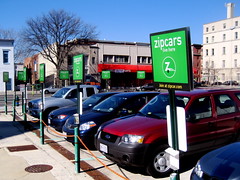
Zipcars Live HereAs Clayton Lane reports at TheCityFix.com, DC has decided to auction car sharing spaces in an effort to maximize revenue from car sharing companies. Which would be fine, if it was also auctioning the rest of the spaces. Imagine how much a street spot in Adams Morgan would go for?

But DC will continue to practically give away residential parking tags (first tag $15; second tag literally free), with the net result being a major subsidy  for more privately-owned cars clogging the streets of DC:
Carsharing should be treated as a public good, even more than the on-street parking that it occupies. Each shared vehicle replaces about 14 private cars, according to comprehensive national research by the University of California, Berkeley. Plus, after joining, members drive about 44 percent fewer miles, according to the average result of ten North American impact studies. Other research shows that carsharing members consume less gas, reduce their carbon emissions by nearly 1 ton per year, walk and bike more, and spend more dollars locally.

DDOT, rather than levy a 20 percent tax on carsharing members whose behavior benefits the neighborhood, should keep carsharing affordable and instead tax private car use – the main source of congestion and many environmental problems. DDOT could raise the same revenue with a painless $2 annual fee for all residential parking tags. Or it could simply charge $100 annually for each household’s second car. Or implement smart meters, which vary prices based on real-time demand, ensuring that around 15 percent of commercial on-street parking spaces remain available. In downtown Redwood City, Calif., smart meters generate $1 million of additional revenue each year for safer, cleaner sidewalks.

In fact, Donald Shoup, in his seminal book, “The High Cost of Free Parking,” estimates the market value of on-street spaces in central Los Angeles at $31,000 each – more valuable than the vehicles parked in them. Subsidizing car ownership with free parking distorts the market, encouraging more people to own and drive cars.
Matt Yglesias rightly calls this a car-sharing tax.

But let's be honest: This is about politics, not policy. Who do you think has more political clout in DC, people who car share or people who can afford multiple cars? Better to indirectly charge car sharers, who are more likely to be young & transient anyway, by gouging the upstart car sharing companies. No DC politician wants to tick off multiple car owners, who are much more likely to write campaign checks with whatever they haven't forked over to Lexus.

Wednesday, April 27, 2011

Why Does Arlington Fight New Highways?

Because Arlington (and DC, Fairfax, etc.) continues to get failing grades for air quality that can be linked directly to excessive pollution from cars, SUVs & trucks.

The American Lung Association gave DC and every Virginia suburb an F for ozone pollution. What effects can humans expect from ozone and other smog-inducing photochemical pollutants?
Ground-level ozone, sulfur dioxide, nitrogen dioxide and carbon monoxide are especially harmful for senior citizens, children, and people with heart and lung conditions such as emphysema, bronchitis, and asthma. It can inflame breathing passages, decrease the lungs' working capacity, cause shortness of breath, pain when inhaling deeply, wheezing, and coughing. It can cause eye and nose irritation and it dries out the protective membranes of the nose and throat and interferes with the body's ability to fight infection, increasing susceptibility to illness. Hospital admissions and respiratory deaths often increase during periods when ozone levels are high.
DC and Loudoun got Ds for particle pollution, while Arlington and Fairfax got Cs. And what does that mean for your health?
[Particulate] pollution is estimated to cause 22,000-52,000 deaths per year in the United States (from 2000) and 200,000 deaths per year in Europe. The effects of inhaling particulate matter that have been widely studied in humans and animals now include asthma, lung cancer, cardiovascular issues, and premature death.
Why does Arlington fight new highways and distant coal plants? To steal a line from Sen. Sheldon Whitehouse, in the contest between pollution and children's lungs, there's a case to be made that someone should be standing up for children's lungs.

Of course, debates about air quality will be nothing more than hot air if Republicans on Capitol Hill succeed in gutting the Clean Air Act. Democrats and several moderate Republicans in the Senate have already beaten back several attacks, but please make sure your members of Congress know you support strong clean air protections.

Wednesday, March 30, 2011

Photos of the 2011 DC Cherry Blossoms

It's cherry blossom time at the Tidal Basin. The Green Miles is skipping it this year because it's been freezing. And added bonus today: Rain mixed with sleet! Which as we all know makes me feel like this.

Fortunately for the cold-and-rain-phobic among us, my friend Sarah visited the blossoms and took some wicked awesome photos:

Thursday, February 3, 2011

DC Moves To Protect Pedestrians With New Cameras

Beatles Abbey Road capaDuring the first 6 months of 2010 (the most recent data period available), 8 pedestrians were killed by cars in DC & 41 pedestrians were run down in Virginia, both sharp increases. Recently, The Green Miles wondered if traffic cameras were possible to protect pedestrians.

Turns out it's not only possible - Lisa Sutter, the head of the MPD’s photo enforcement program, wants to bring crosswalk cameras to DC:
The D.C. police are hoping to install smaller, more mobile cameras in neighborhoods around town, catching drivers who fail to yield to pedestrians at crosswalks, block the box at intersections, or even fail to fully stop at stop signs, among other potential violations. The portable units would probably be battery- or solar-powered and affixed to small concrete pads set up around town, making them far more versatile than the permanent streetside cameras or cruiser cameras now in use. Their modest size would allow them to be used in areas where cameras couldn’t go before. [...]

The department would be continuously moving the cameras around to keep drivers guessing, and they’ll be accompanied by more signs telling drivers to obey the speed limit and stop for pedestrians. With the new technology, the units may be able to detect when a pedestrian has come to a crosswalk, then capture the plates of drivers who fail to yield. “I want to stigmatize [drivers] blowing past pedestrians,” Sutter said.
The new cameras could be on the streets this summer. Any chance we can get some over here in Northern Virginia?

I do have to wonder: Has Lisa Sutter considered the alternative of giant cats?

Wednesday, September 8, 2010

DC Sierra Club Endorses Gray for Mayor

Jim Dougherty, the DC Sierra Club's conservation chair & a member of the national Sierra Club's board of directors, explains the reasons for endorsing Vince Gray over Adrian Fenty at GreaterGreaterWashington.org, concluding:
If we want Washington to take its rightful place alongside Seattle and San Francisco as one of America's most progressive environmental cities, we need an executive that will work hand-in-hand with our now progressive legislature. Gray has the vision; Fenty doesn't.