Showing posts with label transportation. Show all posts

Monday, December 21, 2015

Opposing My Project Doesn't Make Yours Any More Likely

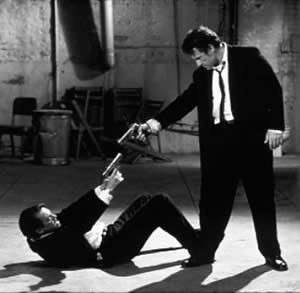
reservoir-dogs-standoffThe stupidest argument I hear on transit is this: "(Progressive idea A) isn't all that great - (progressive idea B) is what we should get behind!"

We should do both - in fact, we can only do both. Opposing A makes the success of B less likely, because losing drains political power.

If you lose on A, the money isn't any more likely to go to B - in fact, it's less likely to do so because you just lost, so GFY. It's a myth that project funding is zero-sum - budgets are made up by politicians, and if you have power there'll be more, and if you don't have power there'll always be less.

In contrast, winning on A makes B even more likely, because winning builds political power, and again, there's always exactly as much money as we're willing to fight for & have the power to deliver.

See:
What other examples did I miss?

Monday, November 2, 2015

Official Admits Iowa Needs to Go on a Road Diet

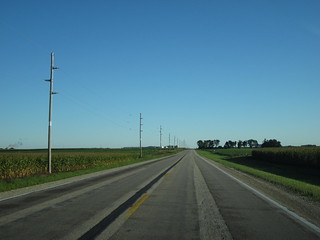
US Highway 218 - IowaThe first step to getting your highway budget back to a sane level is admitting you have a problem. As Charles Marohn reports at StrongTowns.org, Iowa Dept. of Transportation Director Paul Trombino recently did just that, pointing out Iowa can't afford to maintain all the roads & bridges it's built:
I said the numbers before. 114,000 lane miles, 25,000 bridges, 4,000 miles of rail. I said this a lot in my conversation when we were talking about fuel tax increases. It’s not affordable. Nobody’s going to pay.

We are. We’re the ones. Look in the mirror. We’re not going to pay to rebuild that entire system.

And my personal belief is that the entire system is unneeded. And so the reality is, the system is going to shrink.

There’s nothing I have to do. Bridges close themselves. Roads deteriorate and go away. That’s what happens.

And reality is, for us, let’s not let the system degrade and then we’re left with sorta whatever’s left. Let’s try to make a conscious choice – it’s not going to be perfect, I would agree it’s going to be complex and messy – but let’s figure out which ones we really want to keep.
As Congressional budget negotiators come up with increasingly bizarre tricks to try to pay for a transportation budget that's mostly spent on building new roads, the question remains: What if voters don't want to pay for it?

We should talking about building fewer new, unneeded highways and focusing our resources on maintaining what we have. We know urban roads can lose lanes, with Austin recently showing that many urban roads can be slimmed down while improving safety and cutting speeding.

What can we do about expensive and little-used rural highways? How many could lose a lane and no one would ever miss it?

Monday, May 18, 2015

Do Voters Really Want to Spend More on Roads?

Spring in New EnglandFollowing in the footsteps of Massachusetts voters last fall, Michigan voters recently rejected a gas tax increase. This reaction from Gov. Rick Snyder (R-MI), who pushed the tax hike referendum, caught my eye:
"While voters didn't support this particular proposal, we know they want action taken to maintain and improve our roads and bridges," Snyder said.
We hear that from politicians and political commentators all the time, but is that really true? And what if it's not?

Raising the gas tax is a very good idea, yet it's also extremely unpopular. This is always interpreted as anti-tax fervor, or that there's something unique about the gas tax that voters don't want that raised but they'd be more tolerant of some other tax hike to fund roads, because voters are dumb, I guess?

As Gov. Snyder said, it's always taken on faith that voters want to spend more on roads and bridges, but don't want to have to pay for it. Most polling isn't helpful in that it just asks if voters want to raise the gas tax to fund transportation projects, but doesn't ask whether funding more transportation projects is itself a worthy goal.

Here's what some polling can tell us:
  • A 2014 YouGov/Huffington Post poll found fewer voters wanted to spend more (45%) on roads and bridges than wanted to spend the same (31%) or less (15%). That's not exactly a mandate for saying "we know they want action taken," is it?
  • A Smart Growth America poll back in 2007 found voters supportive of spending more on road repair, but strongly opposed to spending more on new roads. This is a key point because states spend most of their transportation money on building new roads.
  • poll ahead of the Michigan referendum showed the biggest chunk of voters didn't want their taxes raised and others didn't like the complex referendum proposal. But at least 1 in 5 voters didn't want to spend the money spent at all, calling it wasteful government spending. 
What would it look like if we stopped increasing spending on roads and bridges? In the short term, we'd build fewer brand new or expansion projects, and focus on repairing existing ones. If those polls are right, that's actually much more in line with public sentiment than our Big New Project status quo.
Would it be a traffic nightmare if we stopped expanding roads? Transportation researchers say no:
The Surface Transportation Policy Project and other researchers have found that for every increase in our highway network, half of the new capacity is taken up by "induced demand" -that is, traffic drawn to the road because it's there. Building new roads and adding more lanes draws people who otherwise would not have driven onto the roads. Combined with the delays created by construction and the time it takes to complete a major project, roadbuilding provides almost no relief from traffic delays. And it's incredibly expensive.
Maybe instead of spending more money on roads and bridges whether voters like it or not, politicians and pundits should try listening to them instead?

UPDATE 5/31/15: I joined the BradCast to discuss this topic, you can listen here.

Friday, August 1, 2014

MA's Secret Plan to Make Regional Bus Commuting More Awesome

Given the "Plus" AND +, how do you say this
out loud? Bus Plus Plus?
I say "secret" because it seems like it's gotten virtually no news coverage - it's been ignored by the statewide standard-bearer Boston Globe and my local New Bedford Standard Times.

The Massachusetts Department of Transportation is making it much more fun, productive and comfy to ride longer-distance regional commuter buses with a program called BusPlus+:
The initial BusPlus+ regional bus purchase will provide thirty one of the new buses to carriers that currently or previously operated an IBCAP regional bus, including Peter Pan Bus Lines, Plymouth & Brockton Street Railway Company, DATTCO, The Coach Company, Bloom Bus Lines, and Yankee Line. In addition, MassDOT is proud to welcome Greyhound as its newest private sector partner.

Customers will experience a more comfortable and convenient service, with new buses that include the latest advances in safety and equipped with fully outfitted restrooms, increased leg room, new comfortable seating, Wi-Fi, and 110V power outlets at every seat.

Through the BusPlus+ program, MassDOT will also work toward the goal of providing a universal smart phone ticketing application to all riders.
I'd noticed the Dattco buses between New Bedford and Boston were newer, roomy enough to fully open my laptop, and with much more reliable WiFi, but had no idea why until I noticed the BusPlus+ sticker on the side of the bus as I was boarding the other day.

At first I wondered about giving taxpayer-purchased buses to private companies. But then again, no one expects public transit to turn a profit, so this may actually be the more fiscally conservative move - instead of taxpayers having to fund a whole new route, they get the benefit of increased service for a relatively small one-time cost.

In the long term, SouthCoast Rail is still the best solution, but until then, small steps to promote bus service make sense.

Friday, October 4, 2013

America Chooses to Make Bicycling Dangerous (Video)

A lot of the public discussion about bicycling gets caught up on a circular debate: Do we have little bike safety infrastructure because relatively few people bike, or do relatively few people bike because we have such unsafe bike safety infrastructure?

It's distracted us from a much more important question: Do the people in the giant metal polluting boxes need the extra safety measures, or do the people on the bicycles? As this video details, bicyclists are 30 times more likely to be injured while riding in the United States than in the Netherlands:

Monday, April 22, 2013

Because Driving Sucks, That's Why

Why Driving SucksMy answer to the question in the headline of this Brad Plumer post, which you should go read.

Driving is expensive, time-consuming, boring*, makes you road rage-y, pollutes the air, and cooks the planet. What's not to like?

Taking the bus or train is no picnic, but at least you can let the driver stress out while you relax. Biking is also not a magic carpet ride, but at least you get some exercise and fresh air and it's extremely cheap.

I would also point out that advances in phone technology have made taking the bus or train significantly more fun. It used to be that you'd have to lug a book or a Walkman with you if you wanted to read or listen to music - and if you forgot one of those, welcome to Boringville. Now I can not only do either of those things on my lightweight, long-battery-life iPhone, I can also play games, read news or text my friends, and it's already in my pocket so there's no remembering involved.

* - I like long drives through scenic areas as much as anyone, but we all know this is 0.0001% of driving. The other 99.9999% involves wishing you were already there.

Tuesday, February 5, 2013

On America's Congested Highways, Every Day is Free Cone Day

zakimGreat analogy from Matt Yglesias to explain why congested roads should be tolled:
Build a useful road and you'll find that space on the road at peak times is a valuable commodity. And yet it's also a commodity that's generally either available for free or else available for a price that's unrelated to the demand for space on the road. Naturally an underpriced valuable commodity leads to overconsumption. Traffic jams, in other words.

Every once in a while Ben & Jerry's holds a "Free Cone Day" that invariably leads to long lines. Roadways in dynamic metro areas are basically holding Free Cone Day five days a week. Charge people enough money to eliminate routine congestion and you'll find yourself with fewer traffic jams and an enormous pool of revenue that can be used to maintain your basic infrastructure and upgrade your bus service.
Watch Jonas Eliasson, Director of the Centre for Transport Studies at Sweden’s Royal Institute of Technology, explain how congestion pricing can improve traffic patterns - and drivers may not even realize they've been nudged out of their congested routine (if you can't watch the video, read about it here):

Tuesday, November 20, 2012

We Love Our Children Enough to Put Them on the Shittiest Buses Possible

Day 11 - Highway 180, CA - IMG_1257.jpgTwo blocks up the hill - that's how far a New Bedford school bus was, yet a cloud of diesel exhaust still hung on my street in its wake, leaving the air smelling like a tire fire as I went out to get the morning paper.

All across America each morning, parents who won't let their children out of the house unsupervised because it's "not safe" are happy to put them on some of the most polluting vehicles in America:
According to a study carried out in the Los Angeles area, the levels of diesel exhaust on a bus can be four times as high as those found in passenger cars driving just ahead of the bus. And the concentration of diesel fumes found inside the buses were more than eight times that of the average amount found in California’s outdoor air.
And this:
Children on diesel buses breathe in more soot than everyone else in the surrounding metropolitan area combined, and up to 70 percent more soot than the average commuter. … Kids not only face this increased risk from exposure; they are also more vulnerable to the impacts of air pollution. Research from the Harvard School of Public Health showed that young children’s lungs will get two and half times the dose of soot particles as an adult’s lungs.
Check out the above link from Get Energy Smart Now's Adam Siegel to learn much more about why investing in hybrid school buses would make our children healthier, save taxpayers money in the long run, and curb climate pollution. And make oil executives and Saudi oil barons angry! Good kids win, bad guys lose.

Monday, September 24, 2012

New Poll: Americans Feel Trapped in Their Cars

Lonely Americans would like to have more public transit options and don't know just how skewed our transportation spending is towards new roads, according to a new Natural Resources Defense Council poll:
  • 55 percent prefer to drive less, but 74 percent say they have no choice 
  • 63 percent (more than three in five Americans) would rather address traffic by improving public transportation (42 percent) or developing communities where people do not have to drive as much (21 percent) – as opposed to building new roads, an approach preferred by only one in five Americans (20 percent) 
  • Americans over-estimate what their state spends on public transportation, estimating that it is an average of 16 percent of their state’s transportation budget – and still they would like that amount nearly doubled, calling for their state to spend an average of 28 percent on public transportation (note: The average percentage of transportation money – state plus federal – spent on transit over the past three years was 6.55 percent per state) 
Opponents of smart growth like to claim America is sprawling and car-dependent because people have sat down, carefully considered the options, and decided to move to a place far from work & friends so they can waste tons of money and countless hours stuck in traffic. But there are two realities here: People don't have all day to crunch the numbers on this stuff; and the amount of transit and by extension the amount of housing near transit is limited (and in some cases it's deliberately limited). So people often just figure out where they'd LIKE to live, then keep looking further and further away from that spot until they can find someplace that's affordable.

This poll suggests many Americans would like to live somewhere that's affordable AND has transit options, and they don't realize just how much of their tax money is going instead to subsidize The Next Phenomenally Expensive Paving Project That Will Surely Solve All Our Transportation Problems.

Wednesday, June 6, 2012

You Can't Get There from Here

Peter Pan bus station, ProvidenceThe Green Miles is on an Amtrak train on the way to Providence for this week's Netroots Nation. I'd been hoping to be able to visit my girlfriend in nearby New Bedford AND go without a car, but limited bus service makes that costly and inconvenient.

Downtown Providence, RI (population: 178,042) and New Bedford, MA (population: 95,072) are 33 miles apart, a 38 minute drive according to Google Maps. But if you don't have a car or want to drive, the only way to get between the two is a Peter Pan bus that only runs every two hours, takes 80 minutes, and costs $33 round-trip. (By comparison, a Megabus round-trip ticket from Providence to New York City costs $28.)

It's a combination of terrible planning, massive public under-investment in regional transportation, and inconvenient state borders. The main Providence bus station is located three miles north of downtown, so you have to take a bus from downtown to the main bus station, then on to New Bedford. SRTA, which serves New Bedford and Fall River, has an annual budget of only $14 million, barely enough to provide minimal intra-city service despite large rider protestsRIPTA only serves Rhode Island and even Massachusetts' next-generation commuter rail plan acts like Rhode Island doesn't exist.

But with a huge swath of Americans 16-34 driving much less and taking transit much more, you have to wonder how long the lonely driver transportation model can hold.

If you're wondering about the title, read this classic Saturday Night Live skit. (Yes, read it. SNL's video archiving sucks worse than NBC's ratings.)

Saturday, May 12, 2012

Did Washington Post Downplay Poll's Support for Silver Line?

UntitledPolls show DC area residents support train, bus, biking and pedestrian projects much more than they support building new or wider highways. However, the Washington Post editorial board strongly supports new highways and spun a poll this week to mean that our fellow Virginians don't support the Silver Line. As Slate's Matt Yglesias points out, the numbers don't necessarily back up that spin:
But the really weird thing is that it's by no means clear that this is what the poll has found. What it says is that 32 percent of the population says the Silver Line project is "not at all important" while 32 percent deems it either "extremely" or "very" important and a further 32 percent says it's "somewhat" important. The "not important to most Virginians" interpretation is supported by lumping the "somewhat" and "not at all" categories together as "negative" responses. But the straightforward reading of the poll is that the median Virginian thinks the Silver Line project is somewhat important. And it is somewhat important! So why not just say that?
In the face of Republican political games, The New Republic's Alec MacGillis says strong support of the Silver Line can be a winner for Tim Kaine in his U.S. Senate race against George Allen.

Monday, April 30, 2012

Virginia Moving Forward with Rail - Will Virginia Beach?

Amtrak in StauntonDespite a Congress that's more interested in pandering to the austerity crowd than actually solving America's problems, Virginia is moving to create jobs & boost our economy with several new rail projects:
The Virginia Department of Rail and Public Transportation is forging ahead on several state rail improvement and expansion projects using mostly state funding, concerned that even promised federal funds won’t materialize in time.

[Department of Rail and Public Transportation Director Thelma] Drake said that her department was hard at work on an Amtrak extension that would connect Richmond to Norfolk (some 111 miles apart, see diagram at top). The project’s cost recently swelled by about $13 million to a total $114.6 million, due to added safety and infrastructure costs, all paid for in state transportation funding. The state believes the service, which will cost $33 for a one-way ticket between Norfolk and Washington, will pay for itself.
Depending on your mileage, it costs about $30 just for gas to drive from Norfolk to DC, so $33 for a one-way ticket would be a huge bargain. (And yes, note the time for posterity - I just said something nice about Bob McDonnell & Thelma Drake. Given how much the McDonnell administration is bungling Metro's Silver Line, don't get used to it.)

Meanwhile, the Virginian-Pilot editorializes in favor of a fresh look at light rail in Virginia Beach:
People in Virginia Beach have been talking about light rail since the 1970s. In 1999, the last time they were asked whether to bring it to the city, about 42,000 voters said no. But that didn't stop the discussions, arguments, affirmations - or the second-guessing - for a dozen years.

In November, the issue is back on the ballot. The City Council wants to take the pulse of the citizens, hundreds of thousands of them this time, on whether to pursue an extension of Norfolk's light-rail line, The Tide, to the Beach. [...]

If voters approve of extending The Tide, it'll be years before trains are rolling to Town Center. If they reject light rail, city leaders must come up with other solutions to traffic problems that are only getting worse.

Virginia Beach failed to research light rail thoroughly before its voters rejected the idea 13 years ago. The city has a chance to do it right this time.
Done right, light rail can spur development, save commuters money, reduce the need for expensive parking, cut traffic and slash air pollution. What's not to like?

Tuesday, February 7, 2012

Why an Outer Beltway is a Bad Idea, Visualized

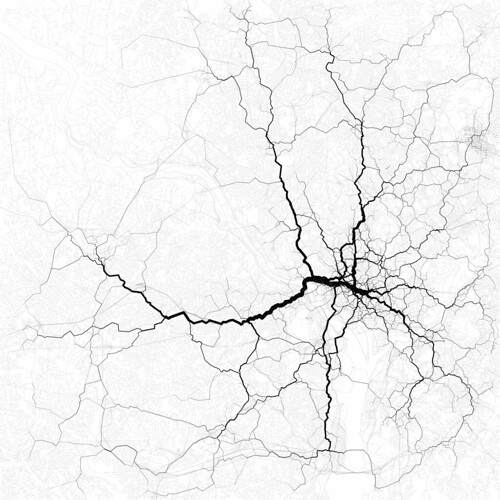
Eric Fischer created this map of Washington, DC using Twitter data from August 2011:
Routing 30,000 randomly-chosen trips through the paths suggested by 10,000 randomly-chosen geotags. These are perhaps the most interesting routes between the endpoints of the trips, even if not necessarily the most likely.
Note that the routes go in & out of the city center, not around it. Makes you wonder who Gov. Bob McDonnell is really working for when he pushes terrible, incredibly expensive ideas like the Outer Beltway.
Paths through Washington, DC
Check out more of Eric's work on Flickr.

Tuesday, January 10, 2012

Why Do We Subsidize Roads But Expect Profits From Amtrak?

Amtrak's Capitol LimitedFederal, state & local governments spent nearly $193 billion on highways in 2008, recouping only about $30 billion of that in toll revenue. That means highways lost $160 billion, money we spent with no expectation of ever getting it back.

Yet when Congress spends a little over $1 billion on Amtrak, why do Republicans expect it to turn a profit?

If Amtrak is expected to turn a profit, shouldn't highways be expected to do so as well? Why should Amtrak be asked to compete on an uneven playing field? It's like asking Starbucks to turn a profit if Dunkin Donuts is handing out free coffee next door.

Thursday, November 17, 2011

Bob McDonnell's Transportation Plans Serve Developers, Not Commuters

US 460 in Rural Dinwiddie County 2The Coalition for Smarter Growth warns Gov. Bob McDonnell's transportation plans will only add more cars from sprawling new developments to Virginia's existing traffic problems:
The state is borrowing $3 billion in state and federal funds on top of their normal annual spending for transportation, and we'll be paying this back for years. We should be setting smart priorities, but instead, VDOT is:
  • Reviving the controversial Outer Beltway through historic landscapes at Manassas Battlefield -- the first ten miles of which could cost $250 million to $475 million -- instead of focusing on fixing existing commuter routes in Northern Virginia.
  • Shifting $200 million in statewide money to a bypass in Charlottesville that won't fix major local traffic problems.
  • Giving $750 million of our tax dollars to subsidize a private toll road (Route 460) through empty farmland southeast of Richmond.
Meanwhile, when asked to help fund critical Tysons Corner transportation needs, the Examiner reports that "Virginia's Transportation Secretary Sean Connaughton warned Fairfax to look elsewhere for cash."
It's not surprising Bob McDonnell's pandering to developers - he's gotten more than $5 million in campaign cash from developers, real estate & construction, by a wide margin his biggest source of private sector contributions. The Coalition for Smarter Growth has a 10-step transportation agenda for Northern Virginia - really radical stuff, like "Bring our local elected officials back to the table in transportation decision making."

Tell Gov. McDonnell to put our transportation dollars towards real solutions.

Monday, August 1, 2011

The Washington Post's Selective Transit Austerity

$140 million for the Columbia Pike streetcar that would give people a cheap, less-polluting way to get to work and draw people to a sorely under-utilized area? A waste of money! Spend it on something else instead! Anything! Like, uh, how about education? Clearly, if you support the Columbia Pike streetcar, you must hate kids!

$110 million to upgrade just one road interchange for drivers (Route 29 & Gallows Road in Merrifield), while leaving it insufficient for pedestrians and bike commuters? Still waiting to hear from the Washington Post editorial board on how that could be better spent on schools. Should be any day now.

My point is not that Columbia Pike streetcar is more worthy of funds than the Route 29 interchange. My point is that maybe at a time of crazy low interest rates when a lot of people need work, we should be doing every project we can. By the time we need to start paying it back, the economy will have recovered - and if it hasn't, we're screwed anyway.

And if you have to resort to "but what if we spent it on free health care for puppies instead?" to make your argument, maybe you should re-think your case.

Wednesday, July 27, 2011

Drivers Oppose The Best Policy To Speed Their Commutes

DC, Friday afternoonStudies have shown that while people like to complain about traffic, most long-haul commuters don't do anything to change their drives. Today's Washington Post article is misleadingly headlined
Traffic science struggles to keep cars flowing on highways in D.C. and elsewhere - we know exactly how to keep traffic flowing, but drivers would rather pay less to sit in gridlock:
First, we don’t hate spending time in our cars as much as we pretend to. How do I know? “Because building more roads doesn’t improve traffic flow,” says Chris Barrett, a Virginia Tech professor who constructs traffic modeling systems and was involved in the Los Alamos effort. “If you decrease the amount of time it takes to travel a certain distance to work, people just move farther away from their offices [for larger yards and cheaper housing, instead of staying put to reduce their commutes]. It changes behavior in a negative way.”

Moreover, people have strongly resisted the best congestion-fighting tool that can be immediately implemented. Every traffic expert I spoke with pointed out the runaway success of London’s congestion pricing system. Drivers who want to enter the heart of the city during busy times have to pay 10 pounds — about $16. The system has made a huge difference in reducing congestion, and the city is using the extra revenue to renovate the subway and add buses.

New York Mayor Michael Bloomberg tried to adopt a similar strategy in 2007, but the state government killed it. A congestion tax has never gotten anywhere in the D.C. area, which one recent survey found was first in the nation as measured by hours wasted stuck in traffic.
That's not a failure of science. That's a failure of political will.

So instead of gridlock-busting congestion pricing that could be used to fix Metro, we get Gov. Bob McDonnell (R-VA) trying to make it look like he's doing something by pushing terrible ideas like the Outer Beltway and Charlottesville Bypass that will cost taxpayers enormous sums of money without easing traffic.

Wednesday, June 15, 2011

What's Next for Metro in Virginia?

Vanishing PointFrom the Washington Examiner's Kytja Weir:
Metro officials are eyeing a Brown Line to join the system's existing palette.

The transit agency is planning for the future, looking at creating a train line that dips from Friendship Heights into the District and back up to Silver Spring and past White Oak. It's also studying a line along the Capital Beltway loop, diverting the Blue Line from its current route across downtown to create a midcity rail line, or running an offshoot from the Green Line to National Harbor.

None of the plans is funded or even firm. Engineering hasn't been done and land hasn't been set aside. But the transit agency is studying what it will need by 2040 to accommodate growth in the region and relieve pressure on the system.

Officials plan to discuss some possibilities with regional leaders Wednesday, then hold workshops in July to hear riders' thoughts. By next spring, Metro hopes to have a final plan identifying which projects it will consider developing.
In general, I'd support lines that get people into & out of DC's center (serving both transportation needs and security purposes) over loop lines. In particular, a new midcity Blue Line could fill in major Metro gaps in places like Georgetown & Thomas Circle.

So what would you like to see after the Silver Line is completed? Maybe a Gold Line down Route 7 as GreaterGreaterWashington.org's Steve Offutt has suggested? There's also the long-discussed Columbia Pike streetcar project.

Friday, June 10, 2011

Annals of Terrible Ideas: An Outer Beltway

DC, Friday afternoonThere's been revived talk lately of building an Outer Beltway, a large highway with a radius about twice that of the existing Beltway. There are plenty of reasons it would be a terrible idea, starting with how ludicrously expensive it would be. If adding HOT Lanes to the Beltway cost $2 billion, how much would a whole new Outer Beltway cost?

But as David Alpert writes at GreaterGreaterWashington.org, the main reason an Outer Beltway would be a boondoggle is that it simply wouldn't ease regional traffic congestion:
The mobility problems outside the beltway are primarily about getting to and from the core, plus the local trips tied up by inadequate local street connections. Yes, traffic is bad for many people, and that's something planners need to address instead of dismissing.

However, more beltways will only accommodate a small fraction of the trips involved. Most people will still drive toward or away from the job centers at or inside the beltway, in DC, Bethesda, Silver Spring, Tysons Corner, Arlington, and Alexandria. An Outer Beltway or three doesn't help with that at all.
That "or three" is no joke - road advocates NVTA envision no fewer than six Beltways (PDF).

Wednesday, June 1, 2011

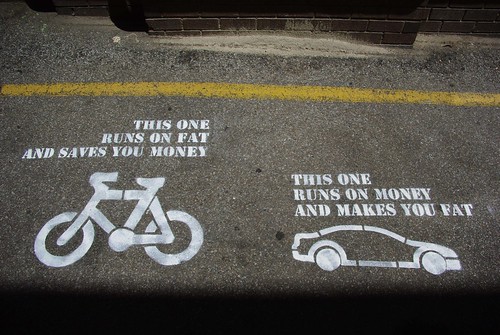
Better To Run Your Commute With Your Paycheck or With Your Biofuel?

What's worse than sitting all day at the office? How about sitting the whole time on your way to and from the office?

From Australian artist Peter Drew:

'This one runs on fat & saves you money' by Peter Drew of Adelaide

Via Andrew Sullivan