Showing posts with label birdwatching. Show all posts

Saturday, February 22, 2014

Snowy Owl at West Island in Fairhaven, MA (Video)

On my third try, I finally got to see one of the snowy owls spending the winter in southeastern New England.

Speculation is that more owls than usual are showing up in the U.S. this winter after an Arctic lemming population boom meant more snowy owl juveniles than usual survived and thrived enough to make the migration.

A snowstorm turned me away from Allens Pond Wildlife Sanctuary in Westport last weekend, and I went home empty-camera'd after a cold, windy Presidents Day walk on Fairhaven's West Island.

But on Saturday I got to West Island just after sunrise and finally saw this snowy owl. Raptors are great for bird watching because when not nesting they're fairly indifferent to people - I was able to walk right up to the tree where the owl was perched (good luck walking up to a jittery songbird). It did seem mildly annoyed when I made noise, kind of like, "Do you mind? I'm hunting here."


One more photo from when I first arrived at West Island. As I walked up from the beach and looked across the salt marsh, I spotted this coyote in the distance running towards the woods. It must've seen, heard, or smelled me well before I saw it, and by the time I got my camera out he was a quarter of a mile away. But it stopped every 100 yards or so and shot a look back at me like "thanks for ruining my morning, jerk":

Tuesday, February 5, 2013

Hawks Are Backyard Badasses And Here's Video Proof

I was putting out the recycling yesterday when I heard a flapping from the neighbor's backyard. By the time I'd grabbed my camera, it was already over - a young Cooper's hawk had nabbed a pigeon and was settling down for a leisurely lunch.

If common hawks like Cooper's, red-tailed and sharp-shinned aren't among your favorite wildlife, they should be. You can spot them just about everywhere, watching rural fields from dead trees, watching the highway median from a lamp-post (my girlfriend never gets tired of me pointing them out), watching for A-Rods at Fenway, or watching you from your office.

In urban areas like New Bedford, hawks are downright essential. Pigeons aren't much better than rats with wings and can overrun downtown areas, spreading disease with their droppings (note that the problem is worsening with warming winters - thanks, climate change!). Sure, bald eagles may look majestic fishing out in placid ponds, but are they willing to confront an URBAN SCOURGE like an avian Charles Bronson? I think not.

And not only are hawks tough, males are devoted husbands and hard-working dads:
Red-tailed hawks are monogamous and may mate for life. They make stick nests high above the ground, in which the female lays one to five eggs each year. Both sexes incubate the eggs for four to five weeks, and feed the young from the time they hatch until they leave the nest about six weeks later.
So sensitive & caring! Now watch one eat a pigeon:


Update: Birding blogger Dendroica pointed out on Twitter that this wasn't a red-tailed hawk as I originally assumed, but a Cooper's hawk. The juvenile Cooper's coloring is similar to a red-tailed, but I should've known better from its small size. The Green Miles will try to do better next time!

Friday, August 19, 2011

Is "Here's a Picture of a Cute Chipmunk" an OK Blog Post Title?

This chipmunk was like a little vacuum cleaner, scrambling across my patio and barely slowing down to pick up sunflower seeds as it went:

I've seen tons of bunnies around East Falls Church, but hadn't seen one on my patio until this weekend. Or more accurately, saw my cat seeing the rabbit:

My friend Brian was over recently & noticed Wilma watching a chipmunk, a squirrel & a few birds on the patio. "I wonder what Wilma would do if she could get out?" he asked. Having previously observed this vicious predator in action, I said, "Let's find out!" and opened the door. Wilma lunged out onto the patio and ... watched the chipmunk & squirrel run away, watched the birds fly away, and moseyed over to the grass and started munching. Cats may be America's top threat to birds, but mine is apparently a pacifist.

So here's the updated list of species I've spotted in just the 7 months since I put a bird-feeder on my patio:

I hadn't realized that as much as I complain about invasive European sparrows & starlings, American squirrels have been introduced to & invaded other parts of the world.

Monday, May 30, 2011

Quick Train Tip for Wildlife Watchers

After a weekend in Massachusetts visiting family, The Green Miles is riding the Amtrak Northeast Corridor Regional train from Providence to DC today. It's about twice as long as flying and just as expensive, but I like the relaxing ride, the ability to get up & walk around, and the view of the shore as the train hugs the Atlantic coast.

I decided to try riding the cafe car this trip. Not only has it given me extra room to spread out my laptop & assorted gadgets, but it gives a much more wide-open view of the shoreline & wetlands to the east. Just this trip, I've spotted:


And of course the usual assortment of crows, Canada geese, sea gulls, etc.

Sunday, April 10, 2011

Why Do Bird Types Show Up at My Feeders in Twos?

Interesting that I haven't been getting new species at my bird feeder one at a time - they've shown up in twos.

The tufted titmouse & Carolina chickadee made sense - similar habitats, similar feeding strategy, safety in numbers (especially given the toughs that hang out around here).

But this week two very different birds showed up on the same day. A White-breasted Nuthatch flew up to the suet feeder:

Then a Dark-eyed Junco came hopping along looking for stray seeds from from my sunflower seed feeder:

While I've seen rabbits, hawks, and even a bald eagle in this area, I hear I haven't met some of the most interesting neighbors. A National Wildlife Federation coworker who lives in Arlington's Madison Manor tells me he regularly sees foxes ... and on trash night, has heard a coyote yipping in the darkness.

Read all my backyard birding posts under my birdwatching tag.

Monday, March 14, 2011

Rainbow Six: Bird Feeder Edition

One of the biggest myths of wildlife-watching is that you have to be at a zoo, a state or national park, or a wildlife refuge to see anything.

But here in East Falls Church, my simple bird-feeder stocked black oil sunflower seed continues to attract a wide range of birds. In fact, a bird showed up last week that I don't think I've ever seen before. When I first saw it, my brain thought "blue jay lite" - blue back, white chest, crested head - but it was way too small and not nearly as shrill. My National Wildlife Federation Field Guide to Birds told me it was a tufted titmouse. (Yes, I keep a bird guide under the window. If the interns at work are going to call me a dorky old man, why not own it?)

Tufted titmouse in Falls ChurchThe titmouse crept up on the feeder in a precision assault, picking off one seed at a time, always in the same fashion - from a tree across the parking lot, to my fence post, to the feeder, to the balcony upstairs to eat - pausing for only a moment at each stop to reassess the situation.

Another first-time visitor showed up the same day: A Carolina chickadee. The bird guide indicated that likely wasn't a coincidence, as the titmouse is known to hang out with other birds, maybe for protection in numbers.

So far, the species I've spotted in just the few months since I started putting out birdseed:
And of course, plenty of squirrels. The National Wildlife Federation can teach you more about making your own yard (or even a porch, patio or balcony) a friendlier place for wildlife. I wouldn't be disappointed if all you get is sparrows the first few weeks, especially if you're right in the city. But spotting even one cardinal or blue jay in the morning can make the commute to work seem a little less dreary.

UPDATE 3/15/2011: The original post referred to the second bird as a black-capped chickadee. However, I told the story to my NWF colleague Doug Inkley, who says it was much more likely a Carolina chickadee. Doug says the two birds look nearly identical, but in this region the black-capped hangs out at higher elevations (like the Appalachian Mountains) while the Carolina is at lower elevations (like Falls Church).

Friday, December 17, 2010

And Now Your Moment of Wren

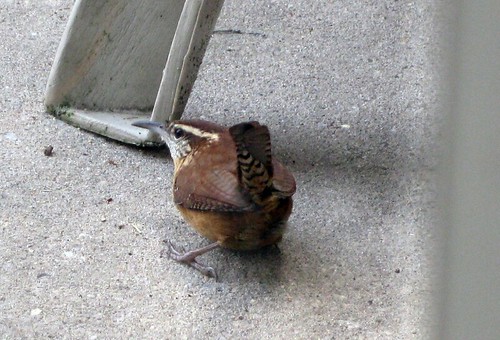
As soon as the weather got really cold, a bird that seems to be a Carolina wren started showing up on my back patio. I'm not exactly an expert on backyard birding, but clearly the birdseed I was throwing out wasn't cutting it. The wren just stomped around angrily:

Carolina Wren in Falls Church, VA

I mean, if it's possible for a bird to look mad ... that wren is pissed.

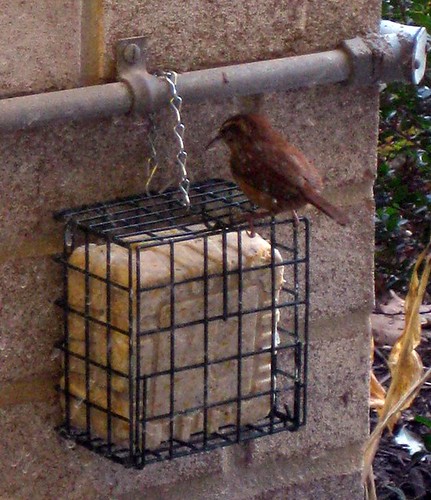
So I did some Googling, found out what wrens like to eat, ordered some truly gross suet studded with insects & hung it above the patio. Sure enough, the very first morning the new feeder was up, the wren found it:

Carolina Wren in Falls Church, VA

Wednesday, December 8, 2010

Bald Eagle Sighting in Arlington

OK, so this beats the brown creeper sighting. Today at noon, I was waiting at a red light at Wilson Boulevard & John Marshall Drive in Arlington near the Falls Church line. I spotted a bald eagle gliding high above the Madison Manor neighborhood:

That black dot between the power lines is the eagle. Apparently my own personal Murphy's law of bird-watching is that anytime I see a bald eagle, I don't have a high quality camera with me. I once saw a bald eagle swoop down over the Potomac & catch a huge fish with its talons - no camera with me.

Tuesday, October 19, 2010

America's #1 Bird Killer Nearly Strikes on My Patio

No, not my cat -- my windows.

I was working at my computer last weekend when I heard a barely-audible thump on the glass, so quiet that the noise itself didn't prompt me to get up to investigate. It was my cat's interest that got me to come look at the tiny bird that had bounced off my patio door.

Brown Creeper -- Vicki's Backyard, Woodstock, GeorgiaThe bird was sitting up with its wings splayed, blinking fast & looking dazed. I checked my National Wildlife Federation Field Guide to Birds & identified it as a brown creeper, a common bird usually seen hopping up & down trees snacking on bugs.

Since it seemed more stunned than seriously injured, I closed the shades so my cat wouldn't stress it out & gave it some time to recover. (In general, it's best to only touch wildlife as a last resort -- an untrained person handling birds & animals can make the situation even worse.) Sure enough, a few minutes later when I went to lock my patio door, it heard the rattle & immediately flew off.

Windows are the single biggest killer of birds in America. Birds simply don't see them. Unfortunately it doesn't seem to matter if you put a sticker or two on the window -- unless it has a covering at least every two inches, it won't be 100% effective. Hence, solutions for bird-proofing windows aren't very attractive.

What can you do? The Fish & Wildlife Service has a good tip sheet (PDF):
  • Use window feeders or place bird baths & feeders either very close to a window (less than 3 feet) or far away (more than 30 feet)
  • Close your blinds & turn off unused lights at night
  • Support programs like Audobon's Lights Out designed to reduce bird impacts
Ironically, just a few days ago I'd been walking through my parking lot thinking, "There are tons of house sparrows here, but with huge tulip poplars all around me, why am I not seeing more interesting birds?" Little did I know a new-to-me species was about to try to fly into my living room.

Friday, July 24, 2009

Video: Handling Hawks in an Urban Habitat

Remember when I nearly left my finger in an owl's belly at Nats Park? I was at work yesterday at the National Wildlife Federation and happened to see this video profile NWF just produced featuring the owl handler, Rodney Stotts of the Earth Conservation Corps:

Sunday, February 1, 2009

Video: Tired of Squirrels Invading Your Birdfeeder?

I don't know what's more awful/hilarious, the squirrel's-eye-view camera or the dizzy squirrel at the end ...

Tuesday, May 22, 2007

My Birdseed Brings All the Birds to the Yard

Paying an extra buck for a bag of good birdseed goes a long way. The cheap stuff at Harris Teeter really only draws sparrows and squirrels -- not exactly rare sightings.

But if I put out sunflower seed consistently (every day for a week or two) in my backyard in Ballston, I start seeing cardinals, blue jays, finches, and today, even a red-bellied woodpecker. We weren't 100% positive on the ID since it only hung around for a minute, but it was an impressive sight.

The Green Girlfriend picked this photo off the net as most resembling the woodpecker that flew off faster than I could find my camera.