
Studies have shown that while people like to complain about traffic, most long-haul commuters don't do anything to change their drives. Today's
Washington Post article is misleadingly headlined
Traffic science struggles to keep cars flowing on highways in D.C. and elsewhere - we know
exactly how to keep traffic flowing, but drivers would rather pay less to sit in gridlock:
First, we don’t hate spending time in our cars as much as we pretend to. How do I know? “Because building more roads doesn’t improve traffic flow,” says Chris Barrett, a Virginia Tech professor who constructs traffic modeling systems and was involved in the Los Alamos effort. “If you decrease the amount of time it takes to travel a certain distance to work, people just move farther away from their offices [for larger yards and cheaper housing, instead of staying put to reduce their commutes]. It changes behavior in a negative way.”
Moreover, people have strongly resisted the best congestion-fighting tool that can be immediately implemented. Every traffic expert I spoke with pointed out the runaway success of London’s congestion pricing system. Drivers who want to enter the heart of the city during busy times have to pay 10 pounds — about $16. The system has made a huge difference in reducing congestion, and the city is using the extra revenue to renovate the subway and add buses.
New York Mayor Michael Bloomberg tried to adopt a similar strategy in 2007, but the state government killed it. A congestion tax has never gotten anywhere in the D.C. area, which one recent survey found was first in the nation as measured by hours wasted stuck in traffic.
That's not a failure of
science. That's a failure of
political will.
So instead of gridlock-busting congestion pricing that could be used to fix Metro, we get Gov. Bob McDonnell (R-VA) trying to make it look like he's doing something by pushing terrible ideas like the
Outer Beltway and
Charlottesville Bypass that will cost taxpayers enormous sums of money without easing traffic.

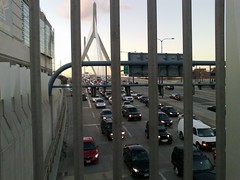 Great analogy from Matt Yglesias to explain why congested roads should be tolled:
