Showing posts with label energy. Show all posts

Tuesday, August 25, 2015

Nothing Natural About Fracked Gas

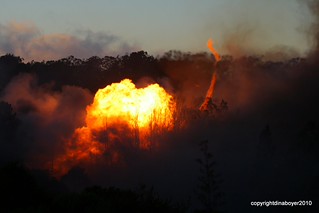
Another Fireball shot from the San Bruno Fire.We don't call it "natural oil" or "natural coal." So why do we refer to methane gas - especially the gas that's been fracked - as "natural"?
Fracking is the process of drilling down into the earth before a high-pressure water mixture is directed at the rock to release the gas inside. Water, sand and chemicals are injected into the rock at high pressure which allows the gas to flow out to the head of the well. [...]

The extensive use of fracking in the US, where it has revolutionised the energy industry, has prompted environmental concerns.

The first is that fracking uses huge amounts of water that must be transported to the fracking site, at significant environmental cost. The second is the worry that potentially carcinogenic chemicals used may escape and contaminate groundwater around the fracking site.
If all that isn't enough, fracked gas also destabilizes our climate and causes earthquakes. Fracking now produces half of the oil and a majority of the gas produced in the United States.

This isn't a semantic debate - it has a real impact in moving public opinion. Ask voters if they want more natural gas and most say yes. Ask if they support fracking and a plurality oppose it.

If you're trying to convince voters to oppose fracked gas pipelines or power plants, call it fracked gas. It's accurate, it communicates the damage caused by fossil fuels, and it's politically effective.

Wednesday, April 8, 2015

Everyone Hates Coal. Pandering To It Is Stupid Politics.

Political reporters paint investments in clean energy as a pander to a narrow segment of the Democratic base, while pledges to continue investment in coal are framed as smart plays to shoring up the moderate middle. And of course you have to support corn ethanol or you'll lose the entire center of the country!

But take a look at this new poll of homeowners by Zogby Analytics for Clean Edge and Solar City:

It's solar and wind that are broadly popular, while coal and biofuels have only fringe support - and keep in mind this question allowed people to name their top three.

Meanwhile, for all the talk of the popularity of fracked gas, it finished a distant third to clean energy.

Wednesday, July 2, 2014

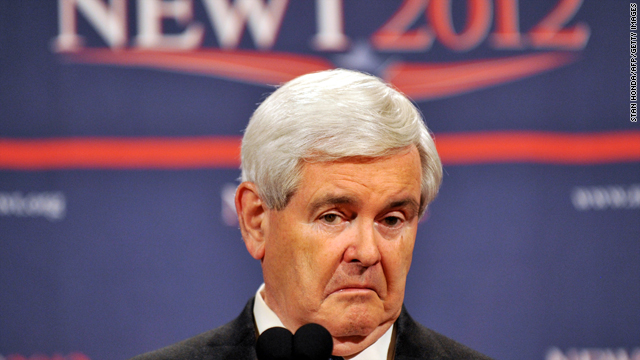
The "Drill Here, Drill Now, Pay Less" Con: Newt Won, America Lost

Back in the summer of 2008, incurable Republican presidential candidate Newt Gingrich pushed the slogan "drill here, drill now, pay less," claiming that making the U.S. more oil-independent would be a solution to high gas prices. Democrats, worried voters would reject the reality there's nothing we can do to lower market-set gas prices and absolutely terrified of saying no to Big Oil, embraced the slogan. Later, President Barack Obama implemented it as our national policy. Six years later, how's drill baby drill working out for you?

Today, while U.S. oil production is near all-time highs, gas prices also remain near all-time highs. Drill baby drill has been great for multinational oil companies, but terrible for American consumers. Meanwhile, we continue shoveling billions in annual taxpayer subsidies to those same oil companies.

A side effect of higher oil production is that oil transportation disasters are also at record highs. Oil train wrecks and spills, gas pipeline explosions, and oil pipeline ruptures are skyrocketing. Our communities, wildlife and clean air and water are now at the mercy of our national petro-state.

Note that gas prices hit their all-time high of $4.46 in July 2008 under President George W. "Texas Oilman Who'll Lasso Those Saudi Arabians Into Submission" Bush, well above the prior peak of $3.70 under President Ronald "Yes Another Oil-Friendly Republican Are You Seeing The Pattern Yet" Reagan.

Aside from Big Oil's record profits, there was one other winner from Newt's drilling push. Gingrich got 1.5 million people to sign his petition, allowing him to cash in by spamming his big new email list. As Chris Hayes has said, "much of movement conservatism is a con and the base are the marks."

Wednesday, March 5, 2014

Why We Should Give Ukraine Free Wind Turbines (and Why We Won't)

Wind turbine, MA Military Reservation, Cape Cod
Russia holds much of its sway over Ukraine and other nations in Eastern Europe because it's a major supplier of natural gas for electricity and home heating.

We're spending $682 billion on fighter jets, bombs, and tanks that are virtually worthless in this situation and $75 billion more on spying that as The Rachel Maddow Show reports failed to warn us this crisis was coming.

What if instead we spent just $500 billion on that stuff that's not helping us and spent the other $250 billion on hiring Americans to build wind turbines, then giving them to Ukraine and other vulnerable nations in the region below cost or free? What if, instead of sending troops, we sent workers to install them? Ukraine already has a burgeoning wind energy industry and has the potential to get 100% of its electricity from wind, solar and biomass energy.

Our current enemy's muscle is reduced, our current allies' power grows. And unlike military aid, if those roles ever flip, Ukraine can't use those wind turbines to kill us.

I know it would never actually happen, because clean energy is silly and threatening to start World War III is serious. But it would be nice if Washington could look at the situation a little more strategically than Hacksaw Jim Duggan vs. The Iron Sheik. Do we punch 'em or hit 'em with the 2x4???

But just like Duggan and the Sheik would go to war in front of the fans then go off and get wasted together after the show, the US and Russia are motivated by the same polluting, climate-disrupting energy interests: Russia is #1 in the world in gas reserves, the US #6. The US is #1 in the world in coal reserves, Russia #2.

If we helped one nation break its addiction to polluting fuels, what's to stop all of them from doing it? What's to stop our own citizens from questioning our energy choices?

Better go back to talking about how Ukraine (and Iraq before that) are really about FREEEDOM and not at all about protecting the wealth and power of our dominant industries and the people who control them. The second one doesn't sound worth dying for.

Monday, February 24, 2014

Plan to "Fix" High MA Natural Gas Prices: You Pay Twice

With New England once again wracked by high natural gas prices this winter, Massachusetts' plan to "fix" it involves building a new gas pipeline to deliver fracked gas from Appalachia (but not from the neighborhood of ExxonMobil's CEO).

Would it be built with the massive profits oil & gas companies are making off of charging us record prices? Nope. As Ariel Wittenberg reports in the New Bedford Standard-Timesyou'll pay twice:
In January, the six New England governors sent a letter to ISO-NE with a plan to diversify the region's energy infrastructure. The plan has two parts, the first of which is to create more pipeline for natural gas with public funding.

"We want more people to switch to natural gas, and we want to be using natural gas for electricity," [Massachusetts Assistant Secretary for Energy Steven] Clarke said. "We want to gain access to affordable, cleaner energy. That's where the pipeline comes in."
Why would we subsidize fracked gas? There's more and more evidence that from a global warming perspective, fracked gas is just as bad as coal. We're just replacing one addiction to climate-disrupting high-carbon energy with another. If we're going to be investing public funding in new energy sources, why not go all out with clean energy, starting with Cape Wind?
[A]fter a particularly bad three-day cold snap in 2004 that strained electric generators, the Massachusetts Department of Energy Resources conducted a study of how Cape Wind would have helped the system.

Using meteorological data from Nantucket Sound, the study found that Cape Wind could have supplied 25,596 megawatt hours of energy during those three days. According to the study, had that energy come from Cape Wind and not natural gas at the time, 184.25 million standard cubic feet of gas would have been saved — enough to heat 1,600 homes for a year.

"Offshore wind would lessen some of the pressure on the pipeline that we have and would make a more secure electric grid," [Cape Wind spokesman Mark] Rodgers said. "Offshore wind can really provide utility-scale clean power to the East Coast at times when it is needed more."
Yes, clean energy will cost a little bit more up front. But how much will it save us in reduced carbon pollution? Superstorm Sandy alone caused $68 billion in damage on the East Coast. We're supposed to get freaked out that offshore wind and local solar will raise our bills by a couple of bucks a month? Please.

Friday, February 14, 2014

Obama Administration Official Shilling Hard for Coal

People who don't listen to what the Obama administration like to complain about an imaginary war on coal. But if you listen to the actual words spoken by actual administration officials, they often sound a lot like coal executives. (I say executives because there are very few coal mining workers left - machines do almost all of the work now.)

Listen to Julio Friedmann, deputy assistant secretary for clean coal at the Energy Department, who makes the Obama administration sound incredibly desperate to be the coal industry's best friend:
Friedmann said it was “unquestionable” that coal would remain an essential element of a “vibrant” American energy portfolio but said it would be difficult to reduce greenhouse gas emissions and address climate change without the use of CCS technologies.

“It's a technology that we simply need to have,” Friedmann said.
Why do we need to have carbon capture & storage coal-fired power plants? If solar, wind and tidal power become cheaper than even dirty coal - and in New England wind is already cheaper than coal - why would it be "questionable" to install as much clean energy as possible, blow up coal plants, and use gas-fired plants to fill in any gaps? (Gas plants can fire up much faster than coal plants and are much cheaper than nuclear.)

Is it to protect coal jobs? The solar energy industry already employs more people than the coal and gas industries combined. Why are Obama administration staffers like Friedmann be putting a thumb on the scale for coal? As Sen. Sheldon Whitehouse (D-RI) explained, we should look out for the fate of high-carbon energy industry workers, but not at the expense of workers in countless other industries like fishing, skiing and foresting that suffer due to carbon pollution.

But as Andrew Breiner reports at Climate Progress, Friedmann has more reasons to advocate for carbon capture & storage coal plants than just, is it good for America? The real question is, is it good for Friedmann's past and likely future employers?
Friedmann is a Ph.D geologist, and comes to the DoE from the Lawrence Livermore National Laboratory, a federally-funded research organization, where he worked in carbon capture and sequestration. His resume also lists work with ExxonMobil and board memberships with the National Coal Council, a coal industry group that lobbies the government. He has also worked with energy companies, as well as with clean energy research organizations. [...]

The very existence of Friedmann’s clean coal post is boon for the coal industry. The possibility of “clean coal” is highly questionable, and industry has pushed the idea for decades to allay concerns about the environment and climate change. While the DoE has pursued a variety of worthwhile efforts to make fossil fuel production generate less CO2, it cannot do enough to make coal a fuel that can be safely pursued. But the DoE will continue to fund research and demonstration projects that support its desirability as a climate change solution, fostering positive public perceptions of coal, and decreasing the perceived urgency of abandoning it.
It is at this point I must remind you that this is a Democratic administration, which is allegedly the party that understands we need to get off of coal as quickly as possible if we have any hope of keeping climate change from becoming climate crisis.

No matter who's in charge in DC, the fix is always in for dirty energy. The default, the center of gravity, the least painful thing is to do what the polluters and their huge piles of desperately-needed campaign cash want you to do.

It's always up to average citizens to make our elected officials feel enough pressure to do the right thing. That's the only way things change.

Monday, September 23, 2013

Breaking: Big New England Wind Contract Much Cheaper Than Coal, Nuclear

Turbines at Fall 8What if the debate about Environmental Protection Agency limits on climate-disrupting carbon pollution was all hot air? What if the falling cost of clean energy has already planted a stake in coal's polluting heart?

As Erin Ailsworth of the Boston Globe reports, a new onshore wind contract just signed in New England is a game-changer for how we talk about energy:
The state’s biggest utilities, in a milestone for New England’s wind power industry, have signed long-term contracts to buy wind-generated electricity at prices below the costs of most conventional sources, such as coal and nuclear plants.

The contracts, filed jointly Friday with the Department of Public Utilities, represent the largest renewable energy purchase to be considered by state regulators at one time. If approved, the contracts would eventually save customers between 75 cents and $1 a month, utilities estimated. [...]

John Howat, senior energy analyst at the Boston-based National Consumer Law Center, said he needed to review the details before he could provide a thorough assessment of the contracts. But his initial reaction to the price — on average, less than 8 cents per kilowatt hour? “Wow.”
For a comparison, in the same time frame gas is projected to cost 7 cents/KWH, coal 10 cents/KWH and nuclear 11 cents/KWH.

A dollar a month may not seem like a lot. But if wind is cheaper than coal, why would you ever build a new coal-fired power plant? And that's not even starting to account for all the climate change, public health and wildlife benefits that come with switching from coal to wind. When the cost of pollution is factored in, both wind and solar power blow the doors off of coal and are competitive with gas.

Why should we go all-in on wind when gas is projected to be slightly cheaper? Because New England is already dangerously dependent on gas, leaving us vulnerable to price spikes like we saw last winter. And since gas can fire up much faster than coal plants, gas and wind actually go very well together. (No, that was not a fart joke. Let's keep moving.)

In this context, the hot air being spewed in Washington over carbon regulations seems quaint at best. At worst, it's a war on consumers as polluters and their allies try to force us to keep buying expensive, dirty energy.

Friday, September 20, 2013

Remember When the Coal Industry Loved "Clean Coal"?

The Environmental Protection Agency is unveiling carbon pollution limits for new power plants today. The coal industry is screaming bloody murder that no one could possibly expect new coal-fired power plants to implement carbon pollution-cutting technology, but it was only a few years ago that Big Coal was promising Americans it could do exactly that.

The rules will require that coal-fired power plants stop treating our skies like an open carbon sewer. While the rules are only being made public today, the coal industry has spent all week promising to send an army of corporate lawyers to fight the pollution restrictions:
Utility companies with large coal fleets already are preparing to challenge the rule, if it is finalized, on the grounds that the agency is requiring pollution controls that have not yet been “adequately demonstrated” in the marketplace. Joseph Stanko, head of government relations for the law firm Hunton & Williams, said the EPA’s reliance on “federally funded demonstration projects” as the base for its new standard “is illegal, it doesn’t ‘adequately demonstrate’ technology for normal use.”
Remember the coal industry was buying billboards promising us coal could be "clean and green with new technologies"?

Ah, but that was before the coal industry blocked a clean energy and climate bill that would've provided billions in taxpayer subsidies for "clean coal." Without taxpayers footing the bill, suddenly the idea of "clean coal" seems crazy to coal lobbyists:
Hal Quinn, president and chief executive of the National Mining Association, said the new standard “effectively bans coal from America’s power portfolio, leaving new power plants equipped with even the most efficient and environmentally advanced technologies out in the cold.” He accused the EPA of “recklessly gambling with the nation’s energy and economic future.”
The last time you heard from the National Mining Association here at The Green Miles, the NMA was suing the Bush administration to strip polar bears of endangered species protection.

Back to that reckless gambling with our energy and economic future. Remember when the coal industry bought millions of dollars worth of ads promising "clean coal" would bring "energy security" AND "affordability"?

Big Coal always puts its own profits above a safe climate and America's public health, and will gladly lie to us to protect them. It's a lesson to remember as the EPA carbon pollution limits move forward.

Tell the EPA you support strong carbon pollution standards for power plants.

Thursday, August 1, 2013

Will Gov. Patrick Listen to Anti-Coal Protesters and Shut Down Somerset's Brayton Point?

Protesters delivered a powerful message to Gov. Deval Patrick (D-MA) on Sunday, asking him to shut down the coal-fired Brayton Point power plant:
Organized by 350.org Massachusetts Action and Better Future Action, protestors carrying mini wind turbines and signs like "Coal is stupid" called for Gov. Deval Patrick to close the coal plant and "ensure a just transition for workers and host communities from the West Virginian mines to Somerset," according to a press release. [...]

Chanting slogans like "All coal is dirty coal, leave it in the ground," a line of protesters snaked past area homes, drawing some bystanders.

"We live nearby and we are concerned about the power plant but didn't realize (the protest) was going to be that big a deal," said Missy Pimentel, surprised by the turnout. "I'm glad they are here."
Police arrested 44 protesters. Show your support by emailing Gov. Patrick asking him to shut down Brayton Point now. (Its recent sale shows Brayton Point is nearly worthless anyway.)

Despite the $30,000 in riot gear that Somerset Police Chief Joseph Ferreira bought especially for the event, all went peacefully. Somerset is now considering a sizeable solar project near the current site of the Brayton Point coal plant that could generate $500,000 a year in revenue for the town.

The event garnered widespread media coverage, though lines like this give me a headache (emphasis mine):
The plant has long been the ire of environmental groups worried that the plant's emissions can cause nerve and brain damage to nearby residents. The latest protest comes after a boat blockade attempted to stop coal shipments to the plant earlier this year.

Dominion Energy, which owns the plant, paid a $3.4 million penalty in April for alleged violations of the Clean Air Act. In documents online protesters allege the plant spews 15,000 pounds of mercury, arsenic, lead, and other hazardous air pollutants into the air each year.
Why are the health impacts and pollutants attributed to environmental groups, as though that's a he said/she said debate rather than scientific fact? If environmental groups stop worrying, will the health impacts go away? Can't we objectively measure the pollutants?

Check out a more in-depth review of the event from Wen Stephenson in The Nation and sign up for updates from the Better Future Project.


Friday, May 3, 2013

Gabriel Gomez is Completely Incoherent on Climate and Energy Policy

Gabriel Gomez, the Republican opponent of Democrat Ed Markey in the U.S. Senate special election to fill John Kerry's seat in Massachusetts, is working hard to be all things to all people, and nowhere is that more evident than his positions truthiness on climate and energy policy:
Climate change is real. However, while science says climate change is real, addressing the problem must be done rationally. Unfortunately, many solutions offered by politicians in Washington are not rational, and would put America at a competitive disadvantage. We need a serious energy agenda that promotes private sector innovation in both the United States and in other countries around the world.
Oh, I get it. He supports confronting climate change with a national policy to spur clean energy projects like Cape Wind, right? Not exactly:
Gomez, however, said [Cape Wind] is an issue that should be decided at the local level, and that the local authorities have been pretty much excluded from the process. Gomez made it clear his is opposed to Cape Wind.
So, local control all the way! Then he must oppose Keystone XL tar sands pipeline because of strong local opposition, right? Wrong again:
The Obama administration is wrong in stopping the Keystone pipeline, a project that will create jobs, drive down our energy costs, and help us to become energy independent.
Worth noting: Gabriel Gomez thinks that for some reason TransCanada is dramatically lowballing the benefits of its own Keystone XL tar sands pipeline. TransCanada doesn't say Keystone will drive down energy costs - it knows Keystone won't lower gas prices anywhere in America and would actually raise gas prices in the Midwest. TransCanada doesn't say Keystone will make America energy independent - it knows Keystone is an export pipeline that's being built to get tar sands to the Gulf Coast and the international market so Canada doesn't have to dump tar sands oil in the Midwest anymore.

To sum up, Gabriel Gomez says he understands climate change is threatening Massachusetts with extreme weather like superstorm Sandy, rising sea levels, and deadly summer heat waves - he just doesn't want to do anything about it. And Gomez thinks we need a national energy policy, except in cases where the mansion views of Republican donors are threatened, or if those donors really want a polluting project built even if it's not in America's national interest.

What's the reason for Gomez's incoherence? With the U.S. Senate's antiquated disclosure laws, we don't know yet where Gomez is getting his money. But given his refusal to sign the people's pledge to reject big-spending special interests, I'd suspect he personally knows exactly what climate change means, but he knows the implications of that truth are far too inconvenient for today's fossil fuel money-addicted Republican Party.

Tuesday, March 12, 2013

North American Energy Independence is Imaginary, Awful and Socialist

Rep. Paul Ryan (R-WI) is once again touting the Republican fantasy called "North American energy independence." Here's a quick reminder of why that concept is phony, horrifying and anti-capitalist:

  • Coal companies want to build coal export terminals in the Pacific Northwest to send America's coal to Asia. Oil companies want to build the Keystone XL tar sands export pipeline to the Gulf Coast to send North America's oil to Asia - and the Republican plan would force its completion! Unless Republicans plan to nationalize the fossil fuel supplies of both the U.S. and Canada and ban exports rendering Keystone pointless, the GOP plan is imaginary
  • If we have any chance of keeping global warming to a livable limit, we need to be on a path to using much less of carbon intensive-fuels right now and keeping a great deal of our known fossil fuel supplies buried in the ground forever. The Republican plan would essentially do the opposite - dig them up and burn them much faster than we're currently doing, cooking the planet even faster than we're currently doing. We're talking a 10 degree rise in temperature and 3+ foot rise in sea level in the lifetime of a child born today. Just imagine superstorm Sandy with an extra 10 degrees of fuel and an extra 3 feet of storm surge. The GOP plan is awful.
  • The Republican plan would continue massive government help and direct subsidies for the worst polluting fuels with no limit on carbon pollution. The GOP plan is socialism for big polluters.

As Steve Benen details, the Ryan budget is also imaginary in that it pretends the 2012 election never happened.

Monday, February 25, 2013

More Coal Closures in Midwest - When Will MA Go Coal-Free?

Ohio Power Co. Muskingum River PlantThe Sierra Club is announcing a big victory for clean air and climate action in the Midwest today:
Today a coalition of citizen groups, states and U.S. EPA announced a landmark settlement agreement with American Electric Power (AEP) requiring AEP to stop burning coal by 2015 at three power plants in Indiana, Ohio and Kentucky. AEP also agreed to replace a portion of these coal plants with new wind and solar investments in Indiana and Michigan, bringing more clean energy on line to meet the region’s electricity needs. [...]

Coal-fired power plants are the nation’s largest source of mercury, sulfur dioxide (SO2) pollution, carbon pollution and many other deadly pollutants that can trigger heart attacks and contribute to respiratory problems. According to estimates from the Clean Air Task Force, 203 deaths, 310 heart attacks, 3,160 asthma attacks, and 188 emergency room visits per year will be averted once the Muskingum River, Tanners Creek and Big Sandy power plants stop burning coal.
Aside from the obvious climate and public health benefits, ratepayers in Ohio should be cheering this long-overdue move to get Ohio off its addiction to one source of energy. In 2009, Ohio was getting a ridiculous 84 percent of its energy from coal. That dropped to 78 percent by 2011, but with coal prices rising, natural gas prices plummeting and the cost of wind and solar dropping by the day, diversifying Ohio's electric portfolio is just good business.

We've nearly weaned ourselves off of coal here in Massachusetts, but the Mt. Tom plant in Holyoke and the Brayton Point station near Fall River remain. (I'm sure it's just a coincidence that the only coal plants left are near poor urban areas.)

Tell Gov. Deval Patrick you want Massachusetts to go coal-free - and while you're at it, show your support for building Cape Wind now.

Sunday, February 24, 2013

THIS is Cheap Heat?

I recently moved from an apartment building (well insulated with a lot of free heat from my neighbors) to an old house (poorly insulated, stand-alone). Even keeping our thermostat as low as we can and doing some weatherization work, our natural gas heating bill last month was $147.

I thought that was a lot, but then my aunt told me her bill for oil heating was $600 last month alone. Big New England electricity customers are also feeling the burn of high natural gas prices.

When people say "but clean energy might cost more" I reply "like our current system is so affordable?" There may be some bumps along the way, but isn't it worth at least trying a different path?

Sunday, February 17, 2013

Overreliance on Gas, Offshore Wind Delay Burning New England

Natural gas has been pitched as a "bridge fuel" by those who don't want to transition New England's electricity supply from dirty fossil fuels like coal and oil to clean energy sources like solar and wind right away.

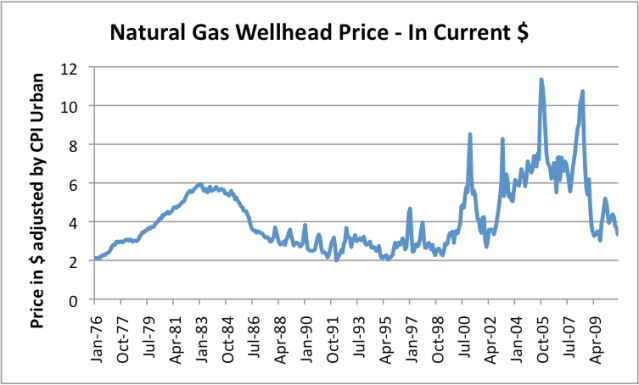
But the toll on the natural gas "bridge" has suddenly gone way up. That's not surprising since, as the chart shows, natural gas has always been subject to wild price swings. With New England now more dependent on natural gas than ever, supply has struggled to keep up with demand. As the New York Times' Matthew Wald reports, that's sent New England electricity prices spiking sharply this winter:
The six-state New England region and parts of Long Island are the most vulnerable now to overreliance on gas, a vulnerability heightened by a shortage of natural gas pipeline capacity, but officials worry that similar problems could spread to the Midwest.

We are sticking a lot of straws into this soft drink,” said William P. Short III, an energy consultant whose clients include companies that move and burn gas. “This is a harbinger of things to come in New England, as well as New York.”
But natural gas companies aren't interested in selling it to New England at a discount. They want to export it to get top dollar on the international market:
Several companies want to liquefy and export gas from the continental United States because of the shale gas glut, and the events in New England could affect that debate. Opposition has come mostly from domestic industries that use the gas. A spokesman for Senator Ron Wyden, Democrat of Oregon and chairman of the Senate Committee on Energy and Natural Resources, said Mr. Wyden saw the price gyrations in New England as a reason to “look before we leap ahead with unfettered exports of gas.”
The natural gas price spike shows that while natural gas may be cleaner burning and at times cheaper than coal, it's still a bad idea to put all our eggs in one fossil fuel basket. The more we can diversify our energy sources with modern, clean energy sources, the more insulated we'll be from price spikes. (Plus there are plenty of questions about the health and water impacts of natural gas fracking.)

Today, there's not one offshore wind turbine harvesting wind energy off the Atlantic Coast. Not one! Wind may cost a little more to build up front, but Mother Nature isn't going to threaten to export our breezes to Europe unless we pay exorbitant prices.

It's been 12 years since Cape Wind was first proposed and our regulators have let big mansion money on the Cape tie it up in regulatory knots. Let's build Cape Wind now - and a lot more offshore wind to follow.

Chart via Our Finite World

Tuesday, February 12, 2013

Tonight's State of the Union: No More Yes Man?

President Obama's first four years saw him attempt to say yes to everything on climate and energy - yes to both the right policy choice AND the political pander. Tougher fuel efficiency standards and new air pollution limits? Yes! The fastest expansion of oil drilling in U.S. history? Yes!

This all-of-the-above strategy has been a failure - instead, we've gotten the worst of all worlds. More risky drilling than ever? Gas prices near record highs? Price tag for climate-fueled weather disasters hitting $188 billion? Yes, yes and yes!

Tonight, I hope President Obama continues his inaugural theme of making good choices and smart investments. He needs to keep saying yes to clean energy investment and yes to carbon emissions continuing to go down while economic recovery continues its upward track.

But he also needs to start saying no - no to America serving as the middleman for dirty, expensive Canadian tar sands. No to unlimited, untracked methane emissions from gas fracking. No to unlimited carbon pollution from existing coal-fired power plants.

The good news for President Obama is that making those hard choices is politically popular. Today's Washington Post poll finds more than half of voters support action on climate change, with just a third of voters in opposition. Climate-fueled extreme weather events like superstorm Sandy have shifted the center - climate action is now a clear political winner.

Now that's worth saying yes to.

Monday, February 11, 2013

Larry Summers' "Energy Transformation" is a Policy About Nothing

In today's Washington Post, Larry Summers has an op-ed saying we should rely more on dirty energy - but dirty NORTH AMERICAN energy!
Fourth, the transformation of the North American energy sector needs to be accelerated. This will have economic and environmental benefits. Those who will decide whether to approve the Keystone XL pipeline, which would run between the tar sands of western Canada and Nebraska, need to recognize that Canadian oil not flowing to the United States will probably flow to Asia, where it will be burned with fewer environmental protections.

Natural gas exploitation, too, could bring huge environmental benefits. Replacing coal with natural gas has much more scope to reduce greenhouse gas emissions than more fashionable efforts to promote renewables. A period of record-low capital costs and high unemployment is the best possible time to accelerate the replacement cycle for environmentally untenable coal-fired power plants. More generally, the production of natural gas and its use in industry should be a substantial job creator for years to come.
This is Summers' entire section on energy. I didn't lift his section on dirty energy out of a broader piece on clean energy or even a make-no-choices all-of-the-above piece. Summers thinks the entire key to our energy "transformation" is what we're already doing - more dependence on high-priced dirty oil, more privatizing our public lands and waters to Big Oil while socializing the risk of oil spills, more putting our water supplies at risk with gas fracking, no mention of climate change.

This is what passes for transformational thinking with the Very Serious People in Washington.

Thursday, January 10, 2013

The Cost of Nuclear Power is Killing Nuclear Power

Prairie Island 2010 Proponents of nuclear power love to blame the lack of new nuclear power plants on environmentalists. But in reality, many environmentalists have given up their past opposition to nuclear on safety grounds in the face of the need to cut carbon pollution from fossil fuels as quickly as possible.

What's stopping the expansion of nuclear power is its own high cost, as in this example from David Shaffer of the Minneapolis Star Tribune:
Xcel originally planned to boost the output of the Prairie Island plant by 164 megawatts with upgrades to the reactor in 2014 and 2015, but the utility shelved those plans last October.

Electricity demand has not been growing as fast as the company earlier estimated, and cheaper natural gas had become more attractive as an alternative power source, the utility told state regulators.
Not only do you have to build the plant (expensive!), you have to have a plan for what to do with the spent fuel (expensive & dangerous!), get a water source to cool the plant (increasingly uncertain - thanks, climate change!) and the big one, you have to insure the plant (incredibly risky & expensive!). At every step of the way, nuclear power relies heavily on taxpayer support, either directly through subsidies & loan guarantees or indirectly through use of public resources & public assumption of risk.

Given all that, why not just build a natural gas plant, or better yet, a wind farm? That's nuclear's real problem.

Friday, September 21, 2012

5 Ways Scott Brown's Climate and Energy Debate Answer Was Wrong

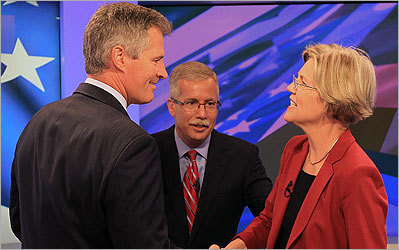
A viewer question focused on climate change in last night's U.S. Senate debate between Sen. Scott Brown (R-MA) and Democratic challenger Elizabeth Warren. Watch it starting at 22:25:
The question: Do you believe climate change is real, and if so what should the federal government be doing about it?
BROWN: Yes, I do. I absolutely believe climate change is real, and I believe there's a combination between manmade and natural. That being said one of the biggest things we can do is get an energy policy and we don't have one. Wind, solar, nuclear, hydro, geothermal, coal, siting, permitting, conservation, a true all of the above approach as I have. Professor Warren has a none of the above approach. She's in favor of wind and solar. She's against the Keystone pipeline which will help create union, all you union guys listening out there, she's denying union jobs and non-union jobs. Making sure we can get more energy on the world market to stabilize those costs that you're paying at the pump. When's the last time we permitted a nuclear facility to make sure we can have that clean energy? I could go on and on but right now the role is actually a balancing role. To find that balance, Jon, because you can't just have one or this or that. she's in favor of putting wind turbines in the middle of our, uh, greatest treasure, on the Nantucket Sound. I, like, President, uh, Senator Kennedy before me believe that's not right because those ratepayers are going to pay a tremendous amount more in their daily costs, and that's not right.
Sen. Brown's response is completely wrong here in at least five different ways:
  • He's wrong about climate science. "The human impact on climate during this era greatly exceeds that due to known changes in natural processes," reports the UN's Intergovernmental Panel on Climate Change. And if climate action and protecting our clean air and water are so important to Sen. Brown, why are they nowhere to be found on his website?
  • He's wrong about our electricity sources. Sen. Brown forgot to mention hydrocarbon gas, which provides more than half of Massachusetts' electricity generation right now. The extremely low cost of "natural" gas is what's putting coal out of business right now, not clean air regulations. And while the nuclear power industry likes to portray itself as the victim of those big, bad anti-radiation activists, we don't build nuclear power plants anymore because they're wicked expensive.
  • He's wrong on what will stop climate change. More coal and the Keystone XL tar sands pipeline? Our dependence on dirty coal is what's fueled our climate crisis in the first place. And building a new pipeline for tar sands - one of the dirtiest fuels on the planet - could be game over for stopping climate catastrophe.
  • He's wrong about energy jobs. The Keystone XL pipeline would create only a fraction of the clean energy jobs that already exist in Massachusetts. TransCanada's original application estimated just 3,500-4,200 short-term construction jobs. Massachusetts' clean tech economy already employs 71,000 people.
  • He's wrong about oil prices. Saying the U.S. can control the global oil market is like saying a junkie can control the cost of a hit. We have just 2% of the world's oil reserves but consume 20% of the world's oil supply. Even under the most optimistic scenarios, drilling in all of our wilderness areas desired by Big Oil combined would only mean a 4-5 cent reduction in the price of a gallon of gasoline by 2025. The only way we can reduce what we pay at the pump is by using less of it - exactly what the Obama administration is doing.
  • Does even Scott Brown know what Scott Brown believes on clean energy? Says he supports wind energy, bashes Cape Wind - classic Both Ways Brown.
Here's Elizabeth Warren's response:
WARREN: Sen. Brown says that he's about a balanced approach. He's not - he's about a rigged playing field. Our clean energy industry - an industry that works here in Massachusetts - has to fight uphill against the oil subsidies. That's what tilts the playing field, and Sen. Brown has helped tilt it for the oil companies. That works against clean energy. The Keystone pipeline? Look, that's not going to produce nearly as many jobs as if we invested that same money in clean energy - that's where you produce real jobs, and that's where Massachusetts has a real advantage. But you know, I just want to stop on this one for a minute, because I think this one is really important. Sen. Brown has been going around the country talking to people saying you've gotta contribute to his campaign because it may be for the control of the Senate. And he's right. This race may really be for the control of the Senate. But what that would mean is, if the Republicans take over the Senate, Jim Inhofe would become the person who would be in charge of the committee that oversees the Environmental Protection Agency. He's a man who's called global warming a hoax. In fact, that's the title of his book. A man like that should not be in charge of the Environmental Protection Agency overseeing their work. I just don't understand how we could talk about going in that direction.
And she backs up the talk with a real plan. Check out Elizabeth Warren's comprehensive climate & energy plan.

Tuesday, September 4, 2012

Impact Of Polluter Spending On Energy Policy Can't Be Ignored

Deepwater Horizon on fire April 22, 2010It's always interesting when reporters try to make sense of politicians' energy positions while ignoring the influence of money in politics.

At the Washington Post's WonkBlog today, Brad Plumer says the Democratic platform is getting more oil- & coal-friendly because ... maybe locking in $4 a gallon gasoline with expensive "unconventional oil" isn't so bad? And jobs or something?

But energy policy isn't created in a vacuum - it's caught in the current of a river of oil money. Oil barons continue pouring ungodly amounts of money into bullying politicians:
The Koch brothers-backed nonprofit Americans for Prosperity and pro-Mitt Romney super PAC Restore Our Future combined to spend about $23.4 million against President Barack Obama during the second half of August.

That’s nearly 10 times the $2.44 million that Priorities USA Action, the main super PAC supporting Obama, spent against Romney, federal records show.
Now, one might think such spending would make Democrats fight for clean energy that much harder. But many Democrats still think appeasement works, and in some ways, that's reflected in the party platform. (Note that climate change is mentioned 18 times in the Democratic platform, so Democrats aren't exactly running away from tackling the climate crisis.)

Since 1990, energy & natural resources industries (mostly Big Oil, electric utilities & mining companies) have combined to give $640 million directly to candidates, a greater majority going to Republicans with each passing year. And in the last 15 years, electric utilities and oil & gas companies have combined to pour $3 billion dollars into lobbying.

All that money doesn't just influence politicians. How many polluter-funded commercials - from Koch-sponsored political ads to BP's image-scrubbing spots - does the average American see in a given week? Dozens?