Showing posts with label fuel economy. Show all posts

Friday, January 8, 2016

"Market Forces" Aren't Boosting SUVs - Congress is Subsidizing Them

driving in the land of giants

With gas prices plummeting below $2 a gallon, SUV and pickup sales are skyrocketing while sales of fuel-efficient and electric cars stall. The conventional wisdom among auto writers is that greenie efforts to cut gas consumption are failing in the face of the Free Market:
It’s the classic battle between market forces and regulators. [...]

Even if you’re a die-hard green car person—or at the very least, someone who sees the long-term value in weaning cars off fossil fuels, as I certainly can—you can see what a tough situation this is for automakers. Standards are forcing them to make cars that people may not necessarily buy, and that they may not necessarily profit from. But what’s the alternative, the government backs off on making cars more efficient? That’s not likely to happen anytime soon.
It is completely false to call this a battle between “market forces and regulators.” The free market hasn’t kept the gas tax artificially low - Congress has done that.

Congress hasn't raised the federal gas tax in more than 20 years. Since it's a set rate of 18.4 cents a gallon that's not indexted to inflation, the tax has effectively fallen 34 percent since 1993. It’s now totally insufficient even to cover the costs of building & maintaining highways, never mind the social costs of burning gas, from local air pollution to global warming.

That low gas tax acts as a subsidy for SUVs and a disincentive for buying electric cars, one it has nothing to do with the free market and everything to do with oil companies’ friends in Congress.

On top of that, the Obama administration has adopted a drill baby drill stance, with active US oil rigs more than doubling under his watch. Again - regulators, not "market forces," putting a thumb on the scale for flooding the market with cheap gas.

Friday, July 5, 2013

Ask The Green Miles: Are Smart Cars the Greenest Choice?

Ning & Smart Girl
The quintessential auto show picture
When folks ask me for advice on car-buying, they almost always bring up Smart Cars. They're so small, they must be the most fuel efficient, right?

But smallest size doesn't necessarily mean the best fuel efficiency. Sure, the Smart ForTwo gives you a really good 36 miles per gallon combined city/highway at a very low base price. But a nice gas-sipping subcompact - say, a Ford Focus or a Toyota Yaris - will give you very similar fuel efficiency (low 30s) with TWICE the passenger volume for only a couple of thousand more.

If you're a short-to-medium distance commuter, all-electrics like the Ford Focus Electric or Nissan Leaf will deliver absolutely amazing savings on fuel cost and pollution. And for folks who regularly make longer drives and need a hybrid, the Toyota Prius is still king.

The Environmental Protection Agency's FuelEconomy.gov gives a great rundown of the most fuel-efficient cars, along with the most and least fuel-efficient SUVs and trucks.

That brings me to a related pet-peeve: When people think I'm reflexively anti-SUV. Yes, if you're a single person driving a Chevy Suburban because you might go skiing once next year, you're wasting money and polluting our air for absolutely no reason. But if you need some room for your family, get a Toyota Highlander Hybrid and you'll be getting only somewhat worse mileage (28 mpg combined) than those Smart Car drivers.

Saturday, March 10, 2012

President Obama on Investing in a Clean Energy Future

President Obama delivers his weekly address from the Rolls-Royce Crosspointe Centre plant in Petersburg, Virginia that makes fuel-efficient jet engines:


Tuesday, January 17, 2012

TheGreenMilesMobile Handles Beltway Better Than $48,720 DoucheMobile

Ford F150 Harley Davidson EditonI was driving home on the Beltway recently in my still-spry 1999 Saturn SL2 with 128,000 miles on it, pleasantly surprised TheGreenMilesMobile remains fun to drive after all these fuel-efficient years, when I noticed a low-riding pickup truck lumber past me with brake lights flashing constantly. It was a Ford F-150 Harley-Davidson edition and the heavy highway-hugger and its overmatched driver couldn't even successfully execute a lurching lane change without repeatedly tapping the brakes.

First, let me make clear I'm not bashing Harleys or the Ford F-150 series here. Harleys get fantastic gas mileage. Ford's base F-150 XL model is an excellent made-in-America truck that gets 17 miles per gallon city and 23 mpg highway, not far from some of the best-mileage pickups like the Chevrolet Silverado Hybrid's 20 city/23 highway.

But the two brands have combined into a gas-guzzling, hideously expensive Frankenstein monster. The Harley-Davidson edition starts at a ridiculous $48,720 and gets a putrid 13 miles per gallon city and 18 mpg highway. So not only does the Harley model get 25 percent worse gas mileage than the base XL model, but you could buy two F-150 XLs for the price of one F-150 Harley - with $4,000 leftover for gas money.

And that's before we talk about what it looks like. I'll leave that to Car & Driver:
If the décor is in fact your style, though, your taste might be a little, shall we say, questionable. Example: There is glitter on the center console. To paraphrase everybody’s favorite park-bench prophet, that’s all we have to say about that.
Not just expensive and planet-killing, but ugly too ... but hey, I'm sure people will think you're just as cool as actual Harley riders.

Wednesday, October 12, 2011

What Good's An SUV If You Can't Afford To Drive It Where You Want To Go?

Sunset at the ledgesConservatives love to paint personal vehicles as the pinnacle of freedom, fuel efficiency standards as the government boot on the neck of Lady Liberty, and walkable communities, car sharing & public transit as creeping communism. But an experience last weekend made America's oil-addicted transportation culture seem more constricting than liberating.

I was up in New Hampshire hiking the Boulder Loop Trail off the Kancamagus Highway in the White Mountain National Forest near the town of Conway. The trail walk to the top of Moat Ridge gave us beautiful views of the surrounding mountains as well as the Swift River running through the Passaconaway Valley.

We were hiking with a couple in their 20s who'd brought their 3-month-old baby along. Except for her request for lunch, we barely heard a peep from the baby the whole hike, she was perfectly happy gently bouncing along in her baby carrier.

As we got back to the parking lot, mom said she'd had a great time and wanted to hike more often for regular exercise. I suggested making a routine of it - finding a favorite spot and going for a hike, say, every Sunday.

"Well ... maybe every couple of weeks," she said.

Why not more often? "This thing," she sighed, pointing to her SUV. "I couldn't afford to drive the hour and back to the mountain every weekend."

Over the longer term, President Obama has taken steps to significantly increase fuel efficiency in new cars, trucks & SUVs. But in the short run, families need to consider all the consequences of owning a gas guzzler. I understand the desire for a roomy vehicle to lug around car seats, strollers & such. But what good is owning that vehicle if it means you can't afford to get to the places you want to go?

The newest vehicle that's both fuel-efficient AND family-friendly? Check out the Toyota Prius V:

Tuesday, August 9, 2011

Saving Money, Sustaining Jobs: What New Fuel Efficiency Rules Mean for Virginia

The Obama administration has announced new fuel efficiency standards for cars & trucks that will save consumers billions at the gas pump. But what many people don't realize is those standards will also sustain thousands of jobs in states like Virginia:
At least 155,000 auto industry jobs now exist in the United States devoted to fuel-efficient vehicle technologies, with that number likely to grow, according to a joint report released today by the UAW and two environmental groups, the Natural Resources Defense Council National Wildlife Federation.

The new study found that more than 300 companies in 43 states and the District of Columbia are currently involved in manufacturing tied directly to clean and fuel efficient technologies. That number is likely to expand even more in the wake of recently announced fuel economy standards that would require a fleet average of 54.5 m.p.g. by 2025.
By 2030, the new fuel efficiency rules will save America 3.4 million barrels of oil per day. If you believe estimates that Virginia has 130 million barrels of oil offshore, that means the new standards will save more oil every 38 days than we could possibly drill for off our beaches:
Jim Lyon, senior vice president of conservation programs at the National Wildlife Federation, said moving to cleaner vehicles will not only lessen dependence on foreign oil – but lessen the pressure to drill for oil domestically in sensitive areas. "The best place to drill for oil is under the hoods of cars and trucks," Lyon said.
Here's what I find most interesting about this jobs report from a Virginia perspective. All we hear about from politicians in Richmond is that Virginia's a coal state, we can't ever possibly hope to burn one lump less of coal than we do now, etc. But according to the most recently available numbers in 2006, the coal industry only employs 5,262 people in Virginia.

Yet according to this report, 11 facilities supplying clean, fuel efficient vehicle technologies employ 2,373 people in Virginia. How often do you hear politicians like Gov. Bob McDonnell talking about how important it is to buy hybrid cars to support those jobs?

Read the full report at NRDC.org & learn more about the new fuel efficiency standards at EPA.gov.

Note: I work for the National Wildlife Federation for my day job, but my blog posts are my own.

Thursday, February 17, 2011

Gas Price Hikes Only OK When Money Goes To Big Oil

In the Washington Post, Steve Pearlstein says raising the gas tax by 60 cents last year would've been seen as political suicide. But gas prices have gone up 60 cents just the same, and instead of funding desperately needed repairs to Metro or our crumbling roads & bridges, the money has gone to BP, ExxonMobil, Hugo Chavez, Mahmoud Ahmadinejad, the list goes on.

And what's been the impact of those gas price hikes?
During that same period, private businesses created 1.2 million jobs and recorded near-record profits, stock prices rose by more than 20 percent and auto sales were brisk enough that General Motors recently handed out $4,000 profit-sharing checks to each of its unionized workers.

History will also record that, during that same time period, not one politician that I am aware of took to the floor of the House or Senate to denounce this "job-killing" 23 percent increase in the price of gasoline.
Doesn't exactly sound like the predicted Armageddon, does it? What anti-tax ideologues will never admit is that there are certain taxes - the gas tax, cigarette taxes, the estate tax - that you can raise with limited economic impact (and contrary to conventional wisdom, an increase in the gas tax is not regressive).

Even though gas prices are back above $3 a gallon, consumption remains near historic highs. Gas consumption just doesn't respond to price changes very quickly - if the price of beer goes up today, I can switch to wine tonight; but if the price of gas goes up today, it might take months or years to change my habits or living arrangements - and if I have kids in school, my hands might be completely tied.

The best way to reduce energy costs for drivers is by increasing vehicle fuel efficiency, which the Obama administration is doing. But when consumption goes down, gas tax revenue goes down, meaning we have less money for transit, roads & bridges. So a gas tax increase makes sense, but as the Car Talk guys famously pointed out, politicians are too wussy to do it.

Friday, February 4, 2011

Have Vehicle Fuels Advanced Since "The Dukes of Hazzard"?

When The Green Miles was 5, I was a huge Dukes of Hazzard fan. So when I couldn't find anything to watch the other night & an episode was just starting, I figured what the heck.

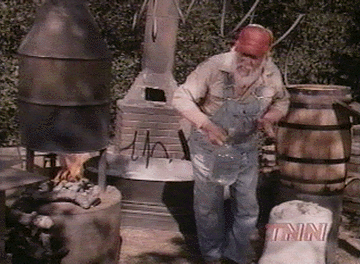
The episode, titled High Octane, features the Duke family entering an alternative fuel contest sponsored by the Department of Energy. They submit a batch of Uncle Jesse's moonshine whiskey & the judge not only gives him top prize, but pronounces it the best tasting fuel and/or whiskey he's ever had.

But shortly after the episode aired, oil prices came back down, President Reagan took office and slashed incentives for alternative energy & conservation, and vehicle fuels have puttered in neutral ever since. We're still putting gas or the equally-bad corn ethanol in our vehicles. And our cars & trucks don't get much better gas mileage than they did in the days of the General Lee:
Fortunately, President Obama has taken bold moves to change that, pushing for significantly higher fuel efficiency standards. The new rules will save 2 billion barrels of oil.

That 2 billion barrels works out to 40 billion gallons of gas. At $3 a gallon, that's enough to buy Americans 8 billion bottles of whiskey. Seems a much better use of the money, don't you think?

Side note: Now I know why my parents refused to watch the Dukes of Hazzard with me. Felt like they only had enough plot for 15 minutes & the writers did all they could to stretch it to an hour. I've seen dogs being taken to the vet that dragged their feet less. Also, fun to watch the General Lee jumps again. Seemed completely plausible when I was 5.

Monday, August 16, 2010

Wherein I Complain About Getting a Good Deal, Again

After complaining about how cheap my flight was (compared to the costs of its pollution), I thought it only fair to complain about getting a free upgrade from Hertz.

I tried to rent a hybrid at Logan Airport, but there were none available. From any of the rental car companies. As much as conservatives hype the free market as a solution to everything, the fact that rental companies don't make hybrids available at any price is a major wart on the invisible hand. So I reserved one of the more fuel-efficient options available, a Toyota Corolla.

2008 Cadillac CTS: All-New Technology, Design and Hand-Crafted Interior
When I got to the Hertz counter, I asked if they had a Prius or another hybrid available. The woman said no, but offered me ... a minivan. No thanks, I said, I guess I'll just stick with the Corolla. "We're out of Corollas, so I've given you a Cadillac CTS," the woman said. 

It's a beautiful car & I've already gotten plenty of ribbing from my relatives. "We thought some big hotshot was pulling into the driveway. Then we said, 'Oh, it's just Miles!'" (And you wonder where I get the snark from.)

The CTS is listed at 18 miles per gallon city & 27 highway, but the car's digital display says it's actually averaging just 18.3 miles per gallon. It's a shame that every "upgrade" seems to lead to a downgrade in fuel efficiency. The last time I was upgraded, I was given an SUV. At first I thought it'd be a nice change of pace. But having to gas it up twice in a few days? Not so fun.

Wouldn't it be nice if an "upgrade" meant you'd be getting a nicer car and saving money on gas?

Sunday, February 8, 2009

Which Came First, the Chicken or the (R)Egg(ulated)?

Who do you blame for America’s inability to break its dependence on oil? It’s a question that didn’t have a clear answer as I walked through the Washington Auto Show this week.

Blame the auto industry?
At the auto show, an industry expert pointed out that GM sells plenty of fuel efficient cars in Europe, where gas is the equivalent of $6-7 per gallon. But that’s because European nations put a heavy tax on gas. Meanwhile, America
ns make their car-buying decisions knowing a gallon of gas is reliably cheaper than gallon of milk. If you want us to sell fuel-efficient cars, says the auto industry, give us and consumers the signals that fuel efficient cars are a long-term good buy.

Blame Washington?
Politicians relentlessly flog independence from oil on the campaign trail, then refuse to support any policies that might accomplish it. Raise fuel economy standards? You’ll cripple the auto industry! Raise the gas tax? You’re taking food off people’s tables! Promote smart growth and public transportation? It’s the American way to live in a McMansion and drive alone an hour to work!


Blame drivers? At some point, from housing to vehicles, Americans stopped buying based on need and started going for volume. Just a generation ago, people with big families would upgrade from a car to a station wagon. Today, every suburban couple demands a Canyonero to tote their 1.5 children to soccer practice. Several mammoth SUVs at the auto show were so big, they didn’t even have fuel economy ratings – they’re classified not as passenger vehicles but as trucks. Americans drive ever more inefficient vehicles on longer and longer commutes while simultaneously demanding a cheap, never-ending, consequence-free fuel supply. If there’s a way the consumption habits of Americans could be less in the national interest, it’s hard to imagine.

In the end, any attempt at finger-pointing ends up in a “which came first, the chicken or the egg” paradox. Americans don’t demand real change from their elected officials, who are content to pander to voters and accept excuses (and contributions) from the auto industry, which fights regulations and tries to misled us into thinking the status quo is the only equilibrium that wouldn’t bankrupt them and us.


So who to blame? To steal a theme from Time’s Person of the Year a few years back … I blame you.

Monday, September 29, 2008

Simple Tips for Cutting Your Car's Carbon Footprint

So I was planning to do a big post to compile in one simple, easy to read list all the tips to improve your gas mileage (and by extension reduce your carbon footprint). But it turns out someone already did it. Should I be happy or jealous?

In any case, check out EcoDrivingUSA.com. Particularly valuable are the eco-driving tips and maintenance practices. My favorite so far is eco-driving tip #5, which answers the AC vs. open windows debate in the most interesting way I've seen yet:

Use Air Conditioning at Higher Speeds

Tip #5Air conditioning can reduce mileage significantly, by as much as 20%. In fact, your air conditioner can consume up to one gallon of gas per tank to cool the vehicle. But driving with your windows open can produce aerodynamic drag, which reduces fuel economy. What's a driver to do? When driving at slower speeds (less than 40 mph), such as driving in urban areas, open windows are better. At higher speeds (over 40 mph), open windows use more fuel than the air conditioner, so close the windows and turn on the air conditioner. Another good idea is to take advantage of the "recycle inside air" feature. The air that is already cooled in the car is reused by the air conditioning system, instead of drawing hot air from the outside to be cooled.

Are there any tips they miss?

Wednesday, September 17, 2008

We Want More Efficient Cars. Does Detroit Get It?

I've been thinking more about the Big Three's demand for big loans ...


http://www.youtube.com/watch?v=HRDe8SHSGnI


If you're a YouTube user, you can subscribe to my videos here.

And if you like the shirt, head over to BustedTees.com.

Wednesday, September 10, 2008

Big Three to DC: Save Us From Our Mistakes

When Congress was looking to tighten fuel economy standards last fall, the Big Three automakers launched a massive push to fight the effort. We don't need more big government regulation! Let the free market decide!

But as Steven Pearlstein writes in the Washington Post, it's a different story when they need a bailout. The Big Three automakers aren't simply asking for government help -- they think they're
entitled to it:
Even before top industry executives arrive in Washington later this month to lobby for their program, General Motors' vice chairman, Robert Lutz, who never misses an opportunity to put his foot in his mouth, was telling reporters in Chicago last week that the industry "deserves" government loans because of all the challenges that have been inflicted upon it. In fact, it's hard to imagine an industry less deserving of government help.

Here are three companies that for decades failed to produce cars that were well designed, well produced and exciting to look at, that fought tooth and nail against efforts to require greater fuel efficiency and, until recently, did too little to bring wages, benefits and retiree costs in line with competitive realities. And while they whined for years that it was unfair trade that put them at a disadvantage, Toyota, Honda, BMW and other foreign transplants came along to prove that it is possible to produce quality cars at affordable prices in U.S. factories while offering decent wages and benefits.

Pearlstein goes on to say that even though the Big Three couldn't be less deserving of help, they should get it anyway because the jobs and pensions of hundreds of thousands of Americans are at stake.

I agree with Pearlstein that we need to do what we can to make sure workers and retirees aren't punished for the mistakes of auto industry executives. But the utter incompetence of those executives is just breathtaking, isn't it? They staked the industry's entire future on never-ending cheap gas. Did any reasonable person ever think $2 a gallon gas was a permanent fixture?

Expensive petroleum is here to stay. The only way alternative is to use less petroleum with more fuel efficient cars, plug-in hybrids, and eventually fully electric cars. Cheaper driving, cleaner air, less global warming pollution, and secure American jobs.

So what's taking us so long to get there?

Tuesday, July 8, 2008

Car Talk Guys to GM: "Why Do You Make Such Shit?"

I was catching up on old podcasts of NPR's Car Talk and heard the Magliozzi brothers mention a recent appearance on PBS. The program NOVA sent Click and Clack in search of the Car of the Future. The whole show is worth checking out, especially if you're new to phenomenal concepts like plug-in hybrids and questionable concepts like biofuels and hydrogen cars.

But this exchange in segment 6 really sums up the program. A GM rep is walking the guys through a car show, trying to show off the Chevy Volt:

RAY MAGLIOZZI: It's right next to the Ford Mustang with 550 horsepower.

BETH LOWERY: Yes. And the Camaro convertible. Isn't that great?

RAY MAGLIOZZI: Yeah.

BETH LOWERY: America is all about choice. If you want a Camaro, buy a Camaro.

RAY MAGLIOZZI: But if we're about hugging trees ...

TOM MAGLIOZZI: With 500 horsepower? Who the hell needs 500 horsepower?

BETH LOWERY: Obviously not you.

TOM MAGLIOZZI: Why do you make such shit? I mean it's ridiculous!

BETH LOWERY: You mean these popular vehicles that are on the floor?

TOM MAGLIOZZI: Yeah, these popular vehicles. Five hundred horsepower ... jeez!

BETH LOWERY: It creates a little excitement, doesn't it?

RAY MAGLIOZZI: You're good, Beth.

TOM MAGLIOZZI: Thanks a million.

RAY MAGLIOZZI: Thanks for your time.

BETH LOWERY: Thanks.

RAY MAGLIOZZI: Sorry for giving you a hard time.

BETH LOWERY: That's okay. I'm used to it.

Despite all their commercials with green trees and blue skies and cheery kids, GM makes clear that all that good corporate citizenship stuff is just greenwashing. They have only one goal -- making as much money as possible.

So the Tappett Brothers come to the conclusion that if we want to cut our gas bills, increase our energy security, and curb the worst effects of global warming, we need government incentives. All the futuristic cars in the world won't matter unless we have the right carrots and sticks to prompt the car industry to make them and consumers to buy them.

Thursday, May 22, 2008

Strange But True: UPS Saves $12 Million the Right Way

Small steps towards energy efficiency may not seem like they add up to much around your home. Changing an incandescent bulb to a compact fluorescent saves you $3 per bulb each year -- nice, but not enough for a beer at the ballpark.

But if you're Wal-Mart and use hundreds of thousands of bulbs, changing to CFLs can add up to millions in savings.

UPS recently made a similar discovery, finding that smarter route planning added up to enormous rewards:

Company leaders figured out that sitting in traffic, waiting to make a left, burns way too much fuel. So they zapped as many left turns as they could from 100,000 truck routes a day.

Instead, drivers are handed computer-generated delivery routes that have them going in efficiently calculated loops, calling for left turns only when necessary.

"You start on the right-hand side of the street and you stay on the right-hand side of the street almost all of the day," said Dan McMackin, a former UPS driver who is now a company spokesman. "The only left turn you make is to come home."

According to the company, this simple technique saves an eye-popping amount of gasoline. "In the last year alone," a UPS release stated, "this system has shaved nearly 30 million miles off UPS's delivery routes, saved 3 million gallons of gas, and reduced emissions by 32,000 metric tons of CO2 - the equivalent of removing 5,300 passenger cars off the road for an entire year."

At $4 a gallon, conserving 3 million gallons of gas translates to a savings of $12 million.

Tuesday, November 20, 2007

Pain at the Pump: A Thanksgiving Tall Tale?

Gas prices are nearing record highs. So people are driving less, right?
Almost six in 10 people surveyed for the Automotive Aftermarket Industry Association of Bethesda, Md., said they have modified their behavior since pump prices began rising. [...]

Of those who said they had changed their behavior, 90 percent said they were driving less, and 75 percent said they were better maintaining their vehicles.
There's only one problem with that ... drivers are telling pollsters a little Thanksgiving holiday fable. They're actually planning to drive more:
Some 31.2 million vacationers will travel by car, up 1.3 percent from last year, AAA said. Another 4.7 million will go by air, up 2.2 percent. The rest will take trains, buses or other modes of transportation. [...]

"This is the first time that we have seen gas prices tipping over $3.00 a gallon in November," said AAA's Darbelnet. "A year ago, prices were in the range of $2.20 a gallon, so this year travelers are really feeling the pinch."
Ah, there's another hiccup. Are drivers really "feeling the pinch"? Obviously drivers are allocating more of their budget to paying for gas. And the media certainly loves to play to populist themes to convince their audience they're clearly not highly-educated McMansion-dwelling SUV-driving elitists but rather Average Joes like them.

But if high gas prices were causing a such a painful "pinch," wouldn't people, like, y'know, drive less? Nope. Gas consumption hasn't posted year-to-year decline in more than 15 years.

Well then Americans must be demanding more fuel-efficient vehicles, right? Nope. Fuel economy hasn't increased significantly in 25 years. In fact, it's not a whole lot different than it was 57 years ago.

OK, OK, so aren't Americans demanding changes from their elected officials? Eh. The energy bill is stuck in Congress and tighter fuel economy standards face an uncertain future.

And as Marc Fisher points out in his "Pretend Primary" series, politicians don't have much incentive to show leadership on problems like sprawl and long drives on the national level:

In Iowa and New Hampshire, there's not much reason for presidential candidates to talk about any of this: In those relatively thinly populated states, people think a 20-minute back-up on the Interstate is bad traffic.
There are plenty of ways we could reduce our national gas bill -- more carpooling and public transportation, higher fuel economy standards, plug-in hybrids, biofuels -- but it seems like both the majority of Americans and the majority of elected officials would rather rail against those dastardly oil barons than embrace real solutions. And as Stuart Smalley once said ... every time you point a finger at someone, there are three fingers pointing back at you.

Friday, June 22, 2007

Sea Change on the Roads? Senate Votes to Boost Fuel Economy

In a landmark vote, the U.S. Senate last night passed the first major revision of fuel economy standards since before The Green Miles was born.

It was not the comprehensive bill it could've been. Senators put off voting on Sen. Jeff Bingaman's national renewable energy standard proposal, which would've meant we'd get 15% of our national electricity from renewable energy sources like solar, wind, and biofuels.

It's really amazing how far senators are behind the rest of the country on alternative energy. Just take a look at this poll from Pennsylvania, where 68% of voters said they'd gladly pay more on their electric bill if it meant more renewable energy.

But senators avoided potential pitfalls, voting down more drilling for fossil fuels and liquid coal. And raising fuel economy standards 42% (from the 24.6 miles per gallon our cars & light trucks get now to 35 miles per gallon by 2020) is a major accomplishment. And as Lowell at Raising Kaine points out, it shouldn't bring our economy to a screeching halt as automakers and some Republicans claim:

By the way, reaching 35 miles per gallon by 2020 shouldn't exactly be a strain on American ingenuity. As the Washington Post points out, the rest of the world is already WAY ahead of us:

In the European Union, automakers have agreed to voluntary increases in fuel-economy standards that next year will lift the average to 44.2 miles per gallon, according to the Pew Center on Global Climate Change. In Japan, average vehicle fuel economy tops 45 miles per gallon. China's level is in the mid-30s and projected to rise, propelled by government policy.
That's right, this new legislation - IF it makes it through the House and is signed by President Bush - will require the United States to catch up with China's current fuel economy in 13 years! Seriously, if our car companies can't manage to do that, they deserve to go out of business. And if our nation can't compete with China, well...what can I say?
Both of Virginia's senators voted in support of the bill. You can see the roll call vote here. Sen. Webb deserves to be thanked for his support of the bill, and you can email him here. And Sen. Warner should be congratulated not only for supporting this excellent piece of legislation, but crossing party lines to do it. Thank him here.

UPDATE: I often get requests for sample notes, so here's what I just sent Sens. Warner and Webb, feel free to copy some/all of it:

Sen. _____ deserves a big thanks for his vote last night in favor of the Senate energy bill. The new fuel economy standard of 35 miles per gallon will go a long way towards both reducing our dependence on foreign oil and cutting our greenhouse gas emissions. I'll watch closely as the Senate takes up related issues in the months ahead, like a 15% national renewable energy standard and a global warming bill to cut carbon emissions 80% by 2050. I hope Sen. ____ strongly supports both of those measures.

Thursday, August 10, 2006

The Shifting Winds of the Global Warming Debate

At this point, even the harshest critics of global warming (like Gregg Easterbrook) are giving up on their argument that the planet is just going through some sort of a natural cycle. The evidence is overwhelming that the planet is warming due to human actions.

The few remaining people clinging to their belief that nothing is wrong have simply stopped debating. Much like Kevin Bacon's character in Animal House, no matter the evidence, they insist all is well.

But many of those global warming critics are now trying to re-frame the terms of the debate, shifting tactics and digging new trenches in the political battle, and environmentalists need to change with the times or risk being caught off-guard.

Republicans who once argued the planet wasn't warming are now admitting that the planet is warming, but that either there's nothing to be done about it, or that the costs of doing something are so high, they're not worth doing. Instead, we should "adapt to inevitable changes."

Corporations are now trying to duck responsibility by painting themselves green. General Motors, famous for being a prime suspect in the murder of the electric car, continues to flog its hydrogen car prototype as proof that it's trying to go green, despite mountains of evidence that hydrogen cars are nothing more than a red herring. And they're still fighting higher fuel economy standards (they haven't been raised in 20 years).

But just because Wal-Mart is now stocking organic products doesn't mean it's suddenly a net benefit to the environment. It's a band-aid on the open wound Wal-Mart has inflicted.

No matter the distractions, environmentalists need to stay focused on what's important. We've played a role in the planet's warming, and we have a role to play in helping return it to balance. It will take major shifts in energy usage and major advances in techology to help that happen. But we have to try. We're already seeing signs of the consequences of inaction.

UPDATE: Another tactic -- don't deny the facts of global warming, just accuse your opponents of being hypocrites.