DC's smoking ban is set to take effect Tuesday, to much hand-wringing from DC bar & restaurant owners. The Washington Post follows the pattern of most media coverage of the ban, mentioning bar & restaurant owners' fears of lost business in the sixth paragraph, but waiting until four paragraphs later to mention that New York City and California (among dozens of other communities) have had smoking bans for years now, and from what I hear, people do still go out there.Sunday, December 31, 2006
In Virginia, It's Still "Thank You for Smoking"
DC's smoking ban is set to take effect Tuesday, to much hand-wringing from DC bar & restaurant owners. The Washington Post follows the pattern of most media coverage of the ban, mentioning bar & restaurant owners' fears of lost business in the sixth paragraph, but waiting until four paragraphs later to mention that New York City and California (among dozens of other communities) have had smoking bans for years now, and from what I hear, people do still go out there.Friday, December 29, 2006
Global Warming Makes Finland So Hot, a Quick Swim is the Only Relief
OK, so that's not quite an accurate caption for today's photo, but there is a flood (no pun intended) of global warming news this week, plus a little comic relief from the Clown Prince of Politics ...Wednesday, December 27, 2006
China Going from Red to Green?

* Now even the Bush administration is admitting climate change is already here, finally recognizing the threat to polar bears.
* China has issued its first report on the impact of global warming in the world's most populous country. The results are ominous but not unexpected -- higher temperatures along with more rain AND more droughts (the extra rain will evaporate faster in the heat). Meanwhile, some American companies are recognizing China as a huge, untapped market for green products and services.
* Cool story from Forbes about a guy who figured out how to make big bucks by convincing people to recycle.
* Over at Bacon's Rebellion, Jim points out one reason why Arlington has fewer traffic problems than Fairfax -- it has 38 times as many people working to convince commuters to ditch their cars.
* And as the nation remembers Gerald Ford, I couldn't help remembering this classic 1996 Saturday Night Live skit, with Dana Carvey portraying Tom Brokaw recording some potential breaking news bulletins before leaving on vacation.
UPDATE: Chinese officials suspected of faking smog data to make clean air targets.
Friday, December 15, 2006
Would You Like Your Air Leaded or Unleaded?
If it's a choice between the health of 300 million Americans or improving the bottom line of battery makers, lead smelters, refiners, the Bush administration will side with industry every time. So here's the choice for you -- would you like your air leaded or unleaded? Other environmental news & notes ...
* Some great tips from Arlington County on going green over the holidays.
* California is getting ready to spend more than $3.4 billion over the next 10 years to subsidize the installation of 1 million solar roofs, or about 3,000 megawatts of electricity capacity, enough at peak output to match six modern natural-gas-fired power plants. It's the biggest solar energy effort in U.S. history.
* Sen. Barbara Boxer (D-CA) flatly says the era of silent but deadly environmental rollbacks is over.
* Think we humans know everything there is to know about everything on this planet? Here are 52 reasons why not.
* Questions about whether a science association is looking out for students or its oil industry funders.
Railing Against the Rails

Thursday, December 14, 2006
Metro's Fare Increase & Incentive Package: A Good Start
Judging by the hysterical reaction on DCist, you'd think Metro was proposing to extract a pound of flesh at each faregate. But I'm going to make the radical argument that the transit agency's plan to increase some fares and create new rider incentives seems not just reasonable, but overdue.Metro faces two major problems, one financial, and one social. While the causes are beyond the reach of 15 cent fare hikes and such, this package seeks to address the effects of both.
There is only one major transit system in the country that lacks a dedicated government revenue stream. There is only one major transit system in the country that serves three states/districts in very similar proportions. Metro.
This year, Congress, DC, Maryland, and Virginia came closer than ever to agreeing on a dedicated funding source, but Virginia Republicans killed the deal. Lacking that funding source, fare hikes are Metro's quickest way to balance its budget is to raise fares. It's not necessarily the easiest, as the public backlash shows, but that Metro is willing to take that heat shows how tight its budget is.
More radical are the financial incentives for commuters to avoid riding during peak hours (5-9:30am or 3-7pm). I do agree with critics who say commuters are at the mercy of their bosses, and that the fare incentives target the thousands of ants marching and not The Man who decides when they work. But the suggested fare incentives are a nudge, not a shove, and hopefully employers and the federal government will take notice.
The overcrowding issues on both Metro and our region's roads are frequently and wrongly labeled as capacity problems. They're not. Metro is half-empty for 18 hours a day, as are all but the most congested local roads like I66 or the Beltway.
The traffic is a result of a social problem -- every employer asking all of their workers to come in at the same time, then telling all of their workers to leave at the same time. As a result, we make extremely inefficient use of our transportation systems.
Aside from high-tech companies, both private employers and government agencies have resisted telecommuting, and individual commuters are left to arrange their own lives around a reverse commute or fight their bosses to let them work a 7-3pm or 11-7pm shift. I pitched something similar to my boss once and was quickly shot down with, "I need you here when I'm here." Nice to know I'm wanted, but what am I, her favorite teddy bear?
It's sad that it's fallen to Metro to try to address decades of short-sighted choices, shirked responsibilies, and failed leadership. But as DC's growth continues, commuters are going to have to let go of the idea that one lane of highway or one rail car should be exclusively theirs to zip straight to work at their chosen time.
And before you accuse me of being a Metro apologist, don't forget Festivus came early this year when I aired my grievances against the system back in July.
Tuesday, December 12, 2006
Just in Time for Christmas: Green Dimes & Red-Hot Car Sharing
I've discovered that this blog has become a clearing house for my friends' environmental news. They send me the articles and I post them here. It's a pretty sweet deal ... they spread the word on cool environmental tidbits, and I don't have to come up with a topic for that week's blog! If you have any articles you'd like me to feature, please post them in the comments section. * General Motors has put together a futuristic green concept car called the "Hummer O2." Never mind that it looks nothing like an actual Hummer ... or that the current H2 gets around 10 miles to the gallon of gas ... GM thinks this proves they care about being environmentally friendly. Right.
* It takes the equivalent of 100 million trees to create the paper to print a year's worth of America's junk mail, but a new organization is pledging to cut down drastically on your junk mail for about $3 a month. It's called Green Dimes, and I don't know if it works, but it's worth checking out!
[November 29th], one of the two major car-sharing companies that operate in the Washington region, Zipcar, announced a $25 million investment that will allow it to possibly double the 350 vehicles it already puts on area streets.
In June, Zipcar's rival, District-based Flexcar, announced a major investment by a company started by AOL co-founder Steve Case. That could set up the Washington area -- one of only two major markets where the two companies compete -- as a testing ground to see just how far car sharing can go in reducing congestion, pollution and parking woes.
"Some of the highest adoption neighborhoods in the country are in D.C.," said Scott Griffith, chief executive of Zipcar, based in Cambridge, Mass. He said that in the Dupont Circle and Capitol Hill neighborhoods, where parking can be difficult to find, more than 10 percent of residents older than 21 use the service.
Wednesday, December 6, 2006
Good News on Green Buildings
The DC Council has given final approval to landmark new law requiring private developers to adhere to the standards of the U.S. Green Building Council: Environmentally friendly buildings can include simple design elements such as abundant natural light -- which can save energy by minimizing the need for artificial light. They can feature windows that open to allow in fresh air, unlike those in most office buildings. Low-emitting carpet and paint can be used to improve indoor air quality.
Green buildings are likely to be equipped with low-flow water fixtures and even, perhaps, no-flush urinals, which use a chemical trap instead of water, Moore said.
Builders can also earn points by recycling materials. Carpet, for instance, is typically replaced in a building every seven years and lasts 20,000 years in a landfill, Moore said. But it can be recycled by shaving the nylon off the top and reusing the backing, she said.
Tuesday, December 5, 2006
Let's Play "If You Ran VRE"

Friday, December 1, 2006
Green Party = Pinko Commies

Thursday, November 30, 2006
I'm Just Glad the Ringleader was Caught & Charged

Two rare Royal Paulownia Trees chopped down in Potomac Overlook Park
The two Royal Paulownia trees, also known as Princess trees or Empress trees, are rare. A single tree’s lumber can bring up to $30,000.
Arlington County Police say that a Northern Virginia Park Authority official discovered the men cutting down the trees.
Police arrested three men including Woodrow Fincham, Jr. of Boston, VA. Fincham has been charged with felony destruction of property. The other two men had been hired for the day by Fincham and were not charged.
Wednesday, November 29, 2006
Climate Change Goes to the Supreme Court
The Supreme Court takes up a major global warming case today, as the Bush administration makes a bizarre argument. Despite its reliance on the unitary executive theory, that Congress and the Supreme Court cannot restrict the unlimited power of the presidency, from torturing terror suspects to ignoring the intent of law through signing statements, the White House is arguing it is powerless to regulate greenhouse gas emissions.Saturday, November 18, 2006
Green Buildings, A Slam from John McCain, and An Eco-Thug

* More election analysis: An eco-thug's demise.
* As I covered back in July, even though not many green candidates were directly elected this year, the shift to Democratic control of Congress could mean big things for environmentalists.
* 30 months after it was due, environmentalists sue the Bush administration for failing to produce a required report analyzing global warming's impact on America. Great quote by Sen. John McCain to an administration official: "You know, you are really one of the more astonishing witnesses that I have [faced] -- in the 19 years I've been a member of this [Senate Commerce, Science and Transportation] Committee."
* How did the Bush administration end hunger in the blink of an eye? It stopped calling it hunger.
Wednesday, November 8, 2006
Election Results: Bye-Bye, Bipartisanship
But the incoming House Speaker has already put loyalty ahead of ideals. And White House allies are saying in no uncertain terms that they have no interest in bipartisanship. "When we want to go up and they want to go down, we want to go right and they want to go left, there's no compromise," said anti-tax activist, White House adviser, and good buddy to Jack Abramoff Grover Norquist.
Harold Meyerson explained it brilliantly in a recent Washington Post column. There's no middle ground anymore. Candidates have to run hard right or hard left to win in the primaries and raise enough money to run in the general elections.
My solution? Proportional representation. If the Democrats get 50% of the vote, the Republicans get 40%, and the Green Party gets 10%, the Congressional seats are divideded up proportionately. Candidates run towards the middle trying to get the most votes, yet the people with fringe views (like, say, environmentalists) are also represented. But it will never happen because it makes too much sense. And because of the dreaded inertia against change.
Monday, November 6, 2006
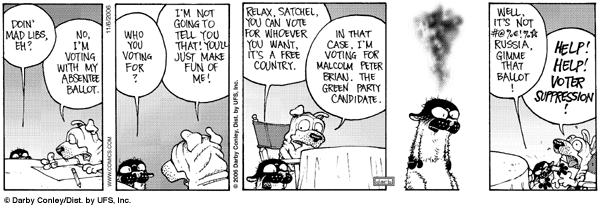
Don't Forget to Vote!

Don't forget to vote on Tuesday! As I've mentioned, control of the House & Senate have major environmental implications.
There are two critical votes right here in Virginia, the Senate race pitting George Allen vs. Jim Webb, and a constitutional amendment banning gay marriage.
Nationwide, it looks like control of the Senate will be decided by the races in Missouri, Montana, Rhode Island, and Tennesee. If you have friends in any of those key states, please email them and make sure they get out and vote!
Friday, November 3, 2006
Why Voting in Arlington Matters
Even worse, usually when I ask them if they're voting in Arlington on Tuesday, they say, "Crap, I forgot to get my absentee ballot!"
They don't know who's running back home, or what the big issues are, but somehow they think they're still supposed to vote not where they live, but where they grew up. Do you still sleep in the bed you grew up sleeping in? Still go to the pizza place you hung out at with your high school friends? No. So why do you think you're supposed to vote there?
The Arlington County Board regularly makes decisions that directly affect you, from big decisions like property taxes (and even if you don't pay those directly, they're reflected in your rent) to relatively minor decisions like whether Dr. Dremo's will remain in its current location.
And it's not like people are voting in overwhelming numbers anyway. In the last presidential election, only 58.3 percent of citizens of voting age cast ballots. In 2002—the last mid-term election—only 48 percent voted. The percentages for people under 40 are even lower.
So register to vote in Arlington now! You can print out the form online. You won't be able to vote Tuesday, but you'll be all set for next November.
Oh, and why can't you register and vote on the same day? Good question.
Other notes ...
* Check out this interview with the producer of An Inconvenient Truth.
* ACE's website updated with three November events and a December cleanup.
* Capitals Iceplex to open soon in Ballston.
* Hope to see you at the next Community Role Models event, the AFAC Food Drive on Saturday November 11th!
Saturday, October 28, 2006
The Trouble with Daylight Savings Time

OK, so here at The Green Miles, we talk about lots of environmental issues, some of them big and pressing (like, say, global warming), and some of them minor but interesting (like, say, organic beer). This is probably in the latter category.
Most of us think of Daylight Savings Time as an inconvenience that screws up our brunch plans twice a year. However, there are some serious arguments against changing the clocks twice a year. One is that it screws up the internal clocks of an entire nation, making it hard for people to wake up for days or even weeks after. An extension of that is that studies have shown that the shift increases traffic accidents for that adjustment period.
But those causes can be taken up by other blogs. What we're worried about is the environmental case -- that the switch back to Standard Time results in higher energy consumption. If we held to Daylight Savings Time year-round, it would result in a small but perceptible reduction in energy usage -- probably about 1 percent.
On a household level, that's not much. But on a national level -- especially in a nation that relies on fossil fuel for power -- that's an equivalent savings of hundreds of thousands of barrels of oil.
So why hasn't something been done about it already? The biggest obstacle seems to be inertia. In an era when Congress can ignore pressing national problems like a budget deficit approaching $10,000,000,000,000, getting lawmakers off their butts to do something about Daylight Savings Time is unlikely.
However, as the lovely and talented Svetlana points out, proponents of change have managed to extend Daylight Savings Time starting next year.
Friday, October 27, 2006
Upcoming Rally for Smoke Free Virginia

New details on a Smoke Free Virginia rally in Arlington coming up soon! Please forward the information to any friends you think might be interested.
New information on the Smoke Free Virginia Now Tour sponsored by the American Cancer Society and other members of the Virginians for a Healthy Future!
The Smoke Free Virginia Now Rally/Awareness Event in Northern Virginia will take place on Tuesday, November 14 from 4:00-5:00pm at Virginia Hospital Center (formerly Arlington Hospital) at 1701 N. George Mason Drive, Arlington. State Senator Brandon Bell will be the featured speaker.
The organizers are looking for as many people as possible to attend the event and show their support for Smoke Free Air in Virginia!
If you have any questions regarding the event, please contact:
Katie A. Pepe
Smoke Free Campaign Coordinator
American Cancer Society
South Atlantic Division
(804)527-3761
Thursday, October 26, 2006
E85: Covering for US Auto Industry's Disregard for Fuel Economy
The American auto industry has hyped E85 vehicles as proof the industry cares about the environment, but as you can see on this map of E85 fueling stations, good luck finding a place to buy the stuff that's open to the public. And despite GM's bragging that millions of so-called flex fuel vehicles are on the road, studies have found few of the car's owners even know what E85 is.
Monday, October 16, 2006
I'm Sensing a Tie-in Here

These two stories were next to each other ... does Yahoo News have a sense of irony? Antarcic ice shelf collapse tied to greenhouse gases, and Americans are making longer drives to work alone.