Showing posts with label gas tax. Show all posts

Monday, July 11, 2016

This is Why We're Supposed to Fight for Gas Tax Hikes?

EmptySteve LeBlanc writes for the Associated Press today about how Massachusetts uses just a tiny fraction of cigarette taxes for anti-smoking programs. By contrast, he says most of a recent gas tax hike goes for its intended purpose:
Drivers paid an extra $257 million to fill up their tanks as a result of the 3-cent-per-gallon increase ... virtually all of the gas tax money went to highway construction and maintenance
As we've discussed before, voters don't want to pay for highway construction, but Democrats are constantly told by Very Serious People that they must campaign for gas tax hikes because it's The Right Thing to Do.

Sure, it's nice to put a more accurate price on gasoline, which gets so many free rides, from polluting our air to getting military protection in the Middle East.

But if the money is just going to pay for more highways, incentivizing more gasoline consumption, it's unclear if raising the gas tax is even a clear net good, never mind worth progressives spending precious political capital on what's a relatively unpopular cause.

I'd rather fight for a millionaire's tax and a carbon tax, wouldn't you?

Monday, May 18, 2015

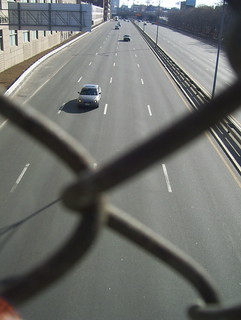
Do Voters Really Want to Spend More on Roads?

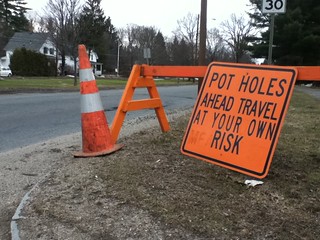
Spring in New EnglandFollowing in the footsteps of Massachusetts voters last fall, Michigan voters recently rejected a gas tax increase. This reaction from Gov. Rick Snyder (R-MI), who pushed the tax hike referendum, caught my eye:
"While voters didn't support this particular proposal, we know they want action taken to maintain and improve our roads and bridges," Snyder said.
We hear that from politicians and political commentators all the time, but is that really true? And what if it's not?

Raising the gas tax is a very good idea, yet it's also extremely unpopular. This is always interpreted as anti-tax fervor, or that there's something unique about the gas tax that voters don't want that raised but they'd be more tolerant of some other tax hike to fund roads, because voters are dumb, I guess?

As Gov. Snyder said, it's always taken on faith that voters want to spend more on roads and bridges, but don't want to have to pay for it. Most polling isn't helpful in that it just asks if voters want to raise the gas tax to fund transportation projects, but doesn't ask whether funding more transportation projects is itself a worthy goal.

Here's what some polling can tell us:
  • A 2014 YouGov/Huffington Post poll found fewer voters wanted to spend more (45%) on roads and bridges than wanted to spend the same (31%) or less (15%). That's not exactly a mandate for saying "we know they want action taken," is it?
  • A Smart Growth America poll back in 2007 found voters supportive of spending more on road repair, but strongly opposed to spending more on new roads. This is a key point because states spend most of their transportation money on building new roads.
  • poll ahead of the Michigan referendum showed the biggest chunk of voters didn't want their taxes raised and others didn't like the complex referendum proposal. But at least 1 in 5 voters didn't want to spend the money spent at all, calling it wasteful government spending. 
What would it look like if we stopped increasing spending on roads and bridges? In the short term, we'd build fewer brand new or expansion projects, and focus on repairing existing ones. If those polls are right, that's actually much more in line with public sentiment than our Big New Project status quo.
Would it be a traffic nightmare if we stopped expanding roads? Transportation researchers say no:
The Surface Transportation Policy Project and other researchers have found that for every increase in our highway network, half of the new capacity is taken up by "induced demand" -that is, traffic drawn to the road because it's there. Building new roads and adding more lanes draws people who otherwise would not have driven onto the roads. Combined with the delays created by construction and the time it takes to complete a major project, roadbuilding provides almost no relief from traffic delays. And it's incredibly expensive.
Maybe instead of spending more money on roads and bridges whether voters like it or not, politicians and pundits should try listening to them instead?

UPDATE 5/31/15: I joined the BradCast to discuss this topic, you can listen here.

Monday, May 4, 2015

Grumpy Old Columnist Tells Kids to Give Up on Divestment

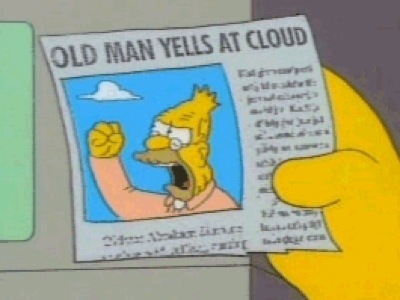
Hey, you kids! Pull up your pants and turn down that loud music! An old lawyer is here to condescendingly tell you how to stop with your popular, effective actions against climate change, and instead take up his ineffective, wildly unpopular niche solution that won't at all solve global warming! 

The fossil fuel divestment movement has gotten hundreds of colleges, communities, religious institutions and foundations to commit to selling off stocks, bonds or funds that invest in climate-disrupting fuels. But Boston Globe columnist Tom Keane is here to tell you divestment is stupid and all those kids are stupid too:
It’s easy to question the students’ tactics. For one, there’s a whiff of hypocrisy. The same students doubtless drive cars, ride the bus, and fly in airplanes, all powered by petrochemicals. Demanding divestment gives the illusion of clean hands without actually having to wash up. Of course, almost all of us who worry about climate change are hypocrites as well. Fossil fuels are ubiquitous and necessary. Yes, Al Gore would jet from country to country telling folks, basically, not to fly in jets. But how else could he get there?
If you go anywhere you're killing the planet! But we have to go places to get anywhere! I have no idea what Keane's point is here. College kids are ruining the planet by taking public transportation?
In any event, occupying presidents’ offices won’t do much to help the environment.
What did protesting ever solve, anyway?
What could? Conservation.
"Mookie Betts won't win the World Series for the Red Sox. What could? A well-constructed 25-man roster and a deep farm system." Is that really a fair standard for judging Betts' effectiveness?

Clearly Keane doesn't understand divestment and hasn't asked anyone to explain it to him. What do you expect, a Boston Globe columnist to leave his office and talk to people who don't agree with him? To understand divestment, go read David Roberts at Vox:
Nobody thinks the divestment movement can hurt fossil fuel companies in any direct financial way, but that's not what it seeks to do. Rather, it seeks to put mainstream institutions on record defining climate mitigation as a moral imperative, to create social consensus that inaction is not neutral — it is immoral.
Green technocrats have tried to sell Washington on solutions like cap & trade and carbon taxes using economic framings like green jobs, investment and risk management. They've lost to every time to polluters using their big money advantage to win the partisan political game. Divestment is an attempt to re-take the moral high ground - to change the game.

But folks like Keane act like all we need is an even wonkier, less popular fix:
The obvious answer is to artificially raise the price of gas by imposing taxes.

It’s an old idea. Europe does it, which is why the price of gas there is upwards of $10 gallon (and why Europeans have smaller cars and drive less). It’s resisted in the United State by both the right and left: Higher taxes are seen as just more fuel for a bigger public sector and they also disproportionately hurt those of more modest means. There is a way around those problems however. Collect the taxes, but then rebate them back. People’s pocketbooks wouldn’t be any lighter, but they would still become much more frugal in their use of gasoline.

It’s a good solution — maybe the only solution. Rather than spending their time in sit-ins, it’s an idea college students might want to rally around.
Look, I'm all for increasing the gas tax - it would raise needed revenue while adding some pain to burning a fossil fuel. But the federal and Massachusetts gas tax combined are a pathetic 44 cents a gallon. Gas is at $2.58 now. Even if you doubled the tax, gas would still be about $3 a gallon. How would that reduce gas use? Gas at $4 a gallon barely made a dent in driving. The truth is that we still subsidize driving in a hundred other ways, from untolled highways to free or low-cost on-street parking to housing policies that encourage sprawl.

Raising the gas tax is an unpopular idea that won't solve the problem, especially since it completely ignores the majority of carbon emissions that come from electricity, industrial, agricultural and other sources.

With Massachusetts Gov. Charlie Baker's administration pushing new & expanded fracked gas pipelines that will make global warming even worse, we need bigger-picture ideas that get to the urgency of ending our fossil fuel dependence entirely. That's where divestment comes in.

Monday, August 22, 2011

With Demand Near Record Highs, Governments Cut Supply of Public Transit

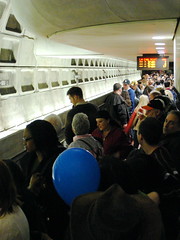
Crowded PlatformAt exactly the time when governments should be working to meet rising public demand for transit, they're instead cutting back:
The economic downturn is playing havoc with the nation’s public transit systems even as ridership remains near record levels: since 2010, 71 percent of the nation’s large systems have cut service, and half have raised fares, according to a survey released Wednesday by the American Public Transportation Association, a transit advocacy group.

And in many cases, those fare increases and service cuts — made necessary by flat or reduced state and local aid — are being implemented on top of similar moves earlier in the downturn.

“It’s compounding,” Art Guzzetti, the vice president for policy at the transportation association, said of the repeated years of service cuts and fare increases. “I’ve been in the business 32 years. We’ve had a lot of ups and downs along the way. That’s been the nature of the business. But notwithstanding that, this is the worst it’s been in my time.”

Since 2006, transit systems have been carrying passengers on more than 10 billion trips a year, a level not seen since the 1950s, the association has found. But on average, they get around a third of their operating money from fares. Most of the money comes from state and local governments, and with tax collections still struggling to get back to pre-recession levels, 83 percent of the transit agencies surveyed reported receiving flat or reduced state aid.
Two things. First, it kills me that progressives are reluctant to raise gas taxes to fund transit because of the myth that the gas tax is regressive. In reality, as ClimateProgress' Joe Romm has detailed, 1 in 4 low-income households don't even own a car. And "most, if not all" gas-guzzling SUVs & pickups are bought by mid- and high-income households. Makes sense - if you're barely scraping by, are you going to buy a Corolla or a Canyonero?

And second, for all the people who take to their smartphones to complain about Metro, how many have ever written Gov. Bob McDonnell to urge Virginia to finally give Metro a dedicated funding source? Who took action to support Democrats like Rep. Jim Moran & Rep. Gerry Connolly in their fight against efforts by Republicans like Rep. Eric Cantor & Rep. Frank Wolf to gut Metro funding?

To get updated on when you can take action to support public transit in the DC area, sign up for emails from the Coalition for Smarter Growth. Or for national news, visit Smart Growth America.

Thursday, February 17, 2011

Gas Price Hikes Only OK When Money Goes To Big Oil

In the Washington Post, Steve Pearlstein says raising the gas tax by 60 cents last year would've been seen as political suicide. But gas prices have gone up 60 cents just the same, and instead of funding desperately needed repairs to Metro or our crumbling roads & bridges, the money has gone to BP, ExxonMobil, Hugo Chavez, Mahmoud Ahmadinejad, the list goes on.

And what's been the impact of those gas price hikes?
During that same period, private businesses created 1.2 million jobs and recorded near-record profits, stock prices rose by more than 20 percent and auto sales were brisk enough that General Motors recently handed out $4,000 profit-sharing checks to each of its unionized workers.

History will also record that, during that same time period, not one politician that I am aware of took to the floor of the House or Senate to denounce this "job-killing" 23 percent increase in the price of gasoline.
Doesn't exactly sound like the predicted Armageddon, does it? What anti-tax ideologues will never admit is that there are certain taxes - the gas tax, cigarette taxes, the estate tax - that you can raise with limited economic impact (and contrary to conventional wisdom, an increase in the gas tax is not regressive).

Even though gas prices are back above $3 a gallon, consumption remains near historic highs. Gas consumption just doesn't respond to price changes very quickly - if the price of beer goes up today, I can switch to wine tonight; but if the price of gas goes up today, it might take months or years to change my habits or living arrangements - and if I have kids in school, my hands might be completely tied.

The best way to reduce energy costs for drivers is by increasing vehicle fuel efficiency, which the Obama administration is doing. But when consumption goes down, gas tax revenue goes down, meaning we have less money for transit, roads & bridges. So a gas tax increase makes sense, but as the Car Talk guys famously pointed out, politicians are too wussy to do it.

Friday, December 26, 2008

Car Talk's Ray: "I Call on All Non-Wussy Politicians to Stand with Me!"

Our economy survived $4 a gallon gas. Now prices at the pump are below $2 a gallon. Economic incentive to buy fuel-efficient cars has faded while funding for transportation infrastructure continues to lag.

Ray Magliozzi, one of the hosts of NPR's Car Talk, says we can kill two birds with one stone by raising the federal tax on gasoline by 50 cents per gallon:
I think it's an idea whose time has come. I know most politicians have been too wussy to do it, but I think the logic of raising the gasoline tax right now is unassailable.

Gas is less than two bucks a gallon. There's never been a better time to do this. If we added a 50-cent national, gasoline tax right now, and gas cost $2.50 a gallon, would that be the end of the world? Hardly.

This new tax would generate between 50 and 100 billion dollars every year for the treasury. That money could be used to help rebuild our crumbling roads and bridges, and develop new technologies for more fuel-efficient cars... further decreasing demand for oil. This is a way for us to get on the wagon, and stop sending money to countries that don't like us. We could become energy independent.

The other thing that the gas tax revenue could fund is high-speed-train infrastructure between major cities. And who would build all of the new high-tech, high-speed trains we'd need? GM and Ford! We'd help them start a mass-transit division, convert some of those factories from building inefficient gas hogs to building high-speed trains.

I'm sick of people whining about a lousy 50-cent-a-gallon tax on gasoline! I think its time has come, and I call on all non-wussy politicians to stand with me, because our country needs us.
Politicians love to talk about energy independence, but generally refuse to do the things that would actually encourage us to consume less oil. And if, heaven forbid, someone does take a stand, there's always some pandering political opportunist or talking head ready to slam them for it.

If you want people to use less of something, the simplest, most direct, most efficient way to do it is to make that something more expensive. In this case, by raising the price of gas to encourage people to use less, we could simultaneously raise funds to invest in ways to lower our energy bills in the long-term and make us even more energy independent -- and by the way, start solving our worsening climate crisis. (One final note - the gas tax isn't nearly as regressive as most people seem to think.)

I'll stand with Ray. Who's with us?

Tuesday, May 27, 2008

One Holiday I'm Glad We're Not Celebrating

The Green Miles recently made headlines (OK, so it was page 48 of the Post Express) for suggesting that public opposition to the Clinton/McCain plan to temporarily eliminate the federal gas tax showed that maybe, just maybe, we'd reached a turning point on energy policy:
Americans are finally saying they don't want short-term cheap gas -- they want solutions that would take long-term pressure off energy prices, like more fuel efficient cars and American-made renewable energy.

But if there's anyone who can keep a good pander alive in the face of increasing public awareness, it's your ratings-seeking media. Last week on WTOP radio, an anchor teased an upcoming gas prices story by saying, "Still ahead, waiting for that bubble to burst so we can fill our gas tanks in a pain-free manner." If anyone out there thinks we'll wake up one day to magically find gas back to $1.09 a gallon, I strongly discourage you from holding your breath.

The great irony is that previous attempts to change our national energy policy (like 2005's Climate Stewardship Act) were rejected because opponents said they might -- get ready for it -- drive up gas prices. So now we have the worst of both worlds -- high gas prices and we're still as addicted to oil as ever. As Joseph Romm writes at Grist, analysts are now revising their previous caps on just how high prices might go:

While $12-15 a gallon gas is probably a long way away -- and still preventable -- it looks increasingly like we dawdled too long on alternatives to avoid $6-7.

What's the reason for the delay in alternatives? I think we all know why.

Cross-posted from Raising Kaine

Thursday, May 15, 2008

Hillary Was For Easing Our Oil Addiction Before She Was Against It

Barack Obama recently appeared on NBC's Meet the Press and Tim Russert grilled him not on global warming, but on what he could do to artificially lower the price of gas to ensure America stays addicted to oil.

That same morning, Hillary Clinton appeared on ABC's
This Week. Did George Stephanopoulos ask her about global warming or green jobs? Nope.

But leave it to a stupid voter to bring it up. I'm sure George was furious. "This is what happens when you let the amateurs ask the questions!"

VOTER QUESTION: I have -- Sen. Clinton, I actually make less than $25,000 a year, so talking about gas prices is not academic for me. I really do feel pain at the pump.

However, I do feel pandered to when you talk about suspending the gas tax. I don't think that it's really a reasonable plan, and call me crazy, but I actually listen to economists, because I think that they know what they studied.

You say that you have both a short- and a long-term plan for our energy consumption. However, since the suspension of the gas tax would encourage continued overconsumption, which could possibly cancel out any price savings and also undermine our efforts to curb global warming, and your long-term plan includes trying to, say, curb global warming, don't you feel that these two plans are in conflict?

CLINTON: No. And let me stand up, because I can see you better from this angle.

You know, actually, I'm glad you asked this question, because I want to make it very clear that we're talking about short-term relief and a long-term plan. And I have a very comprehensive, long-term plan to reduce our dependence on foreign oil, increase the mileage of our automobiles, and to do it in a way that will push us forward as a leader in the world again, which we have not been, on the issue of global warming. And I invite everyone to go to my Web site, HillaryClinton.com, and read about it.

But if you are driving on average in America this summer, you'll save -- according to Department of Energy figures -- about $70. If you are a long-distance commuter, and a lot of people in Indiana and North Carolina are, if you are a truck driver who depends upon your truck for your living, you're going to save a lot more. In fact, truckers will save about $2 billion in fuel costs.

You see, I really believe we've got to start right now demonstrating a willingness to take on these oil companies. I voted against the big oil giveaway in the 2005 energy bill. My opponent voted for it. I'm on record as taking on the oil companies. And I think having a good debate, like we're having right now in this campaign, helps to lay the groundwork for what we're going to need to do.

See, in the short term, Hillary Clinton will sell out the environment hoping to score a few votes by pandering on the gas tax, willing to recklessly encourage higher consumption (which is what's driven prices to where they are now).

But in the
long term, she'll do the right thing. No selling out the environment or pandering then. Really. Trust her.

If you don't know why cutting the gas tax is a horrible idea on every level, read this Tom Friedman column, it explains it much more clearly and wryly than I could.